
 Contract Law
LawTextbook
U.S. Federal Income Taxation of Individuals 2023
Not rated yetRate this bookDeborah A. Geier’s U.S. Federal Income Taxation of Individuals 2023 integrates doctrine with tax structure and policy. The tenth edition is current through December 15, 2022, and contains twenty-one chapters organized around income, consumption, compensation, family transfers, debt, property, cost recovery, losses, and timing. The book repeatedly connects a technical result with the model of taxation behind it. This guide follows that edition, including its historical assumptions; it is a study aid rather than a current return-preparation manual.
Free reading is available at the official source. Opens in a new tab.
 Free
About this book
Deborah A. Geier’s U.S. Federal Income Taxation of Individuals 2023 integrates doctrine with tax structure and policy. The tenth edition is current through December 15, 2022, and contains twenty-one chapters organized around income, consumption, compensation, family transfers, debt, property, cost recovery, losses, and timing. The book repeatedly connects a technical result with the model of taxation behind it. This guide follows that edition, including its historical assumptions; it is a study aid rather than a current return-preparation manual.
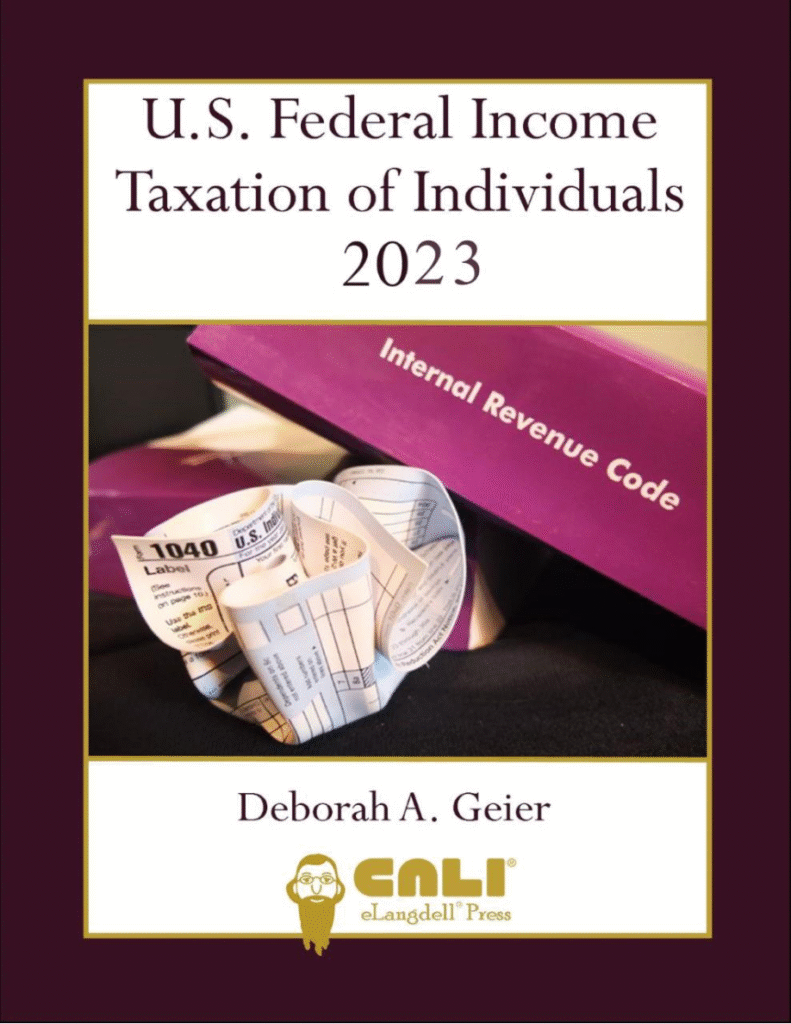
Cover: source-edition cover, displayed to identify the linked book. Publisher and third-party rights remain with their respective holders.
Book summary
About this book
Deborah A. Geier’s U.S. Federal Income Taxation of Individuals 2023 integrates doctrine with tax structure and policy. The tenth edition is current through December 15, 2022, and contains twenty-one chapters organized around income, consumption, compensation, family transfers, debt, property, cost recovery, losses, and timing. The book repeatedly connects a technical result with the model of taxation behind it. This guide follows that edition, including its historical assumptions; it is a study aid rather than a current return-preparation manual.
Chapter-by-chapter summaries
1. Essential Structure of the Income Tax
The tax calculation depends on a defined base and the treatment of receipts, costs, and allowances. Trace a simple hypothetical item through the structure before computing a result. Distinguish an economic concept of income from its statutory implementation. The chapter provides a framework for later analysis, showing why an isolated provision should be understood within the calculation as a whole.
2. Consumption Taxation and the Hybrid System
Income and consumption tax models differ in their treatment of saving and returns. The chapter compares models and identifies consumption-tax features within the statutory system. Follow the same investment through alternative treatments. Distinguish a timing effect from a permanent exemption. This makes preferences and arbitrage understandable as structural relationships rather than disconnected exceptions.
3. Ethical Debates, Theory, and Real-World Effects
Fairness, efficiency, externalities, incentives, politics, and tax expenditures supply competing criteria. Identify the standard used in a policy argument instead of assuming everyone means the same thing by fair. Compare who benefits, who bears costs, and what behavior may change. Economic models inform evaluation but do not by themselves settle the ethical choice among outcomes.
4. Capital Expenditure versus Expense
Current deduction and capitalization assign costs differently over time. Tangible and intangible benefits, repairs, improvements, and inventory-related costs raise classification problems. Identify the expenditure’s function and the relevant unit of property. A business connection does not alone establish immediate deductibility. Trace later basis recovery so that denying a current expense is not confused with denying all tax recognition forever.
5. Compensation
Payment for services can take forms other than wages in cash. The chapter compares direct payments and benefits while examining applicable exclusions. Identify whose obligation was paid, what benefit was received, and why. Separate valuation from inclusion. A benefit’s convenience or employer connection does not establish its treatment without satisfying the source’s statutory conditions.
6. Residual Gross Income
The broad income provision reaches benefits outside the most familiar categories. Analyse what the taxpayer gained and controlled rather than relying on a convenient label. Cases develop the boundaries of realization and economic benefit. Distinguish a general principle from a holding tied to particular facts. This chapter trains students to explain why an item falls inside or outside the base.
7. Gifts and Bequests
Transfers without ordinary exchange raise questions about intention, relationships, and statutory treatment. Distinguish the recipient’s receipt from the transferor’s potential consequences and the property’s basis. Calling a payment a gift does not settle its character. Compare family, employment, and other contexts to identify which evidence matters to the source analysis.
8. Income Shifting in Families
Assignment, marital arrangements, support, and property transfers affect which person reports an item and how family changes alter the result. Construct a dated transaction diagram. Separate the source of income from the destination of cash. The chapter’s rules are historically sensitive, so dates and the edition’s assumptions are essential to a classroom answer.
9. Borrowing and Lending
A genuine obligation to repay explains why loan proceeds differ from an unrestricted gain. Interest, below-market arrangements, and related transactions introduce separate components. Track principal and return independently for borrower and lender. The same cash movement may have different consequences for each party. The chapter prepares for later cancellation and property problems by establishing the baseline relationship.
10. Bad Debts and Debt-Discharge Income
A lender’s loss and a borrower’s relief from obligation require different analyses. Establish the debt, relevant event, amount, and statutory conditions. Do not assume one party’s treatment mechanically determines the other’s. The chapter compares deductions, exclusions, and limitations while showing why a change in enforceable obligation can matter even without a new cash receipt.
11. Debt and Property
Property transactions involving liabilities connect amount realized, basis, and possible debt-discharge issues. Draw both the asset and financing before and after the event. Separate repayment, assumption, disposition, and cancellation. A net-cash figure can obscure important components. The chapter develops the ability to analyse a transaction in legally meaningful steps rather than treating it as one unexplained total.
12. Accounting for and Nonrecognition of Gain
Realization, recognition, basis, and deferral are different concepts. A transaction can establish an economic or realized gain while a provision changes when it is recognized. Track substituted or adjusted basis through later events. Nonrecognition should not automatically be called permanent exemption. The chapter connects the initial result with the deferred consequences built into the continuing tax history of the property.
13. Depreciation and Cost Recovery
Depreciation allocates qualifying capital cost through a statutory system that may differ from economic decline. Identify basis, qualifying use, and the edition’s recovery framework. Compare timing and total recovery. An accelerated deduction affects the pattern across years; it does not necessarily prove that the asset lost that amount of market value. The chapter ties cost recovery to the income-versus-consumption comparison introduced earlier.
14. Capital Gains and Losses
Capital treatment depends on asset and transaction classifications and interacts with holding periods and loss restrictions. Distinguish amount from character. Use a ledger that keeps recognized gains and losses in the correct categories before applying the edition’s netting framework. A profitable investment is not automatically capital gain, and a loss does not automatically create an unrestricted deduction.
15. Tax Shelters
Shelter analysis examines arrangements that separate tax results from the economic activity the system is intended to measure. Identify the claimed benefit, financing, risk, and substantive purpose. Compare the transaction’s overall economics with the pieces used in a tax argument. The chapter connects anti-abuse analysis with policy and statutory structure rather than treating every tax-motivated choice as the same kind of arrangement.
16. Human Capital
Education and the costs associated with developing earning capacity challenge the distinction between investment, expense, and personal consumption. Analyse what a payment produces and which provision addresses it. Compare human-capital treatment with ordinary asset investment without assuming they are identical. The chapter invites both doctrinal reasoning and evaluation of the choices the tax system makes about work, learning, and personal benefit.
17. Homes, Health, Charity, and More
Selected personal expenditures receive special treatment through detailed provisions and limitations. Identify the purpose, qualifying conditions, and interaction with the broader deduction structure. A socially valued expense is not automatically deductible. Compare statutory assistance through tax preferences with direct spending. The chapter’s amounts and restrictions are edition-specific and should be kept separate from present filing rules.
18. Gambling and Hobby Losses
Losses require analysis of the activity, profit purpose, receipts, expenses, and special restrictions. Separate a genuine business question from a label adopted after losses occur. Compare the treatment of income and costs rather than assuming symmetry. The source’s examples show how classification can limit the extent to which an activity reduces income from elsewhere.
19. Mixed Income-Producing and Personal Costs
Travel, activities, property, and other costs can serve more than one purpose. Allocation and substantiation prevent an undifferentiated personal benefit from being treated as wholly income-producing. Identify the component being claimed and the evidence supporting it. A causal connection to work does not automatically convert every associated cost into a business deduction.
20. The Taxable Year
Annual accounting requires dividing continuing economic life into reporting periods. Identify whether the problem concerns a genuinely new item or a later correction or reversal. Construct a year-by-year table rather than collapsing events into a lifetime total. The chapter explains why a formally annual system needs rules to handle relationships that extend beyond one reporting period.
21. Accounting Methods
Methods govern when receipts and costs enter the calculation. Analyse the taxpayer’s method alongside the relevant timing doctrine and any statutory exception. Cash movement, legal entitlement, and performance may occur in different years. The final chapter integrates the structural questions of the book: what is included, who reports it, how it is characterized, and when it belongs in the tax base.
Study instructions
- Maintain a transaction ledger with separate columns for cash, income, basis, liability, deduction, character, and year.
- Compare income-tax and consumption-tax treatment of the same hypothetical investment.
- State the applicable provision and its conditions before discussing policy.
- Track both parties in loan and family-transfer problems without assuming symmetry.
- Treat all figures and temporary provisions as source-edition material and verify current official rules separately.
Questions for reflection
- How can deferral differ from permanent exemption?
- Why is basis essential when a transaction receives nonrecognition treatment?
- When can economic depreciation differ from statutory cost recovery?
- How do mixed personal and business purposes complicate deduction analysis?
Sources and coverage
This original study guide covers all main chapters of the linked edition, or all instructional sections where the work has no numbered chapters. The explanations and suggested practice are written for study; consult the full source for cases, worked examples, illustrations, exercises, and references. Tenth edition for 2023, current through December 15, 2022. Not a statement of current tax law or individual filing advice. Read the source edition.
About access & copyright
This page provides book information and study material. Full-text access is provided by the original publisher or authorised source; a listing does not grant permission to republish the book.
Read our Library Access & Copyright policyExplore the contents
Check the chapters covered in this edition.
Visit the official source
See reading, preview or purchase options.
Save for later
Keep this textbook in your saved collection.
Reader ratings & reviews
Share your thoughts
Your review helps other students choose the right resources.
KEEP LEARNING
Your next great read
Contract Law Civil Law
Torts: Cases, Principles, and Institutions
View Torts: Cases, Principles, and Institutions — book Law
Law of Wills
View Law of Wills — book Law
Bankruptcy Law and Practice
View Bankruptcy Law and Practice — book Law
Basic Income Tax
View Basic Income Tax — book Law
What Color is Your C.F.R.?
View What Color is Your C.F.R.? — book Law
Sources of American Law: An Introduction to Legal Research
View Sources of American Law: An Introduction to Legal Research — book Administrative Law
First Amendment: Cases, Controversies, and Contexts
View First Amendment: Cases, Controversies, and Contexts — bookTorts: Cases and Contexts
Torts: Cases and Contexts
View Torts: Cases and Contexts — bookWetlands Law: A Course Source



