
 Civil Law
Textbook
Torts: Cases, Principles, and Institutions
Not rated yetRate this bookJohn Fabian Witt and Karen M. Tani’s Torts: Cases, Principles, and Institutions places civil liability within its doctrinal, historical, and institutional settings. Ten chapters in the sixth edition move from intentional harms and the development of fault through negligence, plaintiff conduct, causation, duty, non-fault liability, and damages. Cases and notes ask not only what rule a court adopts, but how it distributes responsibility and shapes social relations. This guide follows the July 2022 edition and distinguishes the source’s analysis from claims about current law in every jurisdiction.
Free reading is available at the official source. Opens in a new tab.
 Free
About this book
John Fabian Witt and Karen M. Tani’s Torts: Cases, Principles, and Institutions places civil liability within its doctrinal, historical, and institutional settings. Ten chapters in the sixth edition move from intentional harms and the development of fault through negligence, plaintiff conduct, causation, duty, non-fault liability, and damages. Cases and notes ask not only what rule a court adopts, but how it distributes responsibility and shapes social relations. This guide follows the July 2022 edition and distinguishes the source’s analysis from claims about current law in every jurisdiction.
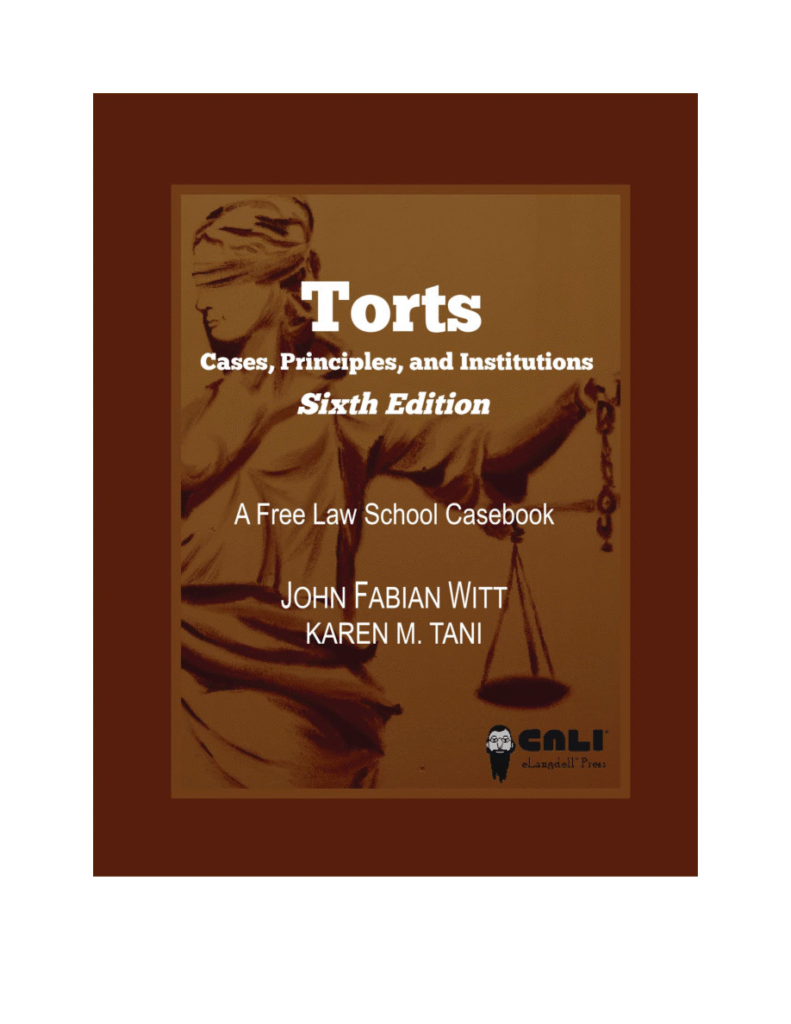
Cover: source-edition cover, displayed to identify the linked book. Publisher and third-party rights remain with their respective holders.
Book summary
John Fabian Witt and Karen M. Tani’s Torts: Cases, Principles, and Institutions places civil liability within its doctrinal, historical, and institutional settings. Ten chapters in the sixth edition move from intentional harms and the development of fault through negligence, plaintiff conduct, causation, duty, non-fault liability, and damages. Cases and notes ask not only what rule a court adopts, but how it distributes responsibility and shapes social relations. This guide follows the July 2022 edition and distinguishes the source’s analysis from claims about current law in every jurisdiction.
Chapter-by-chapter summaries
1. Introduction to American Tort Law
The opening uses battery and the anatomy of a case to introduce claims, institutions, and principles. Vosburg illustrates how facts, procedure, and the legal characterization of conduct affect responsibility. Separate the court’s holding from commentary and broader policy arguments. The chapter frames tort law as a system for addressing injuries through particular institutions, not simply a list of moral judgments about who behaved badly.
2. Intentionally Inflicted Physical Harms
Intentional torts require careful attention to the relevant mental state, protected interest, contact or apprehension, and possible defenses. Intention to act is not interchangeable with intention to cause every resulting injury. Analyse the elements separately and compare consent or privilege with a denial that the claim was established. The chapter’s cases also expose how status, dignity, and power shape the significance of an encounter.
3. Strict Liability and Negligence: Historical Development
The historical transition between liability approaches shows that fault is an institutional choice rather than a natural, self-executing rule. Changing economic and social conditions affect how courts describe accidents and responsibility. Compare the incentives and distributions associated with competing standards. Identify the historical argument separately from a contemporary doctrinal claim. This prepares readers to question assumptions built into later negligence analysis.
4. The Negligence Standard
Reasonable care depends on risk, precautions, circumstances, knowledge, and the legal treatment of custom and statutes. Evidence of common practice may be relevant without automatically determining reasonableness. Analyse the burden and expected benefit of a precaution alongside the source’s other approaches. Distinguish the standard from proof of what the defendant did. A concrete explanation of the alleged unreasonable choice is stronger than merely labeling conduct careless.
5. Plaintiffs’ Conduct
Contributory or comparative fault and assumption-of-risk questions examine the injured person’s behavior and its legal consequences. Identify what the plaintiff allegedly did and how it relates to the injury. Do not assume that any risky behavior defeats a claim. The applicable framework and jurisdiction matter. The chapter asks how responsibility is shared and whether the selected rule changes incentives, compensation, or the fairness of the result.
6. Causation
Factual causation connects conduct with injury through counterfactual and evidentiary reasoning. Multiple causes, uncertainty, and alternative explanations complicate a simple but-for test. State what would likely have happened without the alleged wrong and identify the evidence supporting that account. A temporal sequence or statistical association alone does not complete the analysis. The chapter separates problems of proof from the later question of legal limits on responsibility.
7. Proximate or Legal Cause
Even established factual causation leaves questions about the scope of liability. Foreseeability, intervening events, and the relationship between the risk and resulting harm provide different approaches in the cases. Specify the injury and risk at an appropriate level of detail. Calling an outcome unforeseeable without explaining the relevant comparison hides rather than resolves the issue. The chapter makes normative boundaries visible within apparently causal language.
8. The Duty Problem
Duty organizes questions about when obligations arise, including relationships, omissions, emotional harm, and protected interests. Distinguish duty from whether care was breached and whether the conduct caused injury. A sympathetic loss does not itself establish a legal obligation, and absence of a general rule may leave exceptions. The source’s cases invite comparison of administrability, relational responsibility, and the consequences of extending or limiting a class of claims.
9. Modern Non-Fault Liability
Strict and related liability arrangements examine responsibility without making ordinary negligence the sole basis. Activities, products, institutional relationships, and alternative compensation ideas raise different questions. Identify the specific basis of liability rather than treating strict liability as liability for every loss. Compare how each approach allocates costs, influences precautions, and handles proof. The chapter links doctrinal choices with markets and institutions that manage injury risks.
10. Damages
Compensation translates different losses into legal remedies, including economic and noneconomic components and, under distinct conditions, punitive awards. Measurement and procedural choices affect outcomes. Separate the purposes of restoring loss, deterring conduct, and expressing condemnation. Examine assumptions about future earnings, care, and the value of injury. The final chapter connects calculation with the book’s institutional themes: a damages figure embodies choices about proof, social valuation, and the limits of monetary repair.
Study instructions
- Brief cases with facts, procedure, issue, holding, reasoning, and important limits.
- Create separate checklists for duty, breach, factual cause, scope of liability, defenses, and damages.
- Compare two cases by the facts the courts treat as legally significant rather than by outcome alone.
- Keep doctrinal analysis distinct from historical explanation and policy evaluation.
- Use current jurisdictional sources before relying on the casebook for an actual dispute.
Questions for reflection
- Why does intent require more precision than saying an act was deliberate?
- How does factual cause differ from scope of liability?
- When can custom be informative without being decisive?
- Which social assumptions enter a damages calculation?
Sources and coverage
This original study guide covers all main chapters of the linked edition, or all instructional sections where the work has no numbered chapters. The explanations and suggested practice are written for study; consult the full source for cases, worked examples, illustrations, exercises, and references. Sixth edition, July 2022. Case summaries are study explanations, not current legal advice. Read the source edition.
About access & copyright
This page provides book information and study material. Full-text access is provided by the original publisher or authorised source; a listing does not grant permission to republish the book.
Read our Library Access & Copyright policyExplore the contents
Check the chapters covered in this edition.
Visit the official source
See reading, preview or purchase options.
Save for later
Keep this textbook in your saved collection.
Reader ratings & reviews
Share your thoughts
Your review helps other students choose the right resources.
KEEP LEARNING
Your next great read
Civil Law Civil Law
Law of Commercial Transactions
View Law of Commercial Transactions — book Civil Law
Fundamentals of Business Law
View Fundamentals of Business Law — book Civil Law
Legal Aspects of Property, Estate Planning, and Insurance
View Legal Aspects of Property, Estate Planning, and Insurance — book Civil Law
The Legal and Ethical Environment of Business
View The Legal and Ethical Environment of Business — book Intellectual property law
Australian Trade Mark Law and Practice
View Australian Trade Mark Law and Practice — book Contract Law
The Story of Contract Law: Formation
View The Story of Contract Law: Formation — book Law
Introduction to Criminal Law
View Introduction to Criminal Law — book Law
Evidence: Best Evidence Rule
View Evidence: Best Evidence Rule — book Law



