
 Intellectual property law
Administrative LawTextbook
Wetlands Law: A Course Source
Not rated yetRate this bookWetlands Law: A Course Source by Stephen M. Johnson connects wetland science with United States regulatory institutions and doctrine. This guide follows the fifth edition, August 2024, including its source-era treatment of Sackett and federal jurisdiction. Eleven chapters address regulatory history, administrative law, Clean Water Act requirements, permitting, mitigation, agency roles, state programs, review, enforcement, and takings. The guide identifies the edition rather than representing its rules as verified current law. Study through statutory elements, factual records, and the reasoning of assigned decisions.
Free reading is available at the official source. Opens in a new tab.
 Free
About this book
Wetlands Law: A Course Source by Stephen M. Johnson connects wetland science with United States regulatory institutions and doctrine. This guide follows the fifth edition, August 2024, including its source-era treatment of Sackett and federal jurisdiction. Eleven chapters address regulatory history, administrative law, Clean Water Act requirements, permitting, mitigation, agency roles, state programs, review, enforcement, and takings. The guide identifies the edition rather than representing its rules as verified current law. Study through statutory elements, factual records, and the reasoning of assigned decisions.
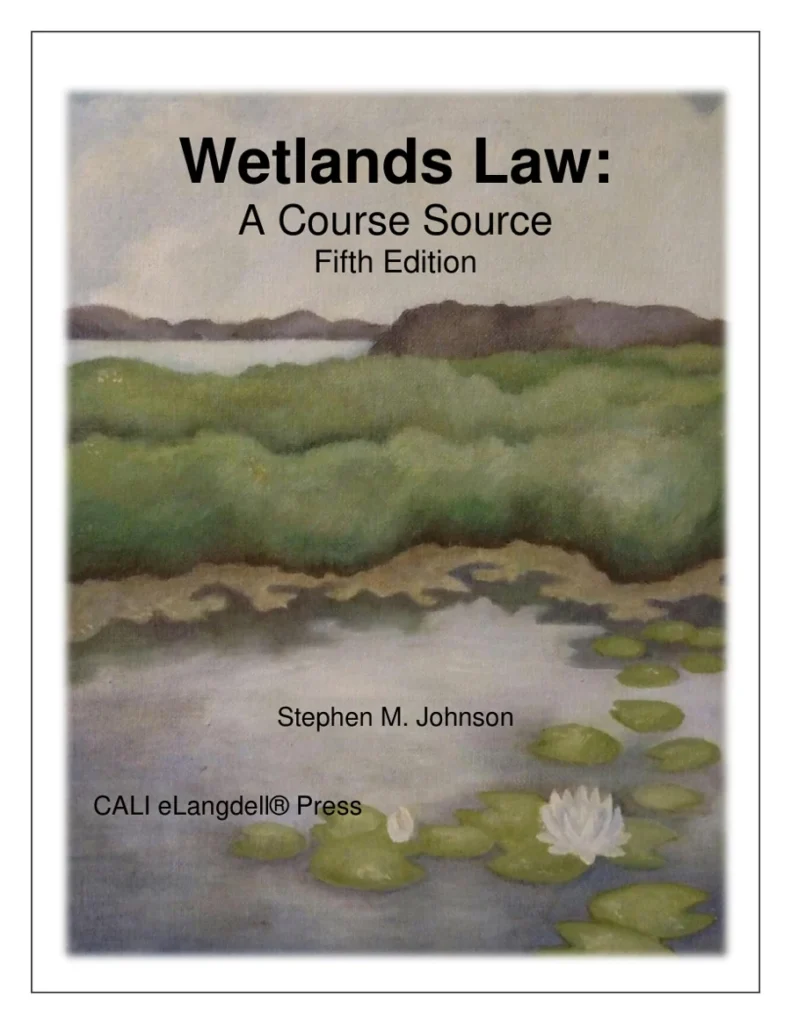
Cover: source-edition cover, displayed to identify the linked book. Publisher and third-party rights remain with their respective holders.
Book summary
Wetlands Law: A Course Source by Stephen M. Johnson connects wetland science with United States regulatory institutions and doctrine. This guide follows the fifth edition, August 2024, including its source-era treatment of Sackett and federal jurisdiction. Eleven chapters address regulatory history, administrative law, Clean Water Act requirements, permitting, mitigation, agency roles, state programs, review, enforcement, and takings. The guide identifies the edition rather than representing its rules as verified current law. Study through statutory elements, factual records, and the reasoning of assigned decisions.
Chapter-by-chapter summaries
1. The science
Hydrology, soils, vegetation, habitat, and ecological functions help explain wetland identification and protection. Scientific identification and legal jurisdiction are different questions: ecological importance does not automatically establish coverage under every program. Create a feature-function table and identify observations a legal decision would require. Keep scientific evidence separate from the legal standard applied to it. The chapter supplies vocabulary for understanding delineation while showing why environmental and jurisdictional boundaries need not coincide.
2. History of regulation
Wetland policy reflects changing attitudes toward drainage, development, public resources, and conservation. Overlapping institutional objectives make more sense in historical context than as parts of one perfectly unified program. Trace a policy shift and identify changes in authority and incentives. A modern environmental objective does not by itself establish that an older statute authorizes every proposed action. Connect the history with the actual legal instruments that later chapters interpret.
3. Administrative law
Agencies act within delegated authority and procedural requirements. A statute, regulation, guidance document, permit, and enforcement order have different legal roles. Map the path from authorization to individual decision and review. Identify which instrument is challenged and the applicable standard before discussing whether the policy is desirable. The source’s account is dated; changes in administrative law after publication must be researched for present legal work rather than assumed absent.
4. Waters of the United States
Federal jurisdiction is a threshold separate from whether an activity needs authorization or can satisfy permit criteria. Definitions have changed through statutes, rules, and decisions, with Sackett central to the fifth edition. Separate physical facts, statutory language, judicial interpretation, and implementation. Ecological connection alone does not resolve the source’s jurisdictional test. Conversely, exclusion from a federal program does not prove that state or other protections are absent.
5. Additions and discharges
Regulated conduct must satisfy statutory elements concerning material, additions, discharges, sources, and activity. Environmental effect alone is not a substitute for the legal test. Break the statutory wording into elements and match each with evidence. Compare moving material within a setting with introducing it from another source, attending to the cases’ reasoning. This method identifies the precise significance of an operation rather than assuming every disturbance triggers the same permit requirement.
6. Section 404 permits
Permitting involves environmental criteria, alternatives, public considerations, and conditions within a defined legal framework. Individual and general permits offer different routes; eligibility for one does not mean absence of all obligations. Build a decision tree beginning with jurisdiction and regulated activity. Identify information needed to assess alternatives and impacts. A permit decision is not an unrestricted balancing exercise: the statute and implementing framework determine which considerations and findings are required.
7. Mitigation
Avoidance, minimization, and compensation have a sequence that matters. Proposed compensation does not automatically eliminate the need to examine less damaging alternatives. Replacement raises questions about ecological equivalence, location, timing, monitoring, and long-term performance. Compare a present functional loss with an uncertain future restoration benefit. Specify measurable performance criteria. The chapter shows why a legal promise of mitigation and evidence that ecological functions have actually been replaced are distinct achievements.
8. EPA’s role and veto
Responsibility is distributed among institutions, including the Corps and EPA. Oversight and statutory authority raise questions about the scope, timing, and consequences of intervention. Identify the exact action and source of authority for each agency. Applicant expectations and environmental concerns do not alone settle interpretation. Read cases for their holdings about language, procedure, and institutional roles, keeping those holdings distinct from broader observations about desirable policy or administrative practice.
9. State roles and programs
Certification, independent state protections, and potential assumption of specified federal responsibilities create layers of authority. State and federal coverage need not match. Analyze a project in a named state rather than assuming one uniform state-law rule. Identify approvals that remain despite federal authorization. The chapter explains why a correct federal analysis can still be incomplete if it ignores separate state or local requirements and the institutional arrangements governing them.
10. Appeals, review, and enforcement
Standing, reviewability, timing, procedure, and remedies affect whether and how a dispute reaches a decision-maker. Enforcement adds questions about discretion and administrative versus judicial routes. Draw a procedural timeline before arguing the merits. Disagreement with an outcome is not itself a ground for reversal. Identify the record, burdens, and legal basis for challenge in source cases. Treat them as learning examples, not current filing instructions for a real dispute.
11. Regulatory takings
Takings doctrine asks when regulation affecting property requires compensation. Reduced value alone does not resolve the issue; characterization of the property, claim, and regulation matters. Compare categorical and contextual approaches in the assigned decisions. Separate the regulation’s validity from whether compensation is required in its application. Environmental benefits and private burdens inform a legally structured inquiry rather than a simple numerical trade-off. Current claims require authority updated beyond the 2024 source.
Study instructions
- Maintain a dated authority table distinguishing statutes, regulations, holdings, and guidance.
- Analyze jurisdiction, regulated activity, permit route, conditions, and review separately.
- Brief each case with posture and the precise instrument challenged.
- Use the August 2024 edition for study and update controlling sources before applying any rule to a present project.
Questions for reflection
- Why can an ecological wetland fall outside a federal program?
- When does compensation fail to answer an alternatives question?
- How does review timing affect legal options?
Sources and coverage
This original reading guide covers the linked edition’s main chapters, or the principal sections of its two-chapter calculus text. Consult the source for full arguments, cases, worked examples, exercises, illustrations, and references. Fifth edition, August 2024. This is a guide to the assigned source, not a verification of rules effective in 2026 or advice about a particular project. Read the source edition.
About access & copyright
This page provides book information and study material. Full-text access is provided by the original publisher or authorised source; a listing does not grant permission to republish the book.
Read our Library Access & Copyright policyExplore the contents
Check the chapters covered in this edition.
Visit the official source
See reading, preview or purchase options.
Save for later
Keep this textbook in your saved collection.
Reader ratings & reviews
Share your thoughts
Your review helps other students choose the right resources.
KEEP LEARNING
Your next great read
Intellectual property law Contract Law
The Story of Contract Law: Formation
View The Story of Contract Law: Formation — book Law
Introduction to Criminal Law
View Introduction to Criminal Law — book Law
Evidence: Best Evidence Rule
View Evidence: Best Evidence Rule — book Law
Federal Rules of Appellate Procedure
View Federal Rules of Appellate Procedure — book Law
Land Use
View Land Use — book Business
Contract Doctrine, Theory & Practice, Volume 1
View Contract Doctrine, Theory & Practice, Volume 1 — book Law
The Ethics of Tax Lawyering
View The Ethics of Tax Lawyering — book Law
Federal Rules of Bankruptcy Procedure
View Federal Rules of Bankruptcy Procedure — book Civil Law



