
 Intellectual property law
Administrative LawTextbook
First Amendment: Cases, Controversies, and Contexts
Not rated yetRate this bookRuthann Robson’s First Amendment: Cases, Controversies, and Contexts organizes constitutional study around speech and religion. Fourteen chapters in the January 2020 second edition examine political expression, content and conduct, the press, public institutions, compelled speech, forums, elections, commercial and sexual expression, establishment, and free exercise. Cases and notes ask how doctrinal classifications shape the analysis. This guide follows that edition’s legal landscape; it does not update the casebook to current doctrine or present historical holdings as universally controlling today.
Free reading is available at the official source. Opens in a new tab.
 Free
About this book
Ruthann Robson’s First Amendment: Cases, Controversies, and Contexts organizes constitutional study around speech and religion. Fourteen chapters in the January 2020 second edition examine political expression, content and conduct, the press, public institutions, compelled speech, forums, elections, commercial and sexual expression, establishment, and free exercise. Cases and notes ask how doctrinal classifications shape the analysis. This guide follows that edition’s legal landscape; it does not update the casebook to current doctrine or present historical holdings as universally controlling today.
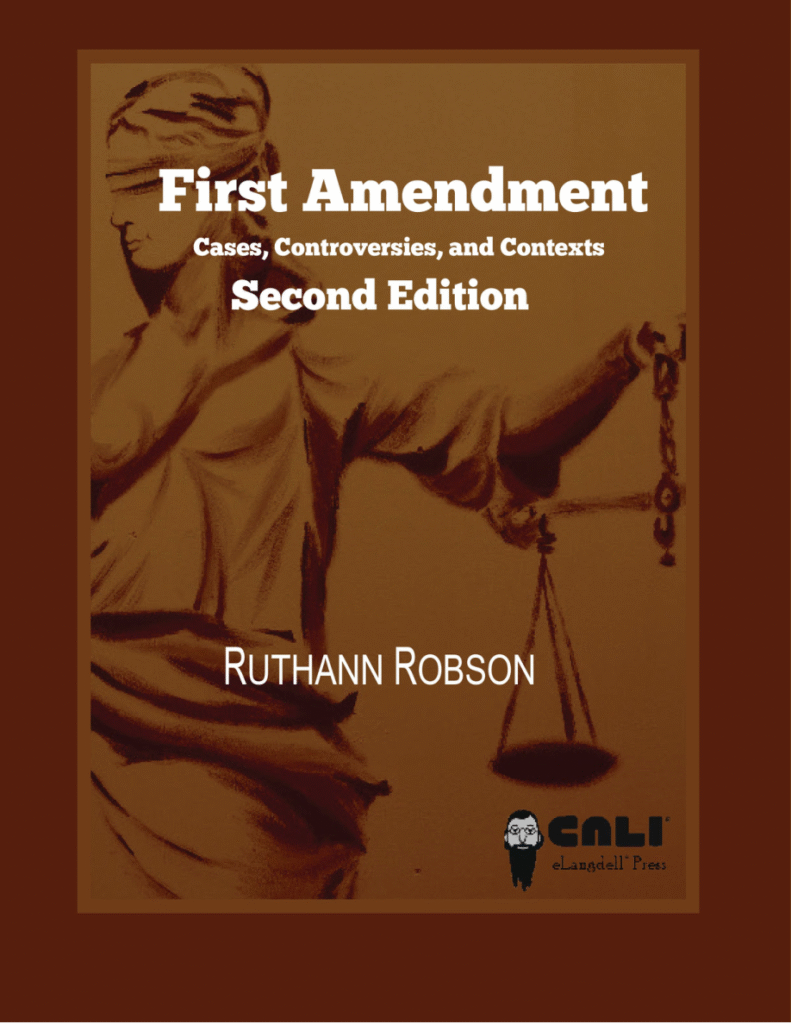
Cover: source-edition cover, displayed to identify the linked book. Publisher and third-party rights remain with their respective holders.
Book summary
Ruthann Robson’s First Amendment: Cases, Controversies, and Contexts organizes constitutional study around speech and religion. Fourteen chapters in the January 2020 second edition examine political expression, content and conduct, the press, public institutions, compelled speech, forums, elections, commercial and sexual expression, establishment, and free exercise. Cases and notes ask how doctrinal classifications shape the analysis. This guide follows that edition’s legal landscape; it does not update the casebook to current doctrine or present historical holdings as universally controlling today.
Chapter-by-chapter summaries
1. Introduction
The constitutional text contains related but distinct protections for religion, speech, press, assembly, and petition. Historical and comparative material broadens the frame. Identify the clause, government action, and claimed burden before selecting a test. A broad appeal to free expression cannot replace classification of the issue. The opening emphasizes the varied terrain of First Amendment analysis rather than one formula resolving every dispute.
2. Political Speech
The cases examine protection for expression addressing public affairs and the relationship between speech, harm, and government authority. Identify the asserted danger and the connection claimed between expression and its consequences. Separate disagreement with a viewpoint from an applicable doctrinal justification for restriction. The chapter’s historical development shows why context and the evolution of standards matter to interpreting a decision.
3. Conduct, Content, and Categories
Classifying regulation by its target and rationale can alter the route of analysis. Expression, conduct, content, and recognized categories are not labels that decide themselves. State what the rule prohibits and why. Compare its application to different speakers or messages. The chapter teaches careful framing because the same factual dispute can look different depending on how the regulated activity is characterized.
4. The Press
Press-related claims raise questions about publication, access, confidentiality, and the relationship between special institutional roles and generally applicable rules. Identify the specific asserted privilege or burden rather than assuming that every journalist claim receives identical treatment. Compare the press’s democratic function with the legal mechanism involved. The source invites analysis of whether institutional status changes the answer and why.
5. Government as Employer and Educator
Government can act through institutions with distinct operational responsibilities. Employee and student expression therefore raises contextual questions different from restrictions on the public generally. Identify the speaker’s role, setting, and claimed institutional interest. Do not assume public ownership removes constitutional limits or that the ordinary public-speech framework applies unchanged. The cases require comparison of purposes, relationships, and doctrinal conditions.
6. Conditions and Compelled Speech
Benefits, participation, and required expression raise questions about government leverage and the right not to speak. Distinguish regulating conduct from requiring endorsement or expression. Identify the condition, benefit, speaker, and message. The chapter examines when a government relationship changes the analysis without assuming that voluntary entry into a program eliminates every constitutional concern.
7. Forums, Time, Place, Manner, and Government Speech
Access to spaces and channels depends partly on classification and the character of the government’s role. Distinguish the government speaking from the government regulating private speech. Identify the forum and the restriction’s operation before applying the source’s framework. Reasonable-sounding management interests do not automatically settle a viewpoint issue, while the location alone does not determine every access claim.
8. Political Process
Election-related expression, association, financing, and participation connect speech doctrine with democratic institutions. Identify the activity and burden precisely rather than treating all political regulation as equivalent. Compare anti-corruption, equality, administrative, and expressive arguments in the cases. The chapter exposes the consequences of different descriptions of political activity and should be read within the edition’s jurisprudential context.
9. Commercial Speech
Commercial expression raises classification and regulatory questions involving information, transactions, and government interests. Identify what makes the communication commercial and whether the asserted concern involves deception or another justification. Follow the source’s sequence rather than assuming that business-related speech has no protection. Compare the availability of information with the aims and design of the regulation.
10. Sexual Speech
Obscenity, sexually explicit material, and related regulations raise distinct questions that should not be collapsed into moral discomfort. Identify the category, audience, medium, and government rationale in each case. The chapter’s controversies show how definitional choices and concerns about harm shape legal analysis. Treat the source’s holdings and tests historically and verify later developments before drawing a present legal conclusion.
11. Defining Religion
Religion-clause analysis can require determining what counts as religion while avoiding inappropriate governmental judgments about belief. Distinguish sincerity, classification, and truth. The chapter introduces a threshold problem with consequences for both protection and limits. Compare how different definitions might include unfamiliar practices or privilege conventional institutions, and identify the administrative difficulties each approach creates.
12. Establishment and Education
Schools and educational support place religion-clause questions within relationships among government, families, and institutions. Identify the challenged practice, recipients, and form of state involvement. Compare coercion, funding, access, and attribution rather than treating them as one problem. The chapter’s 2020 framework must not be mistaken for a current account of an area subject to later judicial change.
13. Establishment in the Public Square
Public displays, ceremonies, support, and government interaction with religion require contextual analysis. Identify who speaks, what history is relevant, and how the practice operates. A symbol’s appearance alone may not explain the constitutional dispute. Compare the purposes and consequences recognized by the source cases. The chapter makes visible how competing accounts of tradition, inclusion, and government responsibility shape reasoning.
14. Free Exercise
Religious exercise claims concern burdens, government rules, exceptions, and possible accommodation. Identify the conduct, asserted belief, rule, and treatment of comparable activity. Separate a constitutional inquiry from statutory protection. The final chapter links the earlier definition problem with practical disputes about government authority and religious practice. It completes the source’s two-part structure without supplying an updated statement of present law.
Study instructions
- Brief each case with the governmental role, speaker, burden, classification, test, and reasoning.
- Create a doctrine map that keeps speech and religion pathways distinct.
- Compare majority and dissent by their framing of the problem and treatment of facts.
- Label notes with the 2020 edition date and verify current treatment before practical use.
- Discuss policy and constitutional doctrine separately so disagreement with an outcome does not replace analysis.
Questions for reflection
- Why can classification change the analytical route?
- How does government speech differ from a forum for private speakers?
- What makes an institutional setting legally significant?
- Why should sincerity be distinguished from the truth of a belief?
Sources and coverage
This original study guide covers all main chapters of the linked edition, or all instructional sections where the work has no numbered chapters. The explanations and suggested practice are written for study; consult the full source for cases, worked examples, illustrations, exercises, and references. Second edition, January 2020. This guide explains the source and does not update it to current constitutional law. Read the source edition.
About access & copyright
This page provides book information and study material. Full-text access is provided by the original publisher or authorised source; a listing does not grant permission to republish the book.
Read our Library Access & Copyright policyExplore the contents
Check the chapters covered in this edition.
Visit the official source
See reading, preview or purchase options.
Save for later
Keep this textbook in your saved collection.
Reader ratings & reviews
Share your thoughts
Your review helps other students choose the right resources.
KEEP LEARNING
Your next great read
Intellectual property law Religion
From Bethlehem to the Vatican: A very basic introduction to Catholic tradition and theology
View From Bethlehem to the Vatican: A very basic introduction to Catholic tradition and theology — book Contract Law
The Story of Contract Law: Formation
View The Story of Contract Law: Formation — book Adult education
Creative and Inclusive Heritage Education: Handbook for Teachers and Trainers
View Creative and Inclusive Heritage Education: Handbook for Teachers and Trainers — book Political Science
American Government and Politics in the Information Age
View American Government and Politics in the Information Age — book Political Science
Social Problems - Continuity and Change
View Social Problems - Continuity and Change — book Law
Introduction to Criminal Law
View Introduction to Criminal Law — book Earth Sciences
World Regional Geography - People, Places and Globalization
View World Regional Geography - People, Places and Globalization — book Law
Evidence: Best Evidence Rule
View Evidence: Best Evidence Rule — book Law



