
 Contract Law
LawTextbook
Sources of American Law: An Introduction to Legal Research
Not rated yetRate this bookSources of American Law: An Introduction to Legal Research by Beau Steenken and Tina M. Brooks explains how legal institutions produce different kinds of authority and how researchers locate, assess, and update them. Nine chapters in the eighth edition, updated July 2024, move from the legal system and electronic research to statutes, cases, regulations, citators, advanced searching, secondary sources, and an integrated process. The book combines conceptual explanations with graduated exercises. This guide follows that edition and emphasizes the reasoning behind a search, not simply the buttons used on a platform.
Free reading is available at the official source. Opens in a new tab.
 Free
About this book
Sources of American Law: An Introduction to Legal Research by Beau Steenken and Tina M. Brooks explains how legal institutions produce different kinds of authority and how researchers locate, assess, and update them. Nine chapters in the eighth edition, updated July 2024, move from the legal system and electronic research to statutes, cases, regulations, citators, advanced searching, secondary sources, and an integrated process. The book combines conceptual explanations with graduated exercises. This guide follows that edition and emphasizes the reasoning behind a search, not simply the buttons used on a platform.
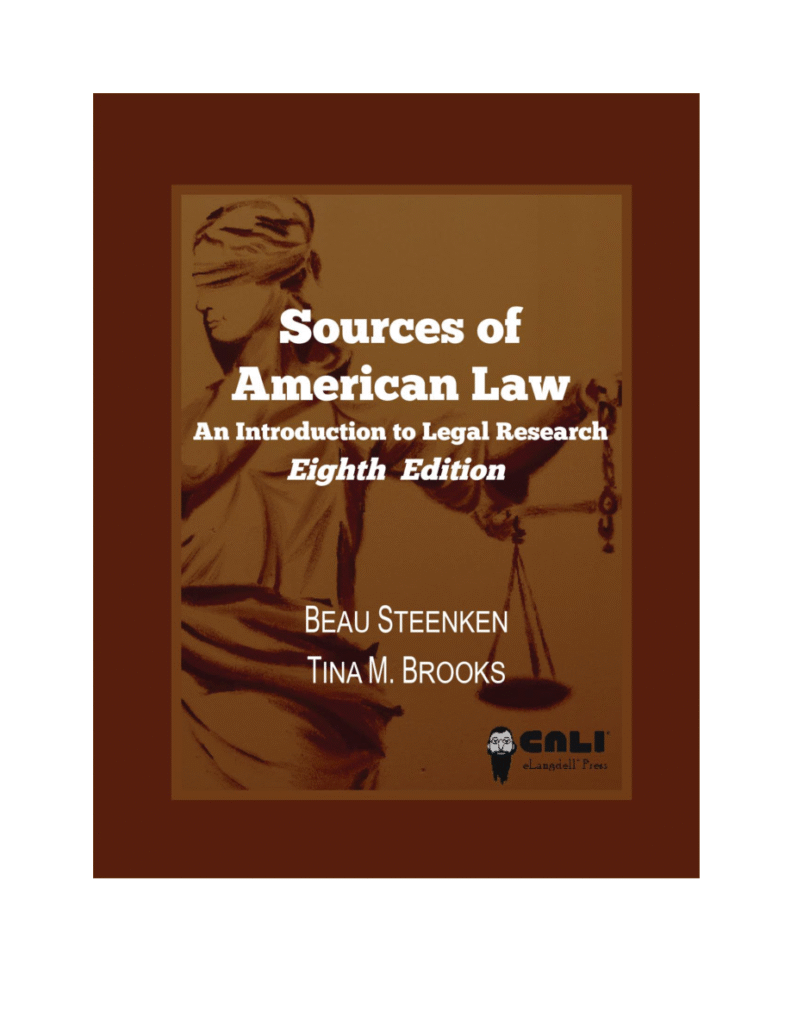
Cover: source-edition cover, displayed to identify the linked book. Publisher and third-party rights remain with their respective holders.
Book summary
About this book
Sources of American Law: An Introduction to Legal Research by Beau Steenken and Tina M. Brooks explains how legal institutions produce different kinds of authority and how researchers locate, assess, and update them. Nine chapters in the eighth edition, updated July 2024, move from the legal system and electronic research to statutes, cases, regulations, citators, advanced searching, secondary sources, and an integrated process. The book combines conceptual explanations with graduated exercises. This guide follows that edition and emphasizes the reasoning behind a search, not simply the buttons used on a platform.
Chapter-by-chapter summaries
1. The American Legal System
Federalism and separation of powers explain why multiple institutions can produce relevant law. Primary and secondary authority differ, as do mandatory and persuasive sources. Draw the court and jurisdictional setting of a hypothetical dispute, then identify which authorities could control it. A highly relevant statement may still be persuasive rather than binding. The chapter makes institutional context a prerequisite to evaluating a search result’s legal weight.
2. Introduction to Electronic Research
Browsing, searching, filtering, Boolean operators, finding aids, and citing references provide complementary routes. Choose a method by the information already known and the question being answered. Keep a search log and revise terminology as new concepts appear. The edition’s discussion of generative AI reinforces the need to verify legal claims against actual sources. A fluent answer or plausible citation is not evidence that the cited authority exists or supports the proposition.
3. Constitutions and Statutes
Legislative materials have a lifecycle, and codes organize enactments with research aids that may be official or editorial. Distinguish text from annotations and historical information. Trace an act to its codified location and investigate changes relevant to the problem’s date. Citation retrieval and topic research answer different needs. The chapter develops both routes while stressing context, effective dates, and updating.
4. Case Law
Opinions, reporters, digests, dockets, and electronic platforms reveal different parts of judicial activity. Identify the court, procedural posture, issue, and holding before deciding usefulness. Headnotes can help locate a topic but are not judicial text. Compare a case’s actual facts with the research problem. A decision with attractive language may be distinguishable, nonbinding, or affected by later treatment.
5. Administrative Regulations
Delegated authority connects statutes with agency rules and other materials. The Federal Register, Code of Federal Regulations, updating tools, decisions, guidance, and executive materials serve different functions. Identify the document type and its legal status before relying on it. A proposed rule is not automatically an effective regulation, and guidance should not be assigned the same force without analysis. Trace the source’s authority and relevant date.
6. Updating Sources of Law
Subsequent judicial treatment, amendment, repeal, and related developments can change an authority’s usefulness. Citators provide discovery paths, but the researcher must interpret what later material actually does. Record the proposition being checked, the later source, and its effect. Updating is issue-specific: a case may remain useful for one point while another has been limited. The process should be integrated into analysis rather than left as an unexamined flag.
7. Advanced Electronic Research
Field searching, advanced operators, topics, key numbers, filters, and citing-reference searches can improve precision. Efficiency requires choosing an approach and understanding its limits, not adding more operators indiscriminately. Compare the result sets from two strategies and explain what each might miss. Database coverage and vocabulary affect discovery. A small set is not automatically thorough, and a large set is not automatically useful.
8. Secondary Sources
Treatises, practice materials, encyclopedias, journals, and other explanatory works provide orientation and routes to authority. Match the source’s depth, audience, jurisdiction, and date with the task. Use references to reach primary materials and evaluate them independently. A respected secondary source can still be outdated or unsuitable for the specific issue. The chapter encourages purposeful selection rather than treating all commentary as interchangeable background.
9. The Research Process
Fact development, scope, queries, primary authority, analysis, updating, and writing form a recursive workflow. Define the required work product and deadline before searching. Revisit facts as the law reveals their significance, and revisit law as facts become clearer. Stopping requires a reasoned assessment of coverage and diminishing returns, not simply fatigue. The final chapter integrates the book into a reproducible process another researcher can understand and continue.
Study instructions
- Start with jurisdiction, relevant date, factual uncertainties, and expected work product.
- Use secondary material for orientation, then gather and analyse primary authority.
- Maintain a proposition-to-authority table with legal weight and updating results.
- Compare browsing, keyword, topic, and citing-reference searches to test coverage.
- Write short interim conclusions so gaps in the reasoning guide the next research step.
Questions for reflection
- How does jurisdiction determine whether authority is mandatory?
- Why is a search result not yet a legal conclusion?
- What is the difference between a rule, a proposal, and guidance?
- When is it reasonable to stop researching?
Sources and coverage
This original study guide covers all main chapters of the linked edition, or all instructional sections where the work has no numbered chapters. The explanations and suggested practice are written for study; consult the full source for cases, worked examples, illustrations, exercises, and references. Eighth edition, July 2024. Platform interfaces and legal materials may subsequently change. Read the source edition.
About access & copyright
This page provides book information and study material. Full-text access is provided by the original publisher or authorised source; a listing does not grant permission to republish the book.
Read our Library Access & Copyright policyExplore the contents
Check the chapters covered in this edition.
Visit the official source
See reading, preview or purchase options.
Save for later
Keep this textbook in your saved collection.
Reader ratings & reviews
Share your thoughts
Your review helps other students choose the right resources.
KEEP LEARNING
Your next great read
Contract Law Civil Law
Torts: Cases, Principles, and Institutions
View Torts: Cases, Principles, and Institutions — book Law
Law of Wills
View Law of Wills — book Law
Bankruptcy Law and Practice
View Bankruptcy Law and Practice — book Law
Basic Income Tax
View Basic Income Tax — book Law
U.S. Federal Income Taxation of Individuals 2023
View U.S. Federal Income Taxation of Individuals 2023 — book Law
What Color is Your C.F.R.?
View What Color is Your C.F.R.? — book Administrative Law
First Amendment: Cases, Controversies, and Contexts
View First Amendment: Cases, Controversies, and Contexts — bookTorts: Cases and Contexts
Torts: Cases and Contexts
View Torts: Cases and Contexts — bookWetlands Law: A Course Source



