
 Contract Law
LawTextbook
Law of Wills
Not rated yetRate this bookBrowne C. Lewis’s Law of Wills connects succession doctrine with family relationships, client representation, and testamentary intention. Sixteen chapters in the 2016 first edition move from ethics and intestacy through freedom, disinheritance, capacity, execution, interpretation, changed circumstances, and nonprobate transfers. Cases, statutes, and problems show how apparently simple wishes depend on legal categories and evidence. This guide follows the source edition for classroom study; state enactments and subsequent decisions must be verified before practical reliance.
Free reading is available at the official source. Opens in a new tab.
 Free
About this book
Browne C. Lewis’s Law of Wills connects succession doctrine with family relationships, client representation, and testamentary intention. Sixteen chapters in the 2016 first edition move from ethics and intestacy through freedom, disinheritance, capacity, execution, interpretation, changed circumstances, and nonprobate transfers. Cases, statutes, and problems show how apparently simple wishes depend on legal categories and evidence. This guide follows the source edition for classroom study; state enactments and subsequent decisions must be verified before practical reliance.
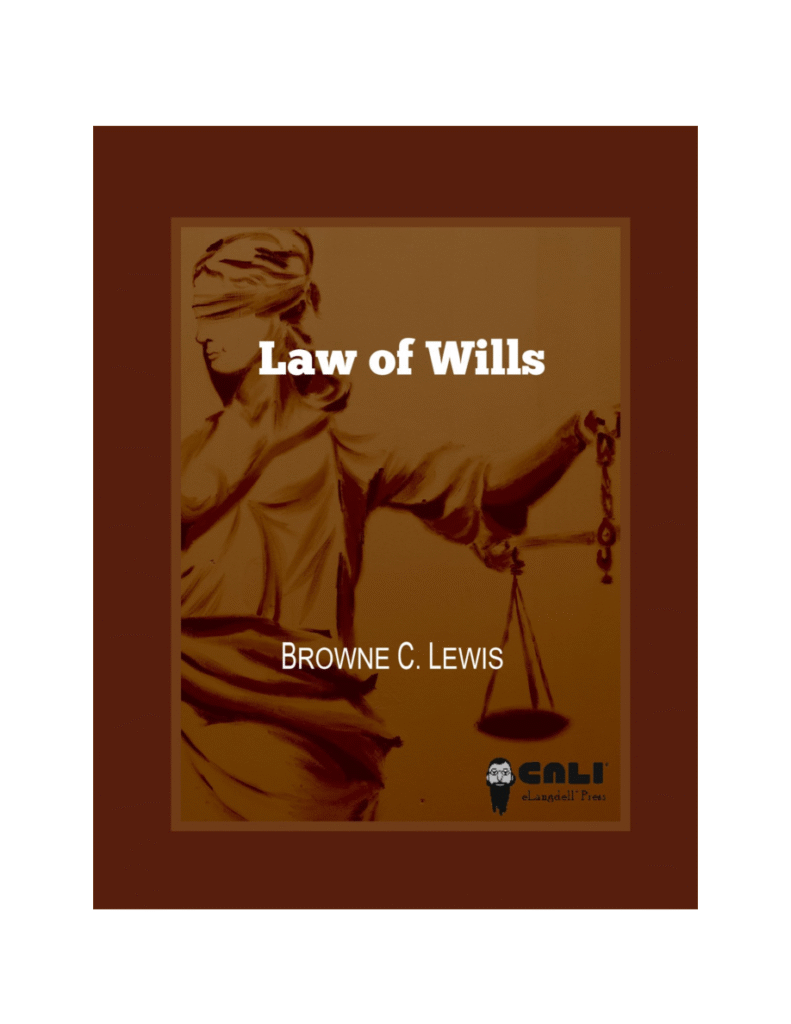
Cover: source-edition cover, displayed to identify the linked book. Publisher and third-party rights remain with their respective holders.
Book summary
About this book
Browne C. Lewis’s Law of Wills connects succession doctrine with family relationships, client representation, and testamentary intention. Sixteen chapters in the 2016 first edition move from ethics and intestacy through freedom, disinheritance, capacity, execution, interpretation, changed circumstances, and nonprobate transfers. Cases, statutes, and problems show how apparently simple wishes depend on legal categories and evidence. This guide follows the source edition for classroom study; state enactments and subsequent decisions must be verified before practical reliance.
Chapter-by-chapter summaries
1. Ethically Representing the Elderly Client
Client identity, conflicts, confidentiality, capacity, and professional responsibility precede drafting. Family involvement can obscure whose interests the lawyer represents. Separate a client’s wishes from a relative’s convenience, and distinguish legal capacity from a general impression of vulnerability. The chapter’s cases show why procedural care protects both autonomy and reliable evidence of intention.
2. Intestacy: Basic Overview
Intestacy supplies a distribution system when property is not effectively disposed of by a will or another mechanism. Identify the property involved and eligible relationships before calculating shares. The statutory scheme is not a direct inquiry into what every decedent probably wanted. Compare its administrative categories with the variety of actual families and circumstances.
3. Intestacy: Surviving Spouse
Spousal inheritance raises classification, marital-status, and family-structure questions. Identify the legally relevant relationships and competing descendants before applying the source’s distribution rules. Marriage, separation, and other arrangements should not be treated as equivalent without authority. The chapter shows how changes in family life challenge the assumptions behind default succession rules.
4. Marital and Adopted Children
Parent-child relationships determine inheritance through doctrines concerning marital and adopted children and the consequences for different family lines. Draw a family tree and mark the legal relationship at each connection. Biological connection and legal parenthood are not always interchangeable. The cases expose the interaction of statutory text, adoption, and the purposes attributed to succession law.
5. Nonmarital Children, Stepchildren, and Foster Children
The chapter examines relationships that challenge a simple marital-family model. Proof of parenthood and statutory recognition can determine whether a person participates in intestacy. Distinguish the existence of a close social relationship from the legal category required by a particular provision. Compare competing approaches without assuming that every jurisdiction treats those relationships identically.
6. Assisted Reproductive Technology
Reproductive technology raises questions about consent, timing, parentage, posthumous conception, and inheritance. Construct a timeline alongside the family tree. Identify whose intention and consent matter and what evidence establishes them. The source demonstrates why traditional categories may not automatically resolve new arrangements. The chapter is edition-specific and should not be read as a current nationwide rule.
7. Testamentary Freedom
Freedom to direct property at death is considered alongside conditions, public policy, and institutional limits. Analyse what a proposed restriction requires and whom it affects. Separate moral disagreement with a condition from the legal basis for enforcing or invalidating it. The chapter asks how far the law should honor choices that continue to influence others after the owner’s death.
8. Disinheritance
Omitting or excluding a person interacts with protections for spouses and other family members. Distinguish the intention to disinherit from whether the intended result is legally effective. Identify which protection or default rule is invoked and which property it reaches. The cases reveal tension between individual choice and the law’s treatment of family obligations.
9. Capacity and Insane Delusion
Testamentary capacity is a specific legal inquiry, not simply a medical diagnosis or a judgment that a decision seems unusual. The chapter also examines a claimed delusion and its connection to the disposition. Separate the applicable test, evidence, timing, and causal significance. A person’s eccentricity alone does not answer whether the source requirements are satisfied.
10. Undue Influence, Duress, and Fraud
These doctrines address different ways intention may be compromised. Identify the alleged conduct, the person’s vulnerability, opportunity, and evidence connecting the conduct with the will. Do not treat an unexpected benefit as proof by itself. Compare a voluntary but unpopular choice with a choice produced through legally significant pressure or deception.
11. Attested Wills
Execution formalities create evidence and safeguards but can generate disputes over compliance. Trace the sequence of signing, acknowledgment, witnessing, and presence under the source rules. Identify the purpose each requirement serves. A document’s apparent authenticity does not automatically establish formal validity, and a technical defect raises a different question from forgery or lack of capacity.
12. Non-Attested Wills
Alternative forms, including handwritten instruments, require their own conditions rather than being informal versions of the same test. Separate the document’s form, intention, authorship, and required content. Compare what evidence supports each element. The chapter illustrates the balance between honoring genuine wishes and preserving a workable system for deciding whether a document should function as a will.
13. Additional Doctrines Impacting Wills
Related doctrines connect testamentary documents with changes, incorporation, and other issues beyond basic execution. Analyse the relationship among instruments and identify the legal route by which an outside writing or act is claimed to matter. The chapter develops a disciplined sequence: establish the relevant doctrine and conditions before relying on a general appeal to the decedent’s intention.
14. Mistakes and Curative Doctrines
Mistakes expose tension between formal documents and intended dispositions. Distinguish an execution defect, a mistaken assumption, and ambiguous language. Explain what evidence the source permits and for what purpose. A desire to reach a fair result does not eliminate doctrinal constraints. The cases ask how a court can correct error without replacing the decedent’s decision with its own.
15. The Stale Will Problem
A will may remain while property, beneficiaries, or family circumstances change. Identify the relevant event and the doctrine governing its consequences rather than assuming that every later change revokes or updates the document. Compare the document’s language with the source’s defaults. The chapter shows why drafting and later review are connected even though the guide itself is not an estate-planning recommendation.
16. Will Substitutes
Beneficiary designations and other nonprobate arrangements can transfer property outside ordinary will administration. Map each asset and the instrument controlling its destination. A will does not necessarily govern everything the owner possessed. The final chapter connects succession planning with multiple legal mechanisms and reinforces the need to distinguish probate property from transfers governed by another arrangement.
Study instructions
- Use a family tree, asset map, and timeline for each problem.
- Keep intestacy, will validity, interpretation, family protection, and nonprobate transfers in separate analytical steps.
- Brief cases with the precise statutory or doctrinal issue and the facts supporting the result.
- For contested intention, identify the evidence, permissible inference, and alternative explanation.
- Verify current state law before applying the source to an actual estate.
Questions for reflection
- How does legal parenthood differ from a social or biological relationship?
- Why is capacity a specific inquiry rather than a general label?
- What purposes do execution formalities serve?
- Why might a will not control a particular asset?
Sources and coverage
This original study guide covers all main chapters of the linked edition, or all instructional sections where the work has no numbered chapters. The explanations and suggested practice are written for study; consult the full source for cases, worked examples, illustrations, exercises, and references. First edition, June 2016. Educational summary, not current estate-planning advice. Read the source edition.
About access & copyright
This page provides book information and study material. Full-text access is provided by the original publisher or authorised source; a listing does not grant permission to republish the book.
Read our Library Access & Copyright policyExplore the contents
Check the chapters covered in this edition.
Visit the official source
See reading, preview or purchase options.
Save for later
Keep this textbook in your saved collection.
Reader ratings & reviews
Share your thoughts
Your review helps other students choose the right resources.
KEEP LEARNING
Your next great read
Contract Law Civil Law
Torts: Cases, Principles, and Institutions
View Torts: Cases, Principles, and Institutions — book Law
Bankruptcy Law and Practice
View Bankruptcy Law and Practice — book Law
Basic Income Tax
View Basic Income Tax — book Law
U.S. Federal Income Taxation of Individuals 2023
View U.S. Federal Income Taxation of Individuals 2023 — book Law
What Color is Your C.F.R.?
View What Color is Your C.F.R.? — book Law
Sources of American Law: An Introduction to Legal Research
View Sources of American Law: An Introduction to Legal Research — book Administrative Law
First Amendment: Cases, Controversies, and Contexts
View First Amendment: Cases, Controversies, and Contexts — bookTorts: Cases and Contexts
Torts: Cases and Contexts
View Torts: Cases and Contexts — bookWetlands Law: A Course Source



