
 Intellectual property law
Contract LawTextbook
Sales and Leases: A Problem-based Approach
Not rated yetRate this bookSales and Leases: A Problem-based Approach by Scott J. Burnham and Kristen Juras develops commercial-law reasoning through the Uniform Commercial Code, cases, and practical problems. Twenty chapters in the July 2023 second edition move from scope and formation through warranties, performance, breach, remedies, and leases. The method is to identify the governing provision, separate its elements, and apply the facts carefully. This guide explains the source edition for study; actual disputes require current enactments and case treatment in the relevant jurisdiction.
Free reading is available at the official source. Opens in a new tab.
 Free
About this book
Sales and Leases: A Problem-based Approach by Scott J. Burnham and Kristen Juras develops commercial-law reasoning through the Uniform Commercial Code, cases, and practical problems. Twenty chapters in the July 2023 second edition move from scope and formation through warranties, performance, breach, remedies, and leases. The method is to identify the governing provision, separate its elements, and apply the facts carefully. This guide explains the source edition for study; actual disputes require current enactments and case treatment in the relevant jurisdiction.
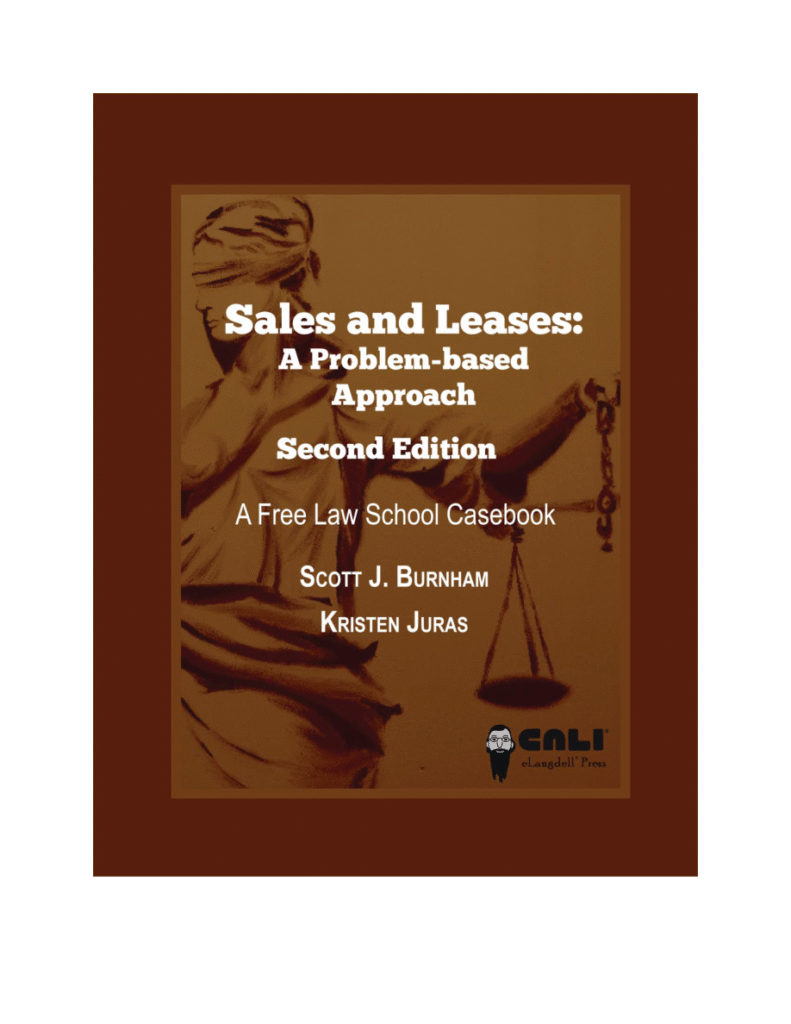
Cover: source-edition cover, displayed to identify the linked book. Publisher and third-party rights remain with their respective holders.
Book summary
Sales and Leases: A Problem-based Approach by Scott J. Burnham and Kristen Juras develops commercial-law reasoning through the Uniform Commercial Code, cases, and practical problems. Twenty chapters in the July 2023 second edition move from scope and formation through warranties, performance, breach, remedies, and leases. The method is to identify the governing provision, separate its elements, and apply the facts carefully. This guide explains the source edition for study; actual disputes require current enactments and case treatment in the relevant jurisdiction.
Chapter-by-chapter summaries
1. Introduction to the UCC and Article 1
History, purposes, agreement, good faith, unconscionability, interpretive hierarchy, and supplementary law establish the framework. Distinguish a default rule from a restriction parties cannot simply remove. Identify the jurisdiction’s enactment before treating model language as controlling. Commercial flexibility works within legal limits rather than replacing careful statutory interpretation.
2. Introduction to Article 2
Goods, mixed transactions, software, and merchant status create threshold questions. Identify what the transaction contains and which rule makes merchant status relevant. A party’s classification may depend on the particular provision. Applying a familiar formation or warranty rule before establishing coverage can produce an answer to the wrong legal problem.
3. Contract Formation
Words and conduct can establish agreement under rules that accommodate some open terms. Construct a timeline of offers, responses, electronic assent, and performance. Separate whether a contract exists from which terms it contains. The chapter prepares for conflicting documents by showing that agreement and the contents of the agreement are related but distinct inquiries.
4. Battle of the Forms
Conflicting orders and acknowledgments require a statutory sequence. Ask whether a contract formed, then analyse additional or different terms and any agreement through conduct. Merchant status, express conditions, and objection matter. Do not assume the last document automatically controls. Explain the route through the provision because small factual differences can change the outcome.
5. Statute of Frauds
An agreement may face an enforceability issue concerning a sufficient record. Compare the general rule with confirmations between merchants and other exceptions. Distinguish evidence of agreement from evidence satisfying the writing requirement. Quantity, signature, agency, and the scope of an exception require separate attention; oral does not automatically mean either fully enforceable or legally irrelevant.
6. Warranties Implied by Law
Title, infringement, merchantability, and fitness obligations depend on different conditions. Ordinary-purpose suitability differs from a buyer’s particular purpose and reliance. Identify the seller, transaction, goods, and defect before choosing the relevant warranty. Establish obligation and breach separately from exclusion, causation, and remedies. The cases show why expectations must be examined in context.
7. Express Warranties and Remote Sellers
Descriptions, statements, samples, and models can have different roles in a bargain. Distinguish a factual commitment from sales talk through the circumstances. Remote-seller issues complicate the connection between a representation and a claimant. Record exactly what was said, by whom, and to whom. A promotional setting alone does not settle the legal analysis.
8. Disclaimers and Third-Party Issues
Excluding a warranty, restricting a remedy, and identifying who benefits from an obligation are separate questions. The chapter includes Magnuson-Moss and third-party considerations alongside disclaimer rules. Compare the exclusion with the specific warranty and examine presentation, language, and timing. A broadly worded clause should not be assigned an effect without checking the conditions imposed by the source law.
9. Parol Evidence and Modification
Integration and interpretation concern the original agreement, while modification addresses a later change. Performance, prior dealings, and trade usage can inform commercial meaning. Put each communication on a timeline and state why it is offered. Calling evidence oral does not answer every question about its effect. Separate an alleged alteration from an argument about what existing terms meant.
10. Delivery Terms and Title
Shipping arrangements distribute obligations, costs, and risks. Title does not answer every question about loss or performance. Map the goods’ movement and identify the legally significant events. Keep ownership, risk allocation, and breach distinct. The chapter teaches precise interpretation of familiar commercial language rather than assuming that a single shipping label resolves the whole dispute.
11. Impracticability
Unexpected events raise questions about basic assumptions and the allocation of risk. Difficulty or increased cost is not itself a complete excuse analysis. Identify the event, contractual provisions, and conditions recognized in the source cases. Consider partial effects as well as total inability. The chapter distinguishes an applicable legal excuse from a party’s preference to avoid an unfavorable bargain.
12. Perfect Tender and Cure
A nonconforming tender must be considered alongside cure and installment-contract rules. Identify the defect, timing, notice, and kind of contract. A possible right to reject does not end the analysis. The chapter examines how performance expectations interact with opportunities to complete the transaction. The buyer’s duties after rejection also matter to the practical outcome.
13. Acceptance and Revocation
Acceptance changes the route available to a dissatisfied buyer. Revocation differs from rejection and has separate conditions. Trace delivery, inspection, use, discovery, communications, and notice. Identify the event alleged to constitute acceptance and the basis for later revocation. Buyers with similar complaints may stand differently because the legally significant sequence differs.
14. Anticipatory Repudiation
A threatened failure before performance is due creates issues of repudiation, insecurity, assurance, and retraction. Distinguish a clear refusal from uncertainty. Analyse both the communication and the recipient’s response. Prematurely treating a contract as ended can create a new problem. The chapter emphasizes timing and statutory mechanisms for addressing insecurity before the performance date arrives.
15. Seller’s Remedies
Resale, market measures, lost profits, the price, and incidental consequences fit different circumstances. Identify the breach, disposition of goods, and seller’s position before selecting a measure. Explain why the remedy fits and avoid duplicate recovery for the same loss. A formula becomes legally meaningful only when its inputs and conditions correspond to the transaction.
16. Buyer’s Remedies
Cover, market measures, damages for accepted goods, consequential loss, and specific relief address different problems. Trace the buyer’s response and distinguish direct, incidental, and consequential components. Show both the rule and arithmetic. The availability of one remedy does not automatically establish every claimed loss; causation, limitations, and supporting facts remain important.
17. Limitation of Remedies
A limited remedy is not the same as a disclaimed warranty. Examine an exclusive repair provision and a consequential-loss clause separately. Ask whether the agreed mechanism functions as intended under the source rules. Invalidating one restriction does not automatically decide the effect of every other term. The chapter develops the relationship between contractual allocation and remedial protection.
18. Statute of Limitations
Accrual and contractual adjustments determine timing under the relevant rules. Construct a dated sequence and identify the event starting the period. Discovery and accrual are not automatically identical. The educational task is transparent analysis rather than memorizing a number without conditions. Real limitation questions require current jurisdiction-specific verification and complete facts.
19. Assignment and Delegation
Transferring a right differs from delegating a duty. Identify what changes, the contract’s restrictions, and the consequences for original and new participants. Delegation does not necessarily release the original obligor. Draw the relationships before and after transfer. This exposes whose expectations and consent matter rather than treating every transfer as the same event.
20. Article 2A: Leases
Leases transfer possession and use through arrangements that must be distinguished from sales and some financing structures. Identify parties, goods, payments, and purpose before importing a sales rule. Compare formation, warranties, performance, and remedies under the lease provisions. The concluding lesson repeats the book’s central discipline: classify the transaction before selecting and applying the governing rule.
Study instructions
- Read the Code provision first and list every condition and consequence.
- Use a transaction timeline and party diagram for each problem.
- Write issue, provision, application, counterargument, and qualified conclusion.
- Keep formation, terms, enforceability, performance, breach, and remedies distinct.
- Verify local enactments and current case treatment before practical reliance.
Questions for reflection
- Why does scope precede warranty analysis?
- How can a contract exist without agreement to every printed term?
- What distinguishes rejection from revocation?
- Why must remedy calculations explain their legal basis?
Sources and coverage
This original study guide covers all main chapters of the linked edition, or all instructional sections where the work has no numbered chapters. The explanations and suggested practice are written for study; consult the full source for cases, worked examples, illustrations, exercises, and references. Second edition, July 2023. Educational explanation of the source, not current jurisdiction-specific legal advice. Read the source edition.
About access & copyright
This page provides book information and study material. Full-text access is provided by the original publisher or authorised source; a listing does not grant permission to republish the book.
Read our Library Access & Copyright policyExplore the contents
Check the chapters covered in this edition.
Visit the official source
See reading, preview or purchase options.
Save for later
Keep this textbook in your saved collection.
Reader ratings & reviews
Share your thoughts
Your review helps other students choose the right resources.
KEEP LEARNING
Your next great read
Intellectual property law Contract Law
The Story of Contract Law: Formation
View The Story of Contract Law: Formation — book Law
Introduction to Criminal Law
View Introduction to Criminal Law — book Law
Evidence: Best Evidence Rule
View Evidence: Best Evidence Rule — book Law
Federal Rules of Appellate Procedure
View Federal Rules of Appellate Procedure — book Law
Land Use
View Land Use — book Business
Contract Doctrine, Theory & Practice, Volume 1
View Contract Doctrine, Theory & Practice, Volume 1 — book Law
The Ethics of Tax Lawyering
View The Ethics of Tax Lawyering — book Law
Federal Rules of Bankruptcy Procedure
View Federal Rules of Bankruptcy Procedure — book Civil Law



