
 Contract Law
LawTextbook
What Color is Your C.F.R.?
Not rated yetRate this bookWhat Color is Your C.F.R.? is a short legal-research workbook written by Nicole Dyszlewski and Raquel Ortiz, with illustrations by Liz Gotauco. Its 2016 first edition combines coloring with practical introductions to sources, finding aids, updating, and help from law librarians. It has instructional sections rather than conventional chapters. This guide follows their complete sequence and explains what each exercise teaches. Database names, interfaces, and cited examples belong to the edition; the activities should be used to practise research methods rather than as current legal answers.
Free reading is available at the official source. Opens in a new tab.
 Free
About this book
What Color is Your C.F.R.? is a short legal-research workbook written by Nicole Dyszlewski and Raquel Ortiz, with illustrations by Liz Gotauco. Its 2016 first edition combines coloring with practical introductions to sources, finding aids, updating, and help from law librarians. It has instructional sections rather than conventional chapters. This guide follows their complete sequence and explains what each exercise teaches. Database names, interfaces, and cited examples belong to the edition; the activities should be used to practise research methods rather than as current legal answers.
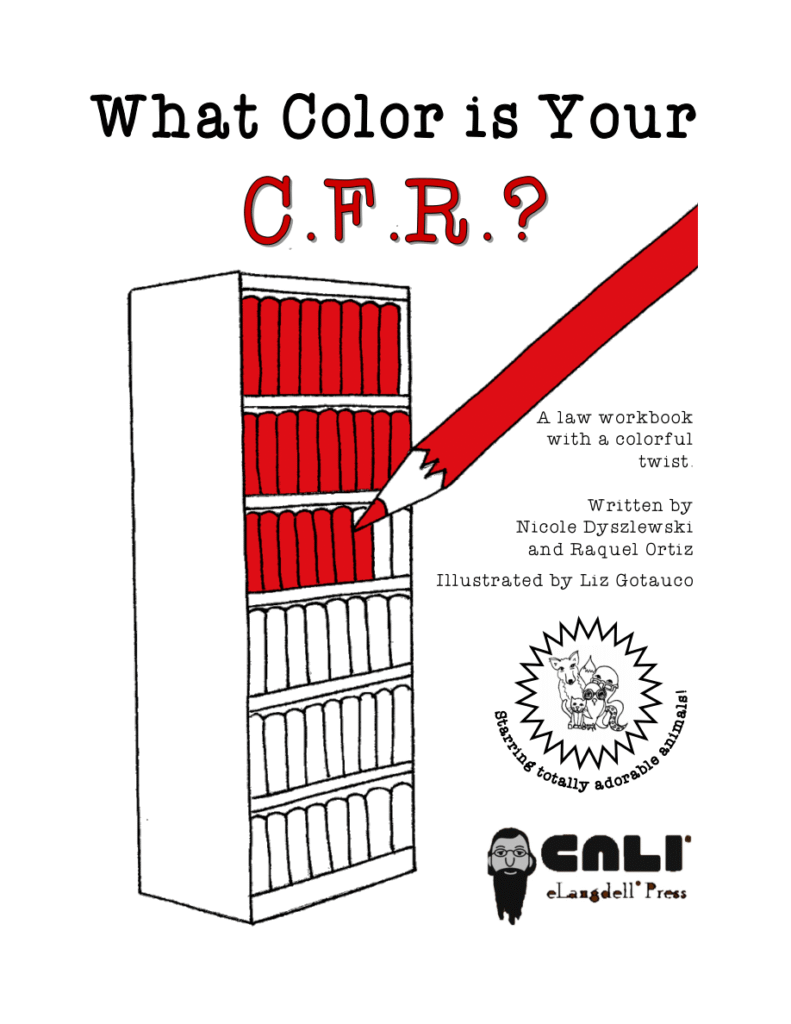
Cover: source-edition cover, displayed to identify the linked book. Publisher and third-party rights remain with their respective holders.
Book summary
About this book
What Color is Your C.F.R.? is a short legal-research workbook written by Nicole Dyszlewski and Raquel Ortiz, with illustrations by Liz Gotauco. Its 2016 first edition combines coloring with practical introductions to sources, finding aids, updating, and help from law librarians. It has instructional sections rather than conventional chapters. This guide follows their complete sequence and explains what each exercise teaches. Database names, interfaces, and cited examples belong to the edition; the activities should be used to practise research methods rather than as current legal answers.
Section-by-section summaries
Orientation: Learning through Research and Coloring
The workbook deliberately lowers the barrier to unfamiliar legal materials. Coloring supports engagement, while short exercises require an actual research action. Treat the activity as a way to organize attention rather than an alternative to reading authority. For each exercise, record the source consulted, the route used, and the unresolved question. That research trail is more useful than merely writing a result in the available space.
What Is the Law?
The opening distinguishes cases, statutes, regulations, constitutions, and court rules. A research question may involve several sources, and ordinary references to the law can conceal which kind is relevant. Classify the source before searching for it. Then identify the jurisdiction and institution producing it. This simple step prevents a secondary explanation or a familiar database entry from being mistaken for the controlling legal text.
Statutes and Codes
Statutes are legislative enactments, while codes organize provisions by subject. Annotated and unannotated versions supply different research assistance. Distinguish enacted text from editorial additions. Read a citation as directions to a location, not as a guarantee that the provision remains current or resolves the problem. The chapter’s comparison develops the vocabulary needed to navigate a code efficiently.
Finding a State Statute: The Reindeer Exercise
The scenario about bringing a pet reindeer to Connecticut provides a concrete reason to use statutory indexes and related terminology. Identify the legal concepts behind the everyday story before selecting search words. Record why a provision might apply and what further source it directs you toward. Finding a plausible hit is an intermediate step; interpretation and updating are still required.
Popular Names and the Peeping-Tom Exercise
A statute may be known by a popular name that differs from its codified location or technical language. Tables and keyword searching offer different routes. Compare the results and explain why wording affects discovery. A popular-name match should lead back to the actual provision and its context. The exercise teaches navigation rather than supplying a permanent answer to the source’s historical example.
Reporters and the Federal Circuit Map
Reporters collect judicial opinions, while publishers may add headnotes and other finding aids. The map exercise links reported decisions with courts and geography. Distinguish a court’s words from an editor’s summary. Identify which court issued the opinion and its position in the relevant system. A published case’s usefulness depends on authority and issue, not merely its appearance in a familiar reporter.
Digests and the Unicorn-Statue Exercise
Digests organize editorial summaries through subjects and key numbers. The imaginative school scenario asks learners to translate a fact pattern into research categories. Try more than one concept and trace a digest reference to the full opinion. A headnote is a discovery aid, not a substitute for the reasoning and facts of the case. Evaluate relevance only after reading the underlying authority.
Updating Print Research
Printed materials describe a point in time and may require supplements or pocket parts. The workbook makes updating part of research rather than a final optional polish. Identify the date of both the main volume and supplement. Ask what period remains uncovered and what other source is needed. An accurately located historical provision may still be an inadequate basis for a present conclusion.
Citator Services
Citators help trace later treatment of cases and other legal materials. Their flags and colors prompt investigation but do not interpret every issue for the researcher. Read the relevant later decision and identify what was affected. Distinguish negative treatment of one proposition from invalidation of an entire opinion. The lesson connects efficient checking with the researcher’s continuing responsibility to analyse significance.
Secondary Sources and Study Aids
Treatises, encyclopedias, articles, and study aids can orient an unfamiliar topic and identify primary authority. They explain law but do not automatically become binding law. Use a secondary source to develop terminology and locate cited authorities, then evaluate those authorities directly. A study aid’s condensed presentation can support review while omitting qualifications essential to answering a detailed research problem.
The Ten-Minute Rule and Asking a Librarian
The workbook encourages seeking help when a good-faith search stops producing progress. Its ten-minute rule is an instructional prompt rather than a universal research deadline. Explain the question, what you tried, and where you became stuck. Recording contact routes turns a vague offer of help into a practical resource. The closing lesson treats assistance as a normal research skill, not evidence that the learner has failed.
Study instructions
- Complete each original exercise independently and keep a log of search terms, finding aids, citations, and unresolved issues.
- Separate source text, editorial headnotes, and your own interpretation.
- Compare an index or digest route with a keyword search and explain the differences.
- Update every authority before treating it as support for a current proposition.
- Ask a librarian a specific question supported by a record of what you have already tried.
Questions for reflection
- Why is a headnote different from a holding?
- When can a popular-name table outperform a keyword search?
- What does a citator flag tell you, and what must you still read?
- How can a research log make a request for help more effective?
Sources and coverage
This original study guide covers all main chapters of the linked edition, or all instructional sections where the work has no numbered chapters. The explanations and suggested practice are written for study; consult the full source for cases, worked examples, illustrations, exercises, and references. First edition, August 2016. Section headings here organize the workbook’s instructional sequence; they are not invented numbered chapters. Read the source edition.
About access & copyright
This page provides book information and study material. Full-text access is provided by the original publisher or authorised source; a listing does not grant permission to republish the book.
Read our Library Access & Copyright policyExplore the contents
Check the chapters covered in this edition.
Visit the official source
See reading, preview or purchase options.
Save for later
Keep this textbook in your saved collection.
Reader ratings & reviews
Share your thoughts
Your review helps other students choose the right resources.
KEEP LEARNING
Your next great read
Contract Law Civil Law
Torts: Cases, Principles, and Institutions
View Torts: Cases, Principles, and Institutions — book Law
Law of Wills
View Law of Wills — book Law
Bankruptcy Law and Practice
View Bankruptcy Law and Practice — book Law
Basic Income Tax
View Basic Income Tax — book Law
U.S. Federal Income Taxation of Individuals 2023
View U.S. Federal Income Taxation of Individuals 2023 — book Law
Sources of American Law: An Introduction to Legal Research
View Sources of American Law: An Introduction to Legal Research — book Administrative Law
First Amendment: Cases, Controversies, and Contexts
View First Amendment: Cases, Controversies, and Contexts — bookTorts: Cases and Contexts
Torts: Cases and Contexts
View Torts: Cases and Contexts — bookWetlands Law: A Course Source



