
 Civil Law
Textbook
Torts: Cases and Contexts — Volume Two
Not rated yetRate this bookEric E. Johnson’s Torts: Cases and Contexts, Volume Two continues with Chapters 13–28. The linked 2016 PDF is not a combined edition, so this guide preserves its actual numbering. It covers strict and products liability, intentional torts, defenses, remedies, multiple defendants, government responsibility, and constitutional torts. Read cases with attention to jurisdiction and procedural posture. These explanations support study of the assigned edition and do not establish the law applicable to a present dispute. Volume One’s earlier chapters are a separate source.
Free reading is available at the official source. Opens in a new tab.
 Free
About this book
Eric E. Johnson’s Torts: Cases and Contexts, Volume Two continues with Chapters 13–28. The linked 2016 PDF is not a combined edition, so this guide preserves its actual numbering. It covers strict and products liability, intentional torts, defenses, remedies, multiple defendants, government responsibility, and constitutional torts. Read cases with attention to jurisdiction and procedural posture. These explanations support study of the assigned edition and do not establish the law applicable to a present dispute. Volume One’s earlier chapters are a separate source.
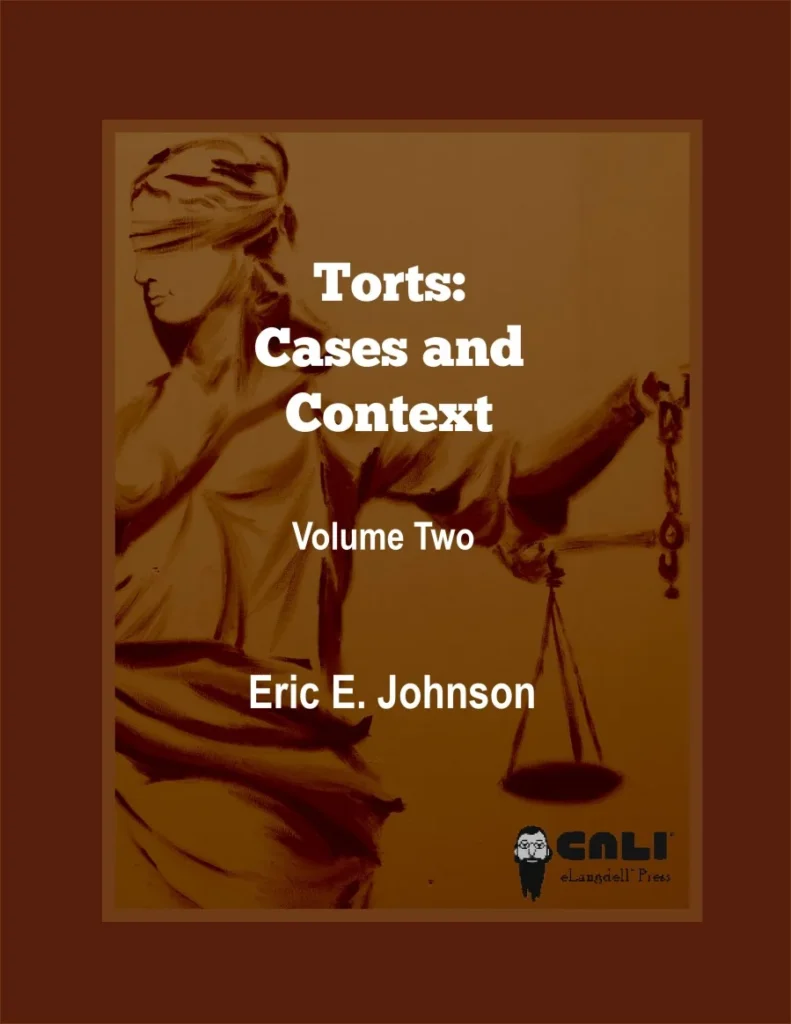
Cover: source-edition cover, displayed to identify the linked book. Publisher and third-party rights remain with their respective holders.
Book summary
Eric E. Johnson’s Torts: Cases and Contexts, Volume Two continues with Chapters 13–28. The linked 2016 PDF is not a combined edition, so this guide preserves its actual numbering. It covers strict and products liability, intentional torts, defenses, remedies, multiple defendants, government responsibility, and constitutional torts. Read cases with attention to jurisdiction and procedural posture. These explanations support study of the assigned edition and do not establish the law applicable to a present dispute. Volume One’s earlier chapters are a separate source.
Chapter-by-chapter summaries
13. Strict liability
The inquiry shifts from reasonable care to whether a defined activity or relationship triggers responsibility. Strict liability still has causal and doctrinal limits. Compare negligence and strict liability using the same accident. Ask how the rule changes incentives concerning the activity’s location or scale as well as care during its performance. Identify the protected interest and scope before concluding that fault is irrelevant to every part of the analysis.
14. Products liability
Manufacturing defects, design defects, and inadequate warnings raise different questions about products and distribution. A safer imaginable design does not automatically satisfy the governing test, and a warning does not always cure another defect. Identify the particular defect theory and supporting evidence in each case. Separate the existence of a defect from proof that it caused the claimant’s harm. Compare how different standards allocate responsibility for evaluating risks and alternatives.
15. Safety and health regulation
Regulatory compliance or violation can affect tort analysis without automatically resolving it. Statutory purpose, protected groups, administrative authority, and possible preemption matter. Identify the rule’s source and intended application, then examine how a court uses it in a civil action. Distinguish desirable safety policy from the legal effect of a particular enactment. A regulatory standard and a common-law duty may overlap without becoming identical inquiries.
16. Introduction to intentional torts
Separate intent, causation, protected interests, and defenses. The required mental state concerns legally specified consequences, not necessarily hostility or a wish to cause every resulting injury. For a hypothetical, state what the defendant intended or knew with the relevant certainty. Then select the cause of action and analyze its elements. Moral blameworthiness alone does not establish an intentional tort, and absence of malice does not automatically defeat one.
17. Battery and assault
Battery concerns prohibited contact; assault concerns the legally defined apprehension of imminent contact. Awareness and injury therefore matter differently. Context helps determine whether contact is harmful or offensive. Analyze the episode separately under each tort’s elements rather than blending them. An injury need not always be physical for the interest to be protected, while an alarming remark is not automatically an assault. Explain which fact supplies each required element.
18. False imprisonment
Confinement requires bounded limits and legally sufficient restraint without the required justification. Threats, authority, awareness, reasonable exits, and duration affect analysis. Difficulty or social awkwardness in leaving is not the same as confinement. Draw the practical boundaries and identify what prevents departure. After establishing the prima facie tort, assess any privilege separately. This sequence prevents a possible justification from obscuring whether a legally meaningful restraint occurred.
19. Intentional infliction of emotional distress
The tort addresses severe emotional harm under demanding conduct and mental-state requirements. Ordinary indignities do not all meet the threshold. Context, relationships, vulnerability, and evidence of severity affect the source cases. Keep conduct, intent or recklessness, causation, and distress distinct. A strong showing on one does not supply the others automatically. Compare nearby fact patterns to identify what changes an upsetting episode into conduct satisfying the applicable doctrine.
20. Trespass to land
Trespass protects possessory interests against specified unauthorized intrusions. Intent to enter differs from intent to violate another’s rights, making mistake analytically important. Boundaries, objects, continued presence, and limits of permission create distinct problems. Identify the claimant’s interest and the defendant’s act before considering consent or privilege. Significant physical damage is not always necessary because control of possession is itself part of the interest protected by the action.
21. Chattels and conversion
Trespass to chattels and conversion address interference with personal property at different levels of seriousness. Duration, control, harm, and the character of interference help distinguish temporary misuse from an interference supporting conversion’s remedy. Analyze damage, temporary use, and permanent appropriation separately. The everyday label theft does not replace the doctrinal elements. Explain why the remedy fits the degree of interference and whether the facts justify treating the property’s full value as the relevant measure.
22. Defenses to intentional torts
Consent, self-defense, defense of others or property, and necessity have conditions and limits. Some permission does not establish consent to every act, and a threat does not authorize an unlimited response. Identify purpose, perceived circumstances, scope, and proportionality under the source cases. Consider whether a privilege changes liability and compensation in the same way. Analyze defenses after the prima facie claim so the role of each fact remains clear.
23. General remedies issues
Liability does not establish every requested form or amount of relief. Proof, causation, mitigation, and remedial objectives shape what a successful claimant can obtain. Make a chart linking each claimed loss to evidence and a legal basis. Separate actionability from valuation. Remedies require reasoned connections between the wrong and the response, not merely an impression that the defendant should pay. The chapter supplies a framework for the detailed damages discussions that follow.
24. Compensatory damages
Compensation addresses legally recoverable losses, including economic and less easily valued harms. Future losses depend on duration, probabilities, and financial assumptions. Compare two calculations and identify why their estimates differ. Link each amount to evidence and a recognized category. Monetary relief cannot literally undo every experience, so questions of consistency and fairness remain. Distinguish the seriousness of an injury from proof supporting a particular valuation.
25. Punitive damages
Punishment and deterrence differ from compensation. Availability and amount depend on governing standards, defendant culpability, and legal constraints. Severe injury alone does not automatically establish entitlement to punishment. Separate facts supporting compensatory losses from those supporting punitive liability. Compare deterrence, punishment, and proportionality as objectives. Read constitutional and jurisdictional limits in the assigned decisions; a dramatic award in one case is not a universal rule for other disputes.
26. Multiple tortfeasors
Several contributors to harm raise questions about causation, divisibility, allocation, collection, and contribution. Begin with a causal diagram before assigning percentages. Joint and several liability and comparative responsibility answer related but different questions. Establish which rule applies and whether the harm can be separated. That several people were involved does not resolve how much each owes, what the claimant can collect from one, or how defendants may adjust burdens among themselves.
27. Immunities and government liability
Public defendants require attention to the statutory route permitting suit, retained immunities, and the kind of conduct challenged. Ordinary private-party analysis cannot simply be transferred unchanged. Identify the defendant and waiver before reaching the underlying elements. An immunity differs from a finding that conduct was reasonable or harmless. Institutional and separation-of-powers concerns affect available remedies. Track jurisdiction and procedural requirements carefully in every assigned case.
28. Constitutional torts
A constitutional violation, cause of action, correct defendant, available remedy, and immunity are separate questions. Organize a problem around the asserted right, official conduct, causal link, and barriers to recovery. Compare damages here with their private-law role. The chapter connects accountability with institutional limits, but the 2016 source cannot be assumed to include later developments. Updated primary authority is necessary before using the material beyond course study.
Study instructions
- Brief cases with facts, posture, issue, holding, reasoning, and a limiting fact.
- Write elements before defenses and remedies in every hypothetical.
- Compare battery and assault, chattels and conversion, compensation and punishment in separate tables.
- Identify source date and jurisdiction; update primary authority for current legal work.
Questions for reflection
- How can strict liability retain important limits?
- Which facts distinguish conversion from lesser interference?
- How does immunity differ from no violation?
Sources and coverage
This original reading guide covers the linked edition’s main chapters, or the principal sections of its two-chapter calculus text. Consult the source for full arguments, cases, worked examples, exercises, illustrations, and references. Volume Two, 2016, Chapters 13–28. Volume One is separate. Legal explanations are tied to this edition, not verified current legal advice. Read the source edition.
About access & copyright
This page provides book information and study material. Full-text access is provided by the original publisher or authorised source; a listing does not grant permission to republish the book.
Read our Library Access & Copyright policyExplore the contents
Check the chapters covered in this edition.
Visit the official source
See reading, preview or purchase options.
Save for later
Keep this textbook in your saved collection.
Reader ratings & reviews
Share your thoughts
Your review helps other students choose the right resources.
KEEP LEARNING
Your next great read
Civil Law Civil Law
Law of Commercial Transactions
View Law of Commercial Transactions — book Civil Law
Fundamentals of Business Law
View Fundamentals of Business Law — book Civil Law
Legal Aspects of Property, Estate Planning, and Insurance
View Legal Aspects of Property, Estate Planning, and Insurance — book Civil Law
The Legal and Ethical Environment of Business
View The Legal and Ethical Environment of Business — book Intellectual property law
Australian Trade Mark Law and Practice
View Australian Trade Mark Law and Practice — book Contract Law
The Story of Contract Law: Formation
View The Story of Contract Law: Formation — book Law
Introduction to Criminal Law
View Introduction to Criminal Law — book Law
Evidence: Best Evidence Rule
View Evidence: Best Evidence Rule — book Law



