
 Intellectual property law
LawTextbook
Bankruptcy Law and Practice
Not rated yetRate this bookGregory Germain’s Bankruptcy Law and Practice, fifth edition, develops bankruptcy through its relationship with ordinary debt collection and property rights. Fourteen chapters move from enforcement and secured claims to the bankruptcy system, estate, exemptions, stay, administration, avoidance, claims, discharge, and reorganization. The central analytical habit is to distinguish what property exists, who has an interest in it, how claims rank, and what the proceeding changes. This guide follows the 2024 edition and describes its classroom framework rather than providing filing or financial advice.
Free reading is available at the official source. Opens in a new tab.
 Free
About this book
Gregory Germain’s Bankruptcy Law and Practice, fifth edition, develops bankruptcy through its relationship with ordinary debt collection and property rights. Fourteen chapters move from enforcement and secured claims to the bankruptcy system, estate, exemptions, stay, administration, avoidance, claims, discharge, and reorganization. The central analytical habit is to distinguish what property exists, who has an interest in it, how claims rank, and what the proceeding changes. This guide follows the 2024 edition and describes its classroom framework rather than providing filing or financial advice.
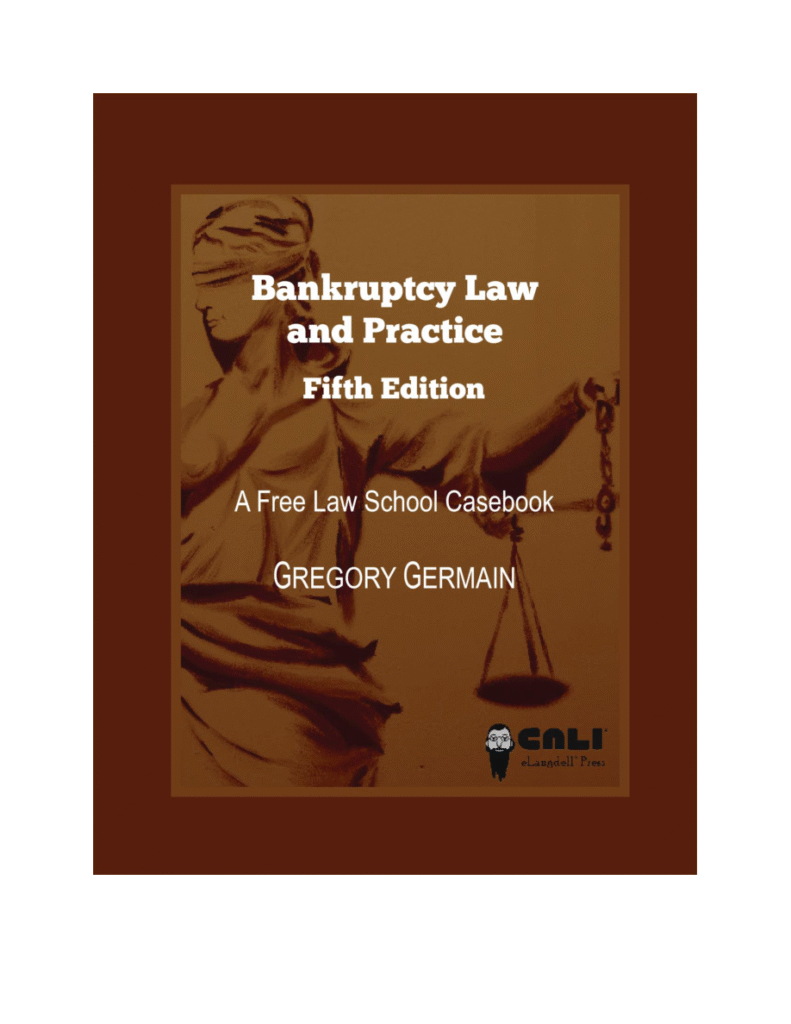
Cover: source-edition cover, displayed to identify the linked book. Publisher and third-party rights remain with their respective holders.
Book summary
Gregory Germain’s Bankruptcy Law and Practice, fifth edition, develops bankruptcy through its relationship with ordinary debt collection and property rights. Fourteen chapters move from enforcement and secured claims to the bankruptcy system, estate, exemptions, stay, administration, avoidance, claims, discharge, and reorganization. The central analytical habit is to distinguish what property exists, who has an interest in it, how claims rank, and what the proceeding changes. This guide follows the 2024 edition and describes its classroom framework rather than providing filing or financial advice.
Chapter-by-chapter summaries
1. A World without Bankruptcy
Individual collection, judgments, garnishment, exemptions, and fraudulent-transfer concepts explain the setting bankruptcy changes. A race among creditors can produce outcomes different from collective administration. Draw the parties, assets, and enforcement steps in a hypothetical collection dispute. Distinguish obtaining a judgment from realizing payment. This establishes why a collective process may matter even when individual claims are valid.
2. Secured Claims
Liens, attachment, perfection, priority, purchase-money interests, and enforcement identify relationships between a debt and particular property. These are distinct concepts: an enforceable interest between parties may still face priority problems against others. Build a dated priority diagram. The chapter supplies a baseline for later bankruptcy treatment rather than assuming that filing erases every pre-existing property interest.
3. Bankruptcy System
Purposes, jurisdiction, venue, voluntary and involuntary commencement, dismissal, conversion, and eligibility organize access to the system. The source’s cases address institutional and constitutional boundaries as well as debtor behavior. Identify the proceeding and decision-maker before analysing a substantive dispute. A problem about whether a case belongs in the system differs from how a claim will be treated inside it.
4. The Bankruptcy Estate
The estate defines the pool of interests subject to administration. Ownership, timing, and the treatment of prepetition and postpetition interests require careful characterization. Identify the debtor’s actual legal interest at the relevant date rather than listing physical objects indiscriminately. The cases show why a right’s source and conditions matter. Property of the estate is a threshold question, not a synonym for everything connected with the debtor.
5. Exemptions
Exemptions protect qualifying interests within an applicable statutory framework. Choice of scheme, objections, planning, and lien impairment create separate issues. Identify what is claimed, the relevant value, and the procedural setting. Exemption and exclusion from the estate are not identical. The chapter’s numerical and timing examples belong to the edition and require current verification before any real-world use.
6. The Automatic Stay
The stay changes collection and other activity at commencement, subject to the source’s scope, exceptions, and relief mechanisms. Identify the act, actor, property, and timing. Do not assume every dispute stops or every creditor action is permitted. Separate applicability from a request for relief and from consequences of violation. The chapter develops the collective proceeding’s relationship with individual enforcement.
7. Operating the Estate
Administration may involve using property, financing activity, transactions, and executory agreements. The chapter examines who can act and what approval or protection is needed. Compare preserving value with distributing value. A transaction that seems commercially attractive can still require analysis of authority and competing interests. The estate is an operating legal arrangement rather than a static list of assets.
8. Enhancing the Estate
Avoidance and recovery rules examine selected prepetition transfers and other transactions that may affect the estate. Distinguish the cause of action, conditions, defenses, and recovery question. A payment close to filing is not automatically avoidable. Construct a timeline of transfer, obligation, and commencement. The chapter connects collective treatment with limits on transactions that alter creditor positions.
9. Secured Claims in Bankruptcy
Security interests interact with valuation, adequate protection, stay relief, and treatment within the proceeding. Separate the amount of a debt from collateral value and the resulting treatment. Identify which interest the proposed protection addresses. The chapter builds on the nonbankruptcy baseline without assuming that security guarantees immediate payment or makes bankruptcy irrelevant to the creditor.
10. Unsecured Claims
Allowance, priority, objections, and distribution determine how unsecured interests participate. Identify the claim’s basis and status before calculating any share. Priority is different from the size or moral urgency of a loss. The chapter asks how the system translates diverse obligations into an ordered distribution framework and what happens when the available pool cannot satisfy them all.
11. Discharge
Discharge concerns personal liability and interacts with exceptions, objections, and the integrity of the process. Distinguish denial of discharge from a particular debt’s nondischargeability and from treatment of a lien. A fresh-start concept does not answer every obligation automatically. The cases require attention to conduct, statutory conditions, and proof rather than treating filing as a universal cancellation.
12. Chapter 13 Reorganization
An individual repayment framework connects eligibility, a plan, creditor treatment, confirmation, performance, and eventual relief. Follow the sequence rather than assuming proposal equals approval or completion. Compare the source’s requirements with the debtor’s projected circumstances. The study goal is to understand how adjustment through a plan differs from liquidation, not to recommend a chapter for a particular person.
13. Chapter 11 Reorganization
Business reorganization involves continued activity, negotiation, classification, disclosure, voting, confirmation, and the treatment of interests. Identify the proposed plan’s structure and the parties whose positions change. A business’s continuation does not alone establish compliance with confirmation requirements. The chapter examines how a collective legal process can restructure relationships while balancing competing claims to value.
14. Integrity of the Bankruptcy Process
Disclosure, truthful participation, sanctions, and related enforcement protect the system’s legitimacy. Analyse the conduct at issue and the source of the proposed consequence. The final chapter connects debtor relief with responsibilities to the court and other participants. The book’s larger lesson is that outcomes depend on both substantive entitlements and reliable procedures for identifying and administering them.
Study instructions
- For each problem, draw assets, interests, claims, priorities, and relevant dates.
- Distinguish estate inclusion, exemption, secured status, claim allowance, discharge, and lien treatment.
- Read statutory conditions and exceptions before applying a general policy such as fresh start or equality.
- Work source problems with explicit assumptions and separate valuation from legal entitlement.
- Check current statutes, rules, figures, and case treatment before practical reliance.
Questions for reflection
- Why does a judgment not guarantee collection?
- How do attachment, perfection, and priority differ?
- What separates exemption from exclusion from the estate?
- Why does discharge not answer every lien question?
Sources and coverage
This original study guide covers all main chapters of the linked edition, or all instructional sections where the work has no numbered chapters. The explanations and suggested practice are written for study; consult the full source for cases, worked examples, illustrations, exercises, and references. Fifth edition, 2024. Legal and financial concepts are explained for study, not individualized advice. Read the source edition.
About access & copyright
This page provides book information and study material. Full-text access is provided by the original publisher or authorised source; a listing does not grant permission to republish the book.
Read our Library Access & Copyright policyExplore the contents
Check the chapters covered in this edition.
Visit the official source
See reading, preview or purchase options.
Save for later
Keep this textbook in your saved collection.
Reader ratings & reviews
Share your thoughts
Your review helps other students choose the right resources.
KEEP LEARNING
Your next great read
Intellectual property law Contract Law
The Story of Contract Law: Formation
View The Story of Contract Law: Formation — book Law
Introduction to Criminal Law
View Introduction to Criminal Law — book Law
Evidence: Best Evidence Rule
View Evidence: Best Evidence Rule — book Law
Federal Rules of Appellate Procedure
View Federal Rules of Appellate Procedure — book Law
Land Use
View Land Use — book Business
Contract Doctrine, Theory & Practice, Volume 1
View Contract Doctrine, Theory & Practice, Volume 1 — book Law
The Ethics of Tax Lawyering
View The Ethics of Tax Lawyering — book Law
Federal Rules of Bankruptcy Procedure
View Federal Rules of Bankruptcy Procedure — book Civil Law



