
Introduction to Sustainability
AppliedTextbook
Learning Statistics with R: A tutorial for psychology students and other beginners
Not rated yetRate this bookLearning Statistics with R introduces statistical thinking and R programming for psychology students and beginners. Danielle Navarro connects research design, data exploration, statistical theory and analysis. The hosted PDF is the newer Quarto version, not the original 2018 layout.
 Free
About this book
This textbook grew from introductory psychology statistics teaching and was released for reuse and adaptation. The reviewed preface describes the transition from its earlier LaTeX form to Quarto and explains the limits of that update. Much of the original instructional approach remains, alongside corrections and short reflections on developments in statistical practice and R. The contents combine conceptual background with practical computing and later statistical tools. Readers should match chapter references and software examples to this hosted edition: its pagination and updated material differ from older versions that share the same title.
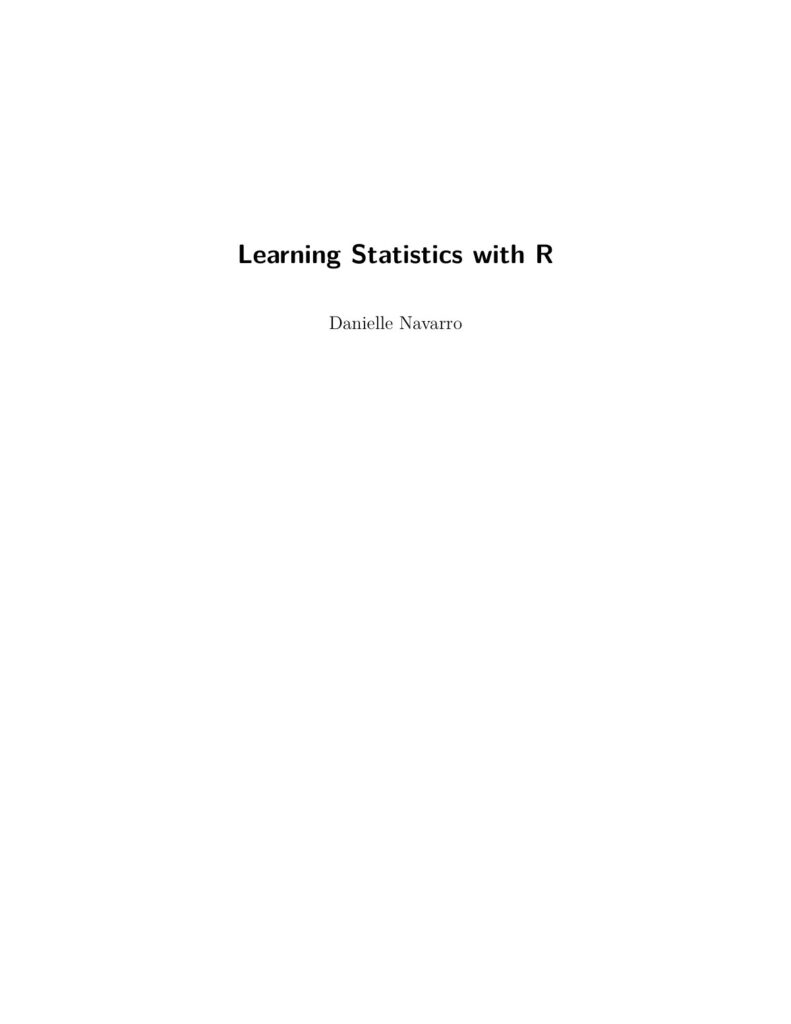
The attached edition contains 796 PDF pages, including front matter. Cover: source edition title page rendered from the PDF. The textbook and its original notices are retained; Academic Master’s study material is separate from the source text.
Book summary
Study overview of the reviewed opening
Navarro’s preface situates the book in the practical challenge of teaching statistics to beginning psychology students using R. The original lecture notes expanded into a textbook because the available beginner resources did not meet that teaching need. Its open licence subsequently allowed other people to adapt the material for their own settings.
The newer Quarto version preserves much of the earlier book while improving its presentation and correcting errors. The author explicitly distinguishes this work from a thorough modernisation. Short epilogues discuss changes in research methods, Bayesian practice, debates about significance and developments in the R ecosystem. This is an important reading distinction: a newly produced PDF can contain a teaching approach developed much earlier.
The verified structure moves from research background and an introduction to R into working with data, statistical theory and statistical tools. That organisation gives a beginner both conceptual and computational entry points. The reviewed preface encourages attention to the version’s changelog rather than treating every edition as interchangeable. The guide does not summarise the statistical chapters or provide current software-installation instructions; those require reading the corresponding sections and checking the tools being used.
Book contents
- A word on statistics
- Why do we learn statistics?
- A brief introduction to research design
- Getting started with R
- R mechanics
- Descriptive statistics
- Drawing graphs
- Pragmatic matters
- Basic programming
- A chat about inference
- Introduction to probability
- Estimating unknown quantities from a sample
- Hypothesis testing
- Categorical data analysis
- The t-test
- Comparing several means (one-way ANOVA)
- Linear regression
- Factorial ANOVA
- Bayesian statistics
- Epilogue
- References
Questions for study
The following prompts are Academic Master’s editorial material.
- Which parts of a textbook’s teaching approach can remain useful after its software ecosystem changes?
- Why should an assignment record the edition and chapter references it uses?
- How does the author distinguish a format update from a complete modernisation?
Sources and coverage
Preface read in full (PDF pages 17–18); contents and Quarto changelog checked.
About access & copyright
Check this edition’s source and licence before reusing its files or content. A library listing does not grant additional rights.
Read our Library Access & Copyright policyEdition awareness
Identify the hosted text as a Quarto version.
Research context
Relate the book’s origin to introductory psychology statistics.
Concepts and computation
Recognise the contents’ combined theoretical and practical route.
Scope of updates
Distinguish corrections and epilogues from wholesale revision.
Reader ratings & reviews
Share your thoughts
Your review helps other students choose the right resources.
KEEP LEARNING
Your next great read
Social Sciences
Programming for Computations – Python: A Gentle Introduction to Numerical Simulations with Python 3.6
Programming for Computations - Python: A Gentle Introduction to Numerical Simulations with Python 3.6
View Programming for Computations - Python: A Gentle Introduction to Numerical Simulations with Python 3.6 — book Humanities
Reading Social Science Methods
View Reading Social Science Methods — book Mathematics
MGF 1131: Mathematics in Context
View MGF 1131: Mathematics in Context — book Engineering & Technology
Ethics in Technology
View Ethics in Technology — book Applied
COMPUTATIONAL PHYSICS: A Practical Introduction to Computational Physics and Scientific Computing (using C++)
View COMPUTATIONAL PHYSICS: A Practical Introduction to Computational Physics and Scientific Computing (using C++) — book Algebra
Advanced Algebra
View Advanced Algebra — book Curriculum & Instruction
Using Open Educational Resources to Promote Social Justice
View Using Open Educational Resources to Promote Social Justice — book Curriculum & Instruction
Intersections of Open Educational Resources and Information Literacy
View Intersections of Open Educational Resources and Information Literacy — book Social Sciences



