
 Mathematics
AppliedTextbook
COMPUTATIONAL PHYSICS: A Practical Introduction to Computational Physics and Scientific Computing (using C++)
Not rated yetRate this bookBuild practical scientific-computing skills through physics problems, numerical programs, and interpretation of results. This second-edition C++ text by Konstantinos N. Anagnostopoulos is intended for readers with introductory university physics. The guide explains the author’s learning approach and offers a structured way to work through examples.
Free reading is available at the official source. Opens in a new tab.
 Free
About this book
The 2016 second edition develops computational physics through worked scientific problems rather than a comprehensive reference treatment of C++. Its forewords describe learning by running programs, changing code, and analyzing the resulting data. It draws on the author’s undergraduate teaching at the National Technical University of Athens.
The verified contents progress from computer tools and kinematics to nonlinear motion, electrostatics, diffusion, quantum problems, random walks, and Monte Carlo methods. The later material includes the two-dimensional Ising model and critical exponents. This is a contents-based description of the book’s scope, not a claim that those chapters have all been reviewed.
The source distinguishes C++ and Fortran versions. This page concerns the C++ second-edition file, version 2.0.20161206201400. Its copyright page identifies separate ISBNs for printed volumes I and II; they should not be confused with one ISBN for a combined PDF.
Sources, access, and reading coverage
Title and copyright pages, chapter contents, working-environment notes, and selected passages in the two forewords (PDF sheets 1–16). Detailed numerical chapters have not been reviewed for this guide. Reviewed 22 October 2026. The study guidance below is original Academic Master editorial material; it does not claim complete chapter coverage.
Official book information; official PDF; Open Textbook Library record. Use the official source for available reading formats.
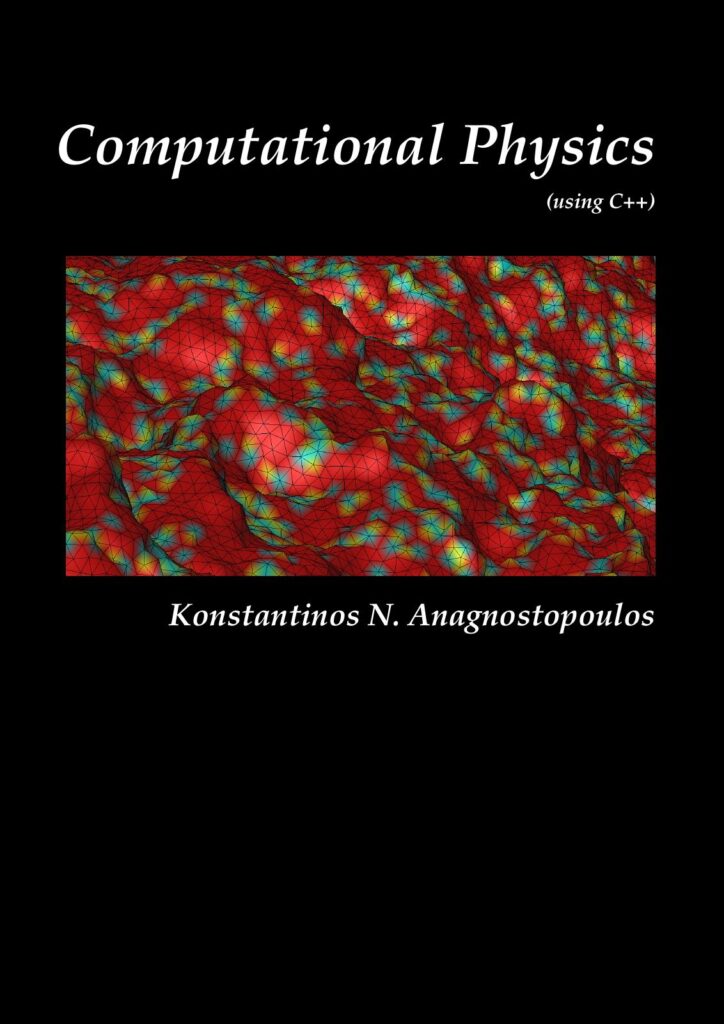
Cover credit: Cover design: K. N. Anagnostopoulos. Image from hexatic-membrane Monte Carlo simulations with Mark J. Bowick. CC BY-SA 4.0.
Book summary
Guide to the reviewed material
In the reviewed second-edition foreword, the author treats a programming language as a means of solving scientific problems. The aim is not advanced object-oriented programming. Instead, the reader is expected to acquire practical numerical skills that can be used across languages and alongside existing scientific software.
The earlier foreword explains why simply reading is insufficient. The teaching model pairs demonstrations with the learner’s own execution of commands and programs. The working-environment notes connect numerical code with terminal tools, plotting, and data handling. Their software examples belong to this edition’s computing context; a course may use updated installation arrangements.
How to study this book
The following instructions are Academic Master editorial guidance.
Create a separate folder for each experiment and retain the original source before making changes. Record the physical question, input parameters, output files, and what each graph represents. Distinguish an unexpected physical result from a compilation, input, or plotting error.
Reproduce a small example before varying one parameter. Where the assigned chapter supplies an analytical comparison or numerical check, use it to assess the result. Keep a short record of discrepancies and the checks you performed, rather than treating a plausible-looking graph as sufficient validation.
Build a vocabulary list that separates mathematical ideas, numerical methods, and computer commands. Follow your instructor’s selected chapter order; the long contents need not become a requirement to finish every topic before completing a course project.
Questions for reflection
- What evidence would persuade you that a numerical result is reliable?
- Which part of an experiment concerns physics, and which concerns the implementation?
- How would you make another student’s rerun of your calculation possible?
About access & copyright
This page provides book information and study material. Full-text access is provided by the original publisher or authorised source; a listing does not grant permission to republish the book.
Read our Library Access & Copyright policyActive practice
Execute and examine examples instead of relying on passive reading.
Scientific purpose
Treat code as a tool for answering a physical question.
Data interpretation
Connect output and plots to assumptions and parameters.
Edition awareness
Keep C++ and Fortran versions, and volume identifiers, distinct.
Reader ratings & reviews
Share your thoughts
Your review helps other students choose the right resources.
KEEP LEARNING
Your next great read
Mathematics Natural Sciences
Ecology for All!
View Ecology for All! — book Chemistry
Chemical Bonding and Organic Chemistry
View Chemical Bonding and Organic Chemistry — book Natural Sciences
Conservation techniques
View Conservation techniques — book Algebra
Advanced Algebra
View Advanced Algebra — book Earth Sciences
Introduction to Earth Science
View Introduction to Earth Science — book Analysis
Basic Engineering Data Collection and Analysis
View Basic Engineering Data Collection and Analysis — book Mathematics
Data Analysis in the Psychological Sciences: A Practical, Applied, Multimedia Approach
View Data Analysis in the Psychological Sciences: A Practical, Applied, Multimedia Approach — book Biology
Virginia Cooperative Extension Gardener Handbook
View Virginia Cooperative Extension Gardener Handbook — book Mathematics



