
 Distance learning
Curriculum & InstructionTextbook
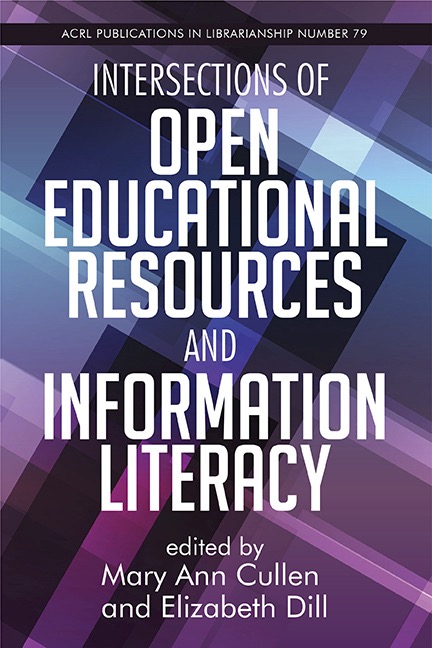
Intersections of Open Educational Resources and Information Literacy
Not rated yetRate this bookThis collection examines relationships between open educational resources and information literacy. Its introduction uses a classroom example to connect the choice of learning materials with students’ evaluation and creation of information.
Free reading is available at the official source. Opens in a new tab.
 Free
About this book
Intersections of Open Educational Resources and Information Literacy brings together seventeen chapters on how openness and information-literacy teaching can support one another. Edited by Mary Ann Cullen and Elizabeth Dill, the collection combines conceptual foundations with classroom projects, librarian collaboration, social-justice questions, student advocacy, and professional learning. This guide follows all chapters in the reviewed ACRL volume. The recurring distinction is between access to information and the ability to evaluate, create, and participate responsibly in it. Readers should compare the contributors’ settings and evidence before adapting a project, keeping student agency, permission, and the work required for meaningful participation visible.
The detailed guide below follows the book’s chapter, unit, or section structure. Read it alongside the study instructions and the complete official text.
Book summary
Chapter-by-chapter summaries
Chapter 1: An open primer
The primer introduces OER, open pedagogy, and information literacy for readers entering the conversation. These concepts overlap but are not interchangeable. A resource’s permissions affect what users may do, while pedagogy concerns the learning arrangement and information literacy concerns understanding and participating in information practices. The chapter supplies vocabulary for the cases that follow. Readers should ask which concept is doing the work in a particular example rather than attach the word open to every desirable activity. This establishes a foundation for examining opportunities and limits with greater precision.
Chapter 2: Parallel tracks toward a common destination
The chapter connects information literacy and open education through their shared educational ambitions while moving beyond cost and access alone. Openness can enable participation in knowledge production, and information-literacy teaching can help students understand the practices involved. Readers should identify where the approaches reinforce each other and where additional support is required. Making material free does not automatically teach evaluation or authorship. The contribution encourages collaboration around learning outcomes, treating access as a beginning that can support a more substantial transformation of what students do with information.
Chapter 3: OER-enabled pedagogy and open scholars
The chapter examines students as contributors to knowledge rather than only recipients of assigned material. OER-enabled activities can provide authentic purposes, but learners need support in evaluating sources, making choices, and communicating for an audience. The author connects those demands with information literacy. Readers should distinguish a public artifact from evidence of learning: the process and reasoning behind it matter. The chapter invites attention to how students enter a scholarly conversation and how instruction helps them understand the responsibilities and opportunities that participation creates.
Chapter 4: Fairy tales, composition, and OER
This case connects a familiar narrative field with academic composition and information-literacy learning. Fairy tales become material for inquiry, comparison, and source-based work rather than only objects to retell. The chapter challenges the limited reach of a single isolated library session by embedding information practices within a course. Readers should examine how the collaboration connects tasks and outcomes over time. The case’s transferable lesson is curricular integration: students need opportunities to use and revisit information-literacy concepts while completing meaningful disciplinary work.
Chapter 5: Library-led OER creation
The collaborative information-literacy project shows librarians contributing to the creation of course material rather than only helping learners find it. The chapter examines institutional context, partnerships, and the work of developing a reusable resource. Readers should distinguish authorship from the broader responsibilities of coordination, review, and maintenance. A useful adaptation begins by identifying the actual curricular need and the people who can address it. The case positions the library as an educational partner whose expertise can shape the resource and its use.
Chapter 6: Open GLAM and primary sources
Galleries, libraries, archives, and museums provide digitized cultural material that can support open education. The chapter connects such resources with primary-source literacy and information literacy. Digitization alone does not settle reuse permissions or provide all the context needed for interpretation. Readers should consider provenance, selection, description, and the limits of a digital representation. The contribution broadens the idea of OER beyond a textbook and shows how cultural heritage can become material for active inquiry when students learn to ask appropriate questions about evidence and its presentation.
Chapter 7: Multimodal composition
Students creating multimodal work make choices about sources, format, audience, and communication. The chapter examines how information-literacy instruction can support these decisions within open pedagogy. A visual, audio, or mixed-media artifact requires evaluation and attribution just as a written paper does, but its practical demands may differ. Readers should make the intellectual criteria explicit and distinguish them from technical polish. Collaboration can provide support at several stages rather than only a final check. The chapter’s emphasis is on preparing learners to make informed choices as creators.
Chapter 8: Situated learning and emerging literacies
The manuscript-transcription project places undergraduates within authentic research practices involving historical recipes. Students develop contextual knowledge, reading skills, and digital-humanities capabilities while contributing to a larger project. The chapter connects learning with participation rather than present information literacy as a checklist acquired in advance. Readers should examine the scaffolding that makes meaningful contribution possible for beginners. Authentic work still requires feedback and manageable responsibilities. The case illustrates how a specific task can create a reason to learn several related practices and understand their role within a research community.
Chapter 9: The open Shark Tank
The business-research case develops an instructional approach through experimentation and reflection. Students work with research and presentation in a recognizable entrepreneurial format. The author’s account does not claim to follow one conventional research-report structure, making it important to distinguish reflective evidence from a universal effectiveness claim. Readers can examine how tasks changed, what outcomes were observed, and what further development remained. The transferable lesson is to align an engaging format with substantive research work and evaluate the relationship instead of assume the format proves its own value.
Chapter 10: Students speak about information’s value
The chapter uses student-created animated stories to explore the value of information. Creation asks students to interpret a concept and communicate it rather than repeat a definition. The project connects open pedagogy with the reflective and participatory elements of information literacy. Readers should examine what the stories reveal about students’ reasoning and where additional dialogue may be needed. A polished animation and a well-supported understanding are related but different achievements. The case makes student perspectives visible while showing how an artifact can become evidence for further teaching.
Chapter 11: Critical librarianship and information injustice
The chapter connects open education with the exclusion or erasure of marginalized perspectives. Access barriers concern more than price, and information systems can reproduce unequal authority even when material is available. Readers should ask whose stories are recorded, how they are described, and who can influence their circulation. Critical information literacy provides a way to examine those relationships. The contribution positions openness as an opportunity for action that still needs deliberate choices, rather than an automatic solution to every form of information injustice.
Chapter 12: Opening the curricular black box
Students as OER creators can examine the choices behind a curriculum rather than encounter it as a finished and unquestionable product. The chapter connects renewable or contributory assignments with information privilege. Creating material for others requires research, evaluation, and awareness of audience and permissions. Readers should also consider student choice and the support needed for participation. The educational value lies in understanding and negotiating those practices, not simply publishing work. The case invites a more visible account of how knowledge is selected and made authoritative in a course.
Chapter 13: Developing student OER leaders
The advocacy program combines student learning with outreach about OER. Interns participate in work that can inform peers and institutional conversations while developing their own understanding. The chapter examines collaboration between library and open-education roles. Readers should distinguish using students as messengers from enabling them to contribute informed perspectives. Preparation, supervision, and meaningful responsibilities are part of the learning design. The case shows how advocacy can become an educational practice when participants understand the issue, examine evidence, and help shape the work.
Chapter 14: Fostering student champions
Hiring practices and collaborative projects provide another route for student participation in open education. The chapter connects institutional support with opportunities for students to develop expertise and influence. Readers should examine how roles are defined and how students’ work is recognized rather than assume that participation alone is empowering. The case also raises sustainability questions: a program needs continuity beyond one enthusiastic person or cohort. Its contribution is to show how employment and collaboration can be designed as part of a broader educational and institutional initiative.
Chapter 15: Framing open education within the library
The chapter asks how open education relates to the library’s mission and how that relationship can be explained to colleagues. Framing affects partnerships, priorities, and the recognition of labor. Readers should identify which responsibilities already support openness and where additional expertise or resources are needed. A broad institutional commitment becomes more useful when translated into concrete roles. The contribution encourages connecting open education with information access and teaching while avoiding the assumption that an existing staff member can absorb every new task without support.
Chapter 16: Breaking open
This chapter examines the development of a student-centered open-pedagogy conversation through a symposium and related critical questions. The authors connect institutional practice with labor, systemic inequality, and pedagogical preparation. Readers should distinguish declaring a commitment to students from examining the arrangements that shape their experience. The information-literacy framework provides a resource for that examination. The contribution broadens the collection’s account of collaboration by asking whose interests an institution serves and what would need to change for openness to support a more ethical educational practice.
Chapter 17: Collaborating for learner empowerment
The closing chapter connects information literacy, OER, and open educational practices within a particular college context. Collaboration helps educators consider new possibilities, but adoption varies according to local conditions and experience. Readers should examine how support is organized and what enables learners to participate with greater agency. The chapter brings the collection’s recurring themes together: permissions create possibilities, information practices make participation meaningful, and institutional relationships help sustain it. A successful adaptation therefore needs attention to pedagogy, resources, and people rather than only the selection of an open tool or text.
Study instructions
Choose a learning resource and list the questions students would need to ask about its authority, purpose, evidence, and suitability. Then distinguish access to that resource from the activities through which students use it.
When studying a case chapter, identify its class, constraints, and intended outcome. Ask what evidence would be needed to judge whether the activity helped students evaluate information. Follow the original chapter and local teaching requirements before adapting an assignment.
Full-book practice and review: Design a small student-authored resource that makes information-literacy decisions visible: selecting evidence, evaluating authority in context, attributing sources, and deciding how a contribution should circulate. Compare the teaching role of the library across two chapter cases. Specify what learners would produce, how the work would be reviewed, and how an alternative would be available when public sharing is unsuitable for a participant.
Questions for reflection
- What changes when students evaluate the text itself?
- How does access differ from participation?
- Which parts of a classroom example depend on its setting?
The study suggestions and questions are independent Academic Master editorial material.
Sources and coverage
All seventeen contributions are covered while retaining the distinction between conceptual frameworks and contextual cases. These original summaries draw on review of the source text, including chapter or section introductions and selected explanations, examples, exercises, and concluding or review material. They are condensed study guides, not a page-by-page account or a replacement for the complete resource. Supplementary study discussions are identified separately.
About access & copyright
This page provides book information and study material. Full-text access is provided by the original publisher or authorised source; a listing does not grant permission to republish the book.
Read our Library Access & Copyright policyEvaluation
Question authority and evidence.
Openness
Distinguish a resource from its teaching use.
Participation
Notice students’ roles as contributors.
Context
Assess a case before generalizing.
Reader ratings & reviews
Share your thoughts
Your review helps other students choose the right resources.
KEEP LEARNING
Your next great read
Distance learning data analysis
Learning Statistics with jamovi: A Tutorial for Beginners in Statistical Analysis
View Learning Statistics with jamovi: A Tutorial for Beginners in Statistical Analysis — book Education
al Data Analytics for Teachers and School Leaders
View Educational Data Analytics for Teachers and School Leaders — book Education
The Delft Method for System Dynamics
View The Delft Method for System Dynamics — book Education
START Handbook: How can I help my first-year students engage, persist and succeed?
View START Handbook: How can I help my first-year students engage, persist and succeed? — book Curriculum planning and development
Personal and professional development of students: A handbook for educators
View Personal and professional development of students: A handbook for educators — book Social Sciences
Psychology 2e
View Psychology 2e — book Business
Principles of Microeconomics 3e
View Principles of Microeconomics 3e — book Business
Principles of Macroeconomics 3e
View Principles of Macroeconomics 3e — book Social Sciences



