
 Engineering & Technology
Textbook
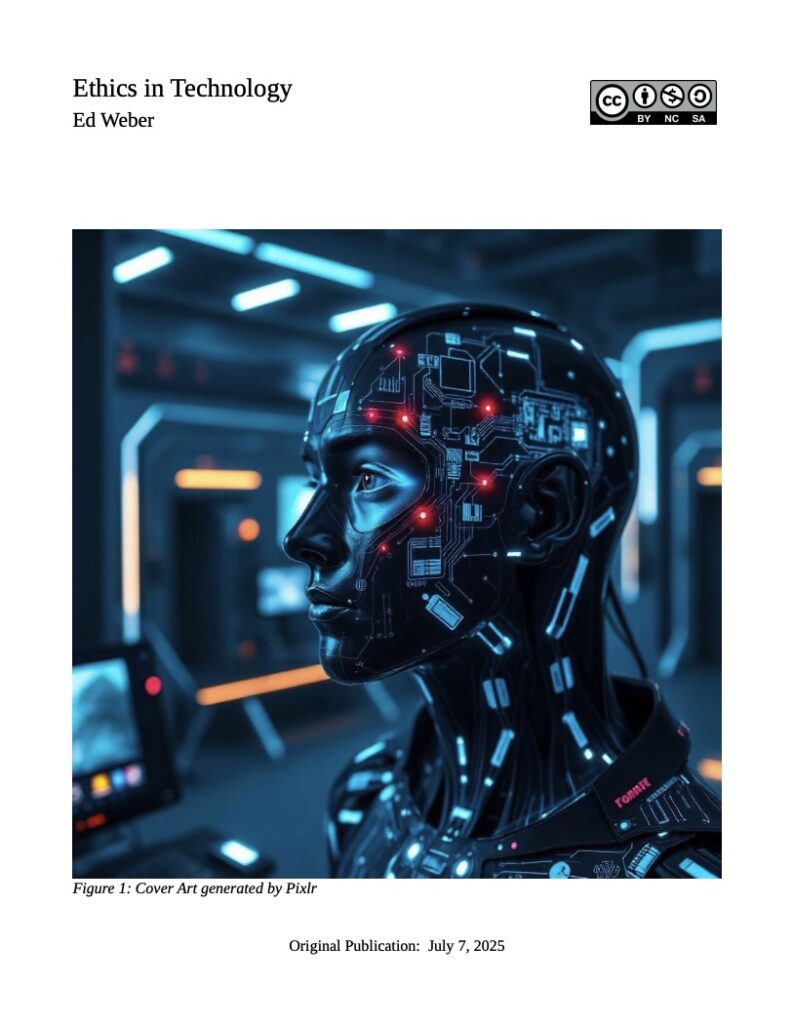
Ethics in Technology
Not rated yetRate this bookEd Weber’s Ethics in Technology uses discussion and contemporary cases to help learners examine the ethical dimensions of developing, adopting, and using technology.
Free reading is available at the official source. Opens in a new tab.
 Free
About this book
The PDF records an original publication date of July 7, 2025. Weber designed the resource for secondary and postsecondary learning, emphasizing practical ethical reflection rather than a comprehensive history of moral philosophy.
Its thirteen chapters address foundational terms and perspectives before examining developers and users, security, equity, privacy, communication, intellectual property, artificial intelligence, bioethics, and technological change. The preface encourages instructors to keep case discussions responsive to changing circumstances.
Book summary
Chapter-by-chapter summaries
1. Preface
Weber introduces the book as a starting point for ethical discussion about technology, rather than a comprehensive history of ethics or a collection of definitive answers. The intended setting includes secondary and postsecondary learning. Contemporary cases are meant to prompt examination of choices made by developers, organizations, and users. Because technologies and examples change, the preface encourages readers and instructors to keep the discussion responsive to new circumstances. Its organizing purpose is the cultivation of ethical attention before a difficult decision is already underway.
2. Ethical Frameworks and Personal Lenses
The second chapter introduces ethical perspectives and the experiences that shape an individual’s judgments. Weber describes these influences as personal lenses. Recognizing them can help explain why people interpret the same situation differently, but imagining another person’s experience is not equivalent to understanding it. Communication and active listening become part of ethical reasoning. The chapter also sketches philosophical approaches that can illuminate different aspects of technology decisions. These provide starting points for discussion rather than a mechanical method that produces the same answer regardless of context.
3. Defining Ethics and Related Terminology
This chapter examines the vocabulary needed for a meaningful ethical conversation. A disagreement may involve different definitions as well as competing values, so clarity about terms is a substantive part of the work. Weber distinguishes ethical evaluation from legality and introduces concepts related to harm, fairness, responsibility, and critical thinking. The chapter uses illustrative material to show how assumptions and biases can influence a response before they are recognized. Its aim is to make the basis of a judgment discussable, allowing participants to identify whether they disagree about facts, meanings, principles, or priorities.
4. Developers and Consumers
Ethical responsibility extends across the creation and use of technology. Consumers make choices about participation, information, and the effects of their behavior, while professionals work within organizational structures that can create competing pressures. Codes of conduct and workplace scenarios bring these responsibilities into concrete situations. The chapter asks what happens when a requested action conflicts with a person’s understanding of good practice. It also connects everyday use with larger systems, showing that ethical questions do not belong only to programmers or senior decision-makers. Responsibility must be examined in relation to a person’s role and available choices.
5. Cybersecurity, Hacking, and Digital Identity
Security becomes an ethical subject when vulnerabilities, access, and information affect other people. The chapter examines hacking alongside the responsibilities involved in discovering, protecting, or exploiting weaknesses. Digital identity and online reputation extend the discussion beyond technical systems to the traces people create and the judgments made from them. Privacy, self-presentation, and trust interact rather than forming isolated issues. Weber’s approach asks readers to consider the consequences of an action for users and communities, not merely whether an action is technically possible or personally advantageous.
6. Justice and Social Equity
Technology can widen access to education, healthcare, and participation, yet its benefits are not distributed automatically. Devices, connectivity, accessibility, skills, and institutional decisions influence who can use a service and on what terms. The chapter examines the digital divide alongside questions of inclusion and human needs. An innovation that is convenient for one group may create a new barrier for another. Its ethical task is therefore to identify the people excluded by an apparently ordinary design choice. The discussion connects equity with the practical conditions under which technology becomes useful.
7. Personal and Social Life
Digital tools shape relationships, leisure, identity, and habits. This chapter considers the opportunities for connection alongside questions about autonomy, tracking, boundaries, and patterns of engagement that people find difficult to control. Digital minimalism is discussed as intentional use rather than an automatic rejection of technology. The examples invite readers to examine whether a tool serves an activity they value or increasingly determines that activity for them. Personal choices also have interpersonal consequences, so the discussion links individual well-being with the expectations and pressures created within social relationships.
8. Privacy, Surveillance, and Data Ethics
The privacy chapter asks how information is collected, interpreted, stored, and controlled. Consent is important, but its meaning becomes complicated when data practices are extensive or difficult to understand. Surveillance, smart-city systems, cloud services, and ownership questions show how the benefits of coordinated information can conflict with autonomy and confidentiality. The chapter encourages attention to the distribution of power: those supplying data may have less control than the organizations processing it. Ethical evaluation must therefore consider purposes, access, accountability, and consequences across the information lifecycle.
9. Digital Communication and Democracy
Communication platforms influence which ideas travel, whom people trust, and how public disagreements develop. Weber examines misinformation, manipulated media, harassment, influencer activity, and the difficult boundary questions surrounding expression. The chapter connects these topics with the responsibilities of both institutions and participants. The speed and reach of digital circulation can amplify a mistake or deliberate distortion, making credibility and media literacy central concerns. Its purpose is not to settle every dispute over acceptable speech, but to make the competing values and the effects of platform-mediated communication visible.
10. Intellectual Property and Digital Economies
The tenth chapter considers the tension between rewarding creators and allowing society to benefit from knowledge and culture. Copyright, patents, and trade secrets provide different forms of control, while digital production and copying complicate their ethical interpretation. Generative tools, digital art, blockchain, and cryptocurrency introduce additional questions about authorship, ownership, provenance, and economic value. The chapter treats these developments as subjects for ethical scrutiny rather than assuming that a technical mechanism resolves a dispute. Readers are asked to examine whose contribution is recognized and whose interests a system protects.
11. Artificial Intelligence, Automation, and Robotics
Automation changes the distribution of work, authority, and responsibility. This chapter examines artificial intelligence through questions about its capacities, the data and objectives that shape it, and the decisions people allow it to influence. Autonomous vehicles, chatbots, robotics, algorithmic bias, and predictive policing provide different settings for considering oversight and accountability. A system’s performance cannot be separated from the domain in which it is applied or the people affected by its errors. Weber’s discussion highlights the ethical choices embedded in development and deployment, rather than presenting automation as an independent force with inevitable consequences.
12. Bioethics and Human Enhancement
The bioethics chapter considers technologies that intervene in bodies, biological processes, and human capacities. Genetic engineering, augmentation, brain-computer interfaces, biotechnology, and cloning raise questions about consent, access, identity, and acceptable purposes. A distinction between treating a limitation and enhancing a capacity can become difficult to maintain in practice. The chapter asks readers to consider who benefits, who may face pressure to participate, and how unequal access could affect social relationships. These are ethical questions about possible uses and implications, not a set of clinical instructions.
13. Disruption and the Paradox of Progress
The concluding chapter examines why advances can bring benefits while destabilizing established livelihoods, systems, and expectations. Planned and inevitable obsolescence, technological lock-in, immersive media, and new production methods illustrate different dimensions of disruption. A development may increase capability without distributing its gains fairly or preserving long-term sustainability. Weber returns to the need for deliberate judgment: enthusiasm for novelty and resistance to change can each obscure important consequences. The chapter closes by treating progress as something to evaluate through its effects, rather than a label that automatically settles an ethical argument.
Study instructions
- Choose a specific technology decision and describe who makes it, who uses the technology, and who may experience its consequences.
- Write an initial judgment, then identify the assumptions and experiences that influenced it. Separate factual claims from value judgments.
- Seek a perspective you have not represented. Formulate a question for someone affected rather than assuming you can infer their experience.
- Revise your analysis by stating the competing considerations and the evidence still needed. Date any contemporary case material and distinguish the book’s examples from developments checked independently.
Study across the full book
- Create a case-analysis sheet identifying the technology, affected parties, competing values, benefits, burdens, and uncertainties. Apply two frameworks from the opening chapters and explain where their reasoning produces different judgments.
- Compare the responsibilities of developers and consumers across the security, equity, privacy, and communication chapters. Distinguish an individual choice from a platform or institutional decision that changes other people's options.
- For the later AI, bioethics, and progress chapters, propose a practical course of action and test it against an objection. Attribute historical cases to the book's publication period and separate ethical reasoning from unsupported predictions about technical capabilities.
Questions for reflection
- How can two people agree about a technical capability yet disagree about its use?
- What would meaningful engagement with another person’s perspective require beyond imagining their experience?
Sources and coverage
These original summaries draw on chapter introductions, selected explanatory passages, examples, and concluding material across the chapters or units listed above. They are a condensed study guide, rather than a page-by-page account of the complete text. Supplementary sections are identified separately.
About access & copyright
This page provides book information and study material. Full-text access is provided by the original publisher or authorised source; a listing does not grant permission to republish the book.
Read our Library Access & Copyright policyReflective judgment
Identify assumptions behind an ethical response.
Shared language
Clarify important terms before debating a decision.
Affected perspectives
Ground discussion in the people who experience consequences.
Reader ratings & reviews
Share your thoughts
Your review helps other students choose the right resources.
KEEP LEARNING
Your next great read
Engineering & Technology Social Sciences
Psychology 2e
View Psychology 2e — book Business
Principles of Microeconomics 3e
View Principles of Microeconomics 3e — book Business
Principles of Macroeconomics 3e
View Principles of Macroeconomics 3e — book Social Sciences
Lifespan Development
View Lifespan Development — book Social Sciences
Introduction to Sociology 3e
View Introduction to Sociology 3e — book Social Sciences
Introduction to Political Science
View Introduction to Political Science — book Social Sciences
Introduction to Anthropology
View Introduction to Anthropology — book Psychology
Introduction to Psychology (University of Minnesota, 2015 Edition)
View Introduction to Psychology (University of Minnesota, 2015 Edition) — book Political Science



