
 Social Sciences
Textbook
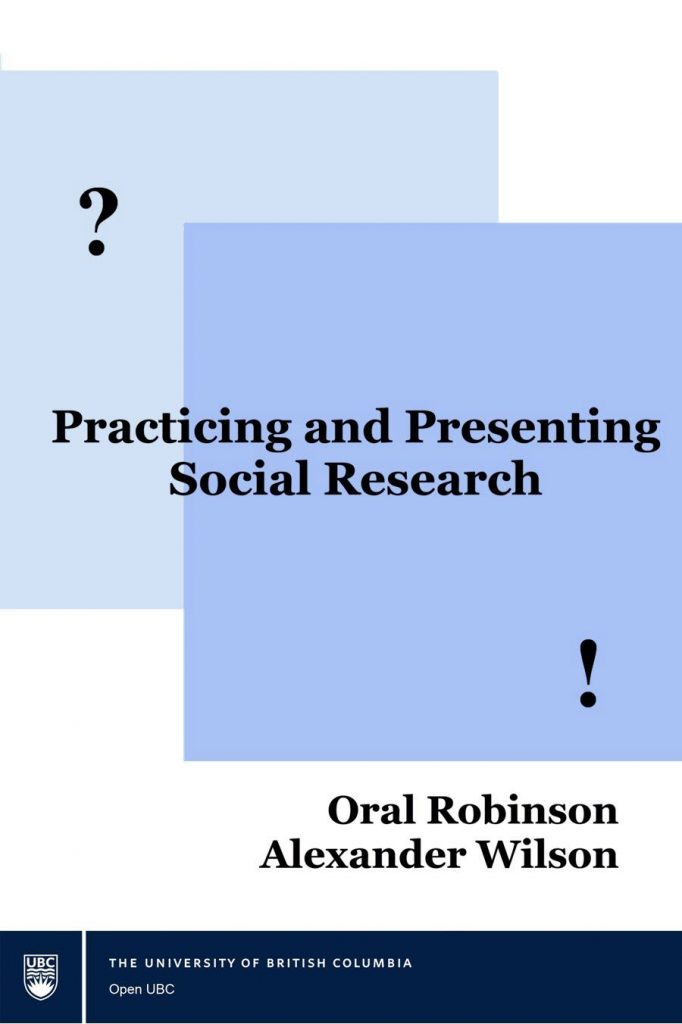
Practicing and Presenting Social Research
Not rated yetRate this bookOral Robinson and Alexander Wilson’s manual supports undergraduate researchers from developing a question to communicating findings. Its opening treats research writing as a learnable practice supported by reflection, planning, and feedback.
Free reading is available at the official source. Opens in a new tab.
 Free
About this book
Practicing and Presenting Social Research follows a student project from an initial idea through research design, ethical review, analysis, writing, presentation, and publication. Robinson and Wilson combine practical worksheets with reflection on positionality, relationships, and researcher well-being. Its thirteen main parts function as a sequence of research chapters. The summaries below explain the decisions each part develops and how those decisions affect the credibility of the final account, rather than treating the book as a checklist of disconnected writing tasks.
The detailed guide below follows the book’s chapter, unit, or section structure. Read it alongside the study instructions and the complete official text.
Book summary
Chapter-by-chapter summaries
Part I: Generating and Developing Original Research Ideas
A research question begins with a relationship between the researcher, a social problem, and existing knowledge. The opening part asks students to consider their motivations and positionality rather than assume that personal experience either guarantees expertise or disqualifies inquiry. Reflexivity makes the influence of perspective visible, while relational accountability directs attention to obligations toward the people and communities involved. A broad interest must become a question that can be answered with accessible evidence in the available time. The chapter evaluates significance, feasibility, clarity, and analytical depth. Its worksheets help students move from a universe of possible topics toward a focused investigation whose contribution can be explained.
Part II: Developing a Research Proposal
The proposal is an argument that a specific project is worthwhile and practicable. Its introduction establishes the question and context; its engagement with scholarship shows how the study relates to what is already known; its methods explain what evidence will be obtained and how it will answer the question. An abstract compresses that logic without replacing it. A timeline forces the researcher to account for access, review, collection, analysis, and revision instead of budgeting only for writing. The chapter's central standard is alignment: a compelling question cannot rescue a design that cannot address it, and a sophisticated technique is unhelpful when it serves a different question.
Part III: Ethics Review
Ethical review requires translating a research plan into an account of how people will be recruited, informed, treated, and protected. The chapter helps readers decide when institutional review is relevant and work through the application process. Consent, capacity, confidentiality, possible harms, benefits, access permissions, and the handling of research materials require concrete answers. Ethics is therefore part of design, rather than a form submitted after the important decisions have been made. The chapter also asks researchers to explain the project's social value in terms that participants and reviewers can understand. Its institutional examples should be read alongside the requirements of the student's own university and research setting.
Part IV: Researching with Self-Care
Research progresses through sustained work under uncertainty, making well-being relevant to project quality. The chapter distinguishes self-care from avoidance and connects realistic time management with manageable writing routines. Rituals can reduce the friction of beginning work, while mindfulness and reflection help students recognize stress rather than simply extend working hours. Supervisory relationships benefit from explicit expectations, prepared meetings, and constructive responses to feedback. Peer support counters isolation and offers opportunities to discuss common difficulties, including imposter feelings. The practical lesson is to build a workable research process around actual human capacity; a schedule that assumes unlimited concentration and no setbacks is a weak project plan.
Part V: Academic Writing
Academic writing turns research into an intelligible, evidence-based argument for a particular audience. The chapter treats clarity, organization, concision, and genre as connected decisions. Different disciplines and kinds of thesis may organize claims differently, but readers still need to understand what a paragraph contributes and how its evidence supports its point. Selecting quotations and examples already involves interpretation: evidence never arrives on the page without choices about framing and context. The chapter encourages writing that makes those choices defensible rather than disguising them. Revision therefore addresses the structure of reasoning and the adequacy of support, as well as sentence-level correctness and scholarly style.
Part VI: The Literature Review
A literature review synthesizes a conversation rather than listing one source after another. Searching, selecting, reading, and organizing studies help identify patterns, disagreements, theoretical approaches, and gaps relevant to the question. The chapter asks readers to track what each source investigates, how it investigates it, what it concludes, and how it relates to other work. The review becomes the foundation for justifying a new inquiry and interpreting its eventual findings. Accurate citation and careful notes keep paraphrase separate from quotation and preserve the origin of ideas. A strong review explains why the chosen literature matters to the project's argument instead of merely demonstrating that many publications were consulted.
Part VII: Writing the Methods Section
The methods section explains both what was done and why those choices suit the inquiry. It describes the research setting, participants or materials, sampling, recruitment, data collection, and analytical procedures with enough specificity for readers to evaluate the evidence. The chapter distinguishes reporting a method from merely naming it: an interview study, for example, still requires an explanation of whom the researcher interviewed, what topics were explored, and how the material was interpreted. Ethical considerations and practical modifications belong in the account when they shape the data. The resulting section should connect the research question to the actual process, including limitations that affect what the findings can support.
Part VIII: Data Collection
Data quality is built during collection, not repaired entirely afterward. This part compares primary and secondary sources and examines sampling, access, recording, and organization. Primary research offers control over what is asked or observed but introduces practical and ethical demands; secondary data can broaden the project while constraining available variables and definitions. The discussion also recognizes theoretical theses, essays, and systematic literature reviews as approaches with their own evidence-selection responsibilities. Organized files, consistent labels, and documentation reduce avoidable uncertainty. When the available material is incomplete or poorly matched to the original question, the researcher must reconsider the design or scope instead of silently treating the data as ideal.
Part IX: Qualitative Data Analysis
Qualitative analysis moves between detailed material and an emerging explanation. Transcription and coding help the researcher become familiar with the data and identify recurring concepts, contrasts, and relationships. The chapter discusses ways to develop and present themes without reducing participants' accounts to isolated quotations. Describing the sample or sources establishes the context in which interpretations were formed. Quotations should be selected and introduced to demonstrate an analytical claim, with enough context to avoid misleading the reader. Mapping and storylining can connect categories into a coherent account of the phenomenon. The outcome is a reasoned interpretation whose connection to the evidence remains visible, including variation that complicates a simple narrative.
Part X: Quantitative Data Analysis
Quantitative analysis begins with cleaning data and establishing procedures that fit the variables and research design. Descriptive statistics characterize the sample; inferential techniques address questions about differences and associations while acknowledging uncertainty. The chapter illustrates how to present outputs from methods such as group comparisons, association tests, and regression in usable prose and tables. A software table is not itself a research finding: the writer must identify the relevant statistic, explain its meaning, and relate it to the question. Secondary datasets require attention to original definitions and collection procedures. Statistical significance should be interpreted alongside effect size, sample characteristics, and the limits of the design rather than equated with social importance.
Part XI: Writing the Discussion and Conclusion
The discussion explains what the results contribute to the problem introduced at the beginning. It reconnects findings with the literature, considers theoretical and practical implications, and distinguishes supported interpretations from speculation. Unexpected results can refine the explanation rather than simply being omitted. Limitations should identify how particular design or data constraints affect the conclusions, making them analytically useful instead of ceremonial admissions. Recommendations for future research follow from unresolved questions and those limitations. The conclusion then articulates the central contribution succinctly, answering the research question at the level the evidence permits. Repeating every result is less effective than explaining the significance of the overall argument.
Part XII: Presenting Your Research
Presenting requires adapting a research argument to a medium, audience, and time limit. Oral talks and posters need a clear route from the problem and question to methods, principal findings, and implications. The chapter emphasizes selection: a short presentation cannot reproduce every detail of a thesis, but it must retain enough evidence for the audience to assess the main claim. Visuals should clarify relationships or results and be readable at the scale of use. Rehearsal helps control timing and transitions, while preparation for questions strengthens the presenter's understanding of choices and limitations. Dissemination is treated as part of research because an inaccessible account limits who can learn from the work.
Part XIII: Publishing Your Research
Publication asks the researcher to reshape a project for a journal's audience, scope, and conventions. The chapter discusses finding suitable venues, adapting a manuscript, and responding to editorial and reviewer feedback. A thesis chapter usually needs substantial revision before it functions as an independent article: the question, contribution, and evidence must be clear without the surrounding dissertation. Submission requirements, citation practices, authorship arrangements, and publication credibility deserve attention before sending the manuscript. Reviewer comments are material for a reasoned revision process rather than a demand to accept every suggestion uncritically. The final lesson is that research communication continues after the first complete draft, through revision and participation in a scholarly conversation.
Study instructions
Write a question, explain why it matters, and identify the kind of evidence needed to answer it. Compare that requirement with what is feasible within your time and setting. Record your assumptions and your position in relation to the topic.
Use the manual’s project sequence to make milestones, but consult the full source and institutional requirements for ethics and methods. Return to the question when revising a proposal or report, checking that each section contributes to the inquiry.
Full-book practice and review: Build a research portfolio that follows the thirteen parts from a question to a proposal, ethics review, collection plan, analysis, discussion, and presentation. Explain how the question constrains the method and how practical or ethical limits may require revision. Use the self-care section when planning the work. Before proposing publication, distinguish the evidence obtained from broader claims the design cannot support.
Questions for reflection
- What evidence would answer the question?
- Which design decision must be made before collecting information?
- How will the intended audience understand the contribution?
The study suggestions and questions are independent Academic Master editorial material.
Sources and coverage
These original summaries draw on the source text, including chapter or section introductions and selected explanations, examples, exercises, and review material. They are condensed study guides, not a page-by-page account or a replacement for the complete resource. Additional synthesis sections are identified separately.
About access & copyright
This page provides book information and study material. Full-text access is provided by the original publisher or authorised source; a listing does not grant permission to republish the book.
Read our Library Access & Copyright policyCoherence
Connect question, design, and evidence.
Planning
Match scope to a realistic project.
Writing
Treat communication as a developing practice.
Reflection
Make assumptions and positionality visible.
Reader ratings & reviews
Share your thoughts
Your review helps other students choose the right resources.
KEEP LEARNING
Your next great read
Social Sciences Business
Principles of Microeconomics 3e
View Principles of Microeconomics 3e — book Business
Principles of Macroeconomics 3e
View Principles of Macroeconomics 3e — book Social Sciences
Lifespan Development
View Lifespan Development — book Social Sciences
Introduction to Sociology 3e
View Introduction to Sociology 3e — book Social Sciences
Introduction to Political Science
View Introduction to Political Science — book Social Sciences
Introduction to Anthropology
View Introduction to Anthropology — book Psychology
Interpersonal Communication: A Mindful Approach to Relationships
View Interpersonal Communication: A Mindful Approach to Relationships — book Psychology
Introduction to Psychology (University of Minnesota, 2015 Edition)
View Introduction to Psychology (University of Minnesota, 2015 Edition) — book Political Science



