
 Humanities
Textbook
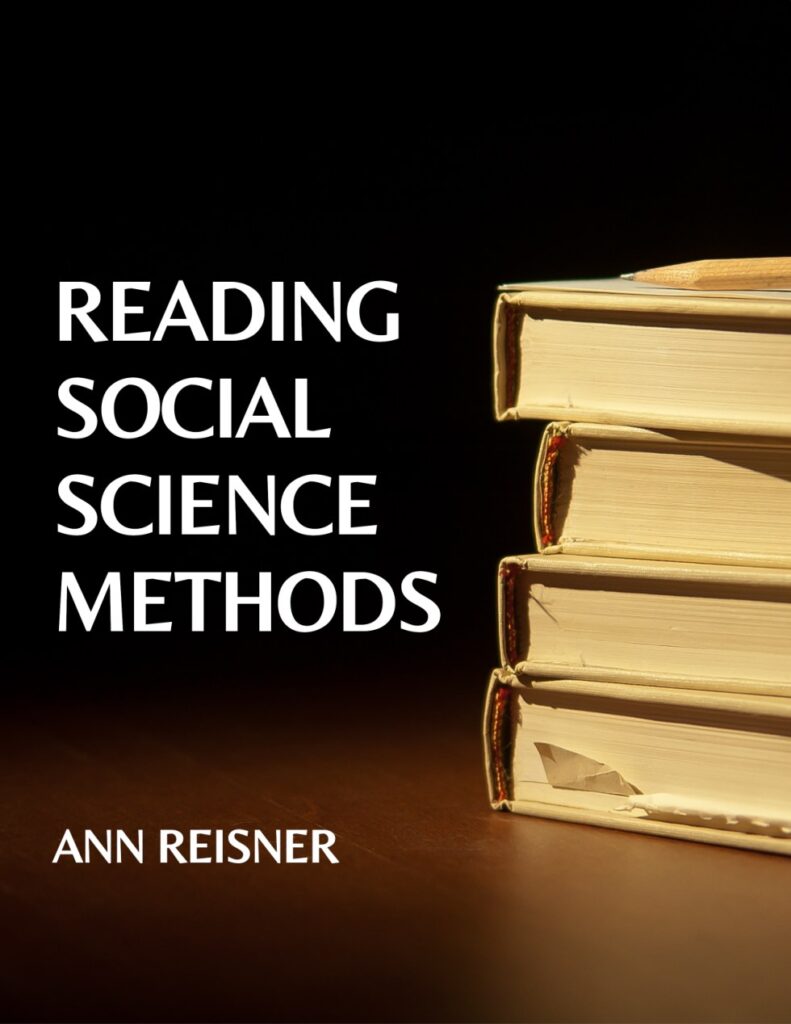
Reading Social Science Methods
Not rated yetRate this bookAnn Reisner teaches readers how to evaluate social-science evidence. The book organizes research appraisal around the relationship between a question, a method, the people or materials studied, and the conclusions that the evidence can support.
Free reading is available at the official source. Opens in a new tab.
 Free
About this book
About this book
Reading Social Science Methods was published by Windsor & Downs Press in 2023 for introductory students in the social sciences and humanities. Its central educational task is informed reading of research, rather than requiring every reader to conduct an original study.
Five parts introduce research judgment, surveys, content analysis, experiments, and the synthesis of findings. The opening chapter connects research literacy with everyday decisions. The first survey rule then asks whether questioning respondents is an appropriate way to investigate the proposed question.
Book summary
Guide to the reviewed material
Reisner’s opening makes the quality of evidence a condition for deciding how much weight to give a finding. The first survey lesson focuses on fit: respondents must be able and willing to supply the information sought. A question about a population also requires scrutiny of whom the researchers actually approached.
Study instructions
- Choose one published survey article and restate its research question in a single sentence before reading its conclusions.
- Record the intended population, the participants actually questioned, and the information each survey item could reasonably obtain.
- Apply the first judgment rule: explain whether the desired information is accessible through respondents’ answers. Distinguish what people report from independently observed behavior.
- Write a short appraisal with two separate decisions: whether the method fits the question and how broadly the result can be interpreted. Use the later method-specific chapters to extend the appraisal.
Questions for reflection
- Could the same questionnaire be suitable for one research question and unsuitable for another?
- What additional evidence would justify extending a finding beyond the people studied?
Sources and coverage
Reviewed publication details, contents, the opening introduction (PDF pages 8–10), and the first survey judgment rule (PDF pages 22–24). Other parts are identified from the contents and are not individually summarized.
About access & copyright
This page provides book information and study material. Full-text access is provided by the original publisher or authorised source; a listing does not grant permission to republish the book.
Read our Library Access & Copyright policyMethod fit
Match a research question to the evidence a survey can supply.
Population claims
Compare the intended group with the participants reached.
Critical appraisal
Give reasons for accepting or limiting a research conclusion.
Reader ratings & reviews
Share your thoughts
Your review helps other students choose the right resources.
KEEP LEARNING
Your next great read
Humanities Humanities
French OER 1
View French OER 1 — book Humanities
French OER 2
View French OER 2 — book Engineering & Technology
Ethics in Technology
View Ethics in Technology — book Curriculum & Instruction
Using Open Educational Resources to Promote Social Justice
View Using Open Educational Resources to Promote Social Justice — book Curriculum & Instruction
Intersections of Open Educational Resources and Information Literacy
View Intersections of Open Educational Resources and Information Literacy — book Social Sciences
Practicing and Presenting Social Research
View Practicing and Presenting Social Research — book Political Science
Introduction to Comparative Government and Politics
View Introduction to Comparative Government and Politics — book Humanities
Elementary Swahili: Lugha na Utamaduni
View Elementary Swahili: Lugha na Utamaduni — book Social Sciences



