
Game Based and Adaptive Learning Strategies
Curriculum & InstructionTextbook
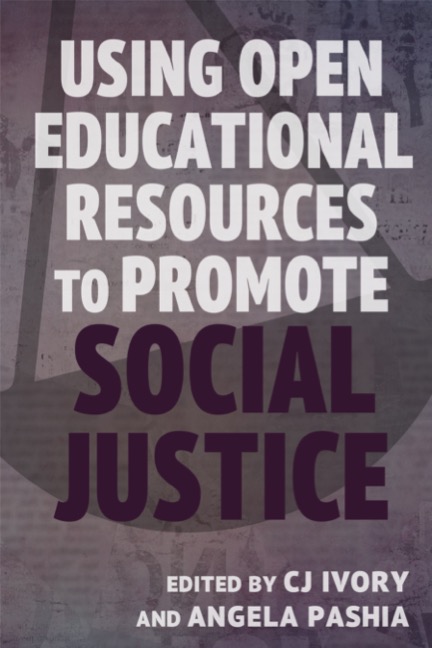
Using Open Educational Resources to Promote Social Justice
Not rated yetRate this bookThis edited collection considers how open educational resources can support social justice beyond reducing textbook costs. Its introduction connects openness with authorship, curriculum, representation, and institutional practice.
Free reading is available at the official source. Opens in a new tab.
 Free
About this book
About this book
CJ Ivory and Angela Pashia edited this 2022 Association of College and Research Libraries collection. The introduction explains that their collaboration grew from work combining open education and social-justice concerns. The contents include theoretical questions, practical accounts, and institutional experiences. Contributors retain distinct perspectives and, as the editors explain, may select different licences for their work. This page reviews the editors’ introductory framing; it does not treat the entire collection as one argument or assume every contribution has identical reuse terms.
Sources and reading coverage
Title, copyright, contents, and selected introduction passages on PDF sheets 6–7 were reviewed. Later chapters and case studies were not comprehensively assessed.
Consult the official source for the available edition and publication details.
The consulted PDF contains 323 sheets, including preliminary material. PDF sheet numbers can differ from printed pagination.
Book summary
Guide to the reviewed opening
The editors describe becoming interested in a wider purpose for OER than affordability alone. Their account of a publication agreement also connects the subject of openness with the practical conditions under which academic work is published.
The introduction locates part of their own route within critical race theory while acknowledging that this is one aspect of a broader social-justice field. That distinction matters: the editors’ starting point is not presented as an exhaustive account of every contributor’s concern.
The resulting learning question is how educational resources are made, whose knowledge they represent, and which practices accompany their use. The later chapters need direct reading for their particular claims and evidence. This guide remains with the introductory purpose and the collection’s multi-author structure.
How to study this book
When reading a contribution, separate its definition of a problem, its proposed practice, and the evidence for the connection between them. Note whose experience is represented and whose perspective may be missing.
Compare a resource’s accessibility and cost with questions about participation, representation, and authorship. Check the licence of the specific chapter or asset before reuse, rather than assuming one permission statement covers the whole collection.
Questions for reflection
- How does a resource’s openness differ from its price?
- Whose knowledge is represented in a proposed curriculum change?
- What evidence supports a claim about educational justice?
The study suggestions and questions are independent Academic Master editorial material.
About access & copyright
This page provides book information and study material. Full-text access is provided by the original publisher or authorised source; a listing does not grant permission to republish the book.
Read our Library Access & Copyright policyScope
Examine openness beyond affordability.
Attribution
Keep contributors’ arguments distinct.
Representation
Ask whose experiences inform a resource.
Practice
Connect a proposed change with evidence.
Reader ratings & reviews
Share your thoughts
Your review helps other students choose the right resources.
KEEP LEARNING
Your next great read
Computer Science
 Humanities
Reading Social Science Methods
View Reading Social Science Methods — book Engineering & Technology
Ethics in Technology
View Ethics in Technology — book Curriculum & Instruction
The Asynchronous Cookbook
View The Asynchronous Cookbook — book Curriculum & Instruction
Technology in Schools
View Technology in Schools — book Curriculum & Instruction
Intersections of Open Educational Resources and Information Literacy
View Intersections of Open Educational Resources and Information Literacy — book Social Sciences
Practicing and Presenting Social Research
View Practicing and Presenting Social Research — book Political Science
Introduction to Comparative Government and Politics
View Introduction to Comparative Government and Politics — book Library Science and Museum Studies
Scholarly Communication Librarianship and Open Knowledge
View Scholarly Communication Librarianship and Open Knowledge — book Curriculum & Instruction



