
Game Based and Adaptive Learning Strategies
Computer ScienceTextbook
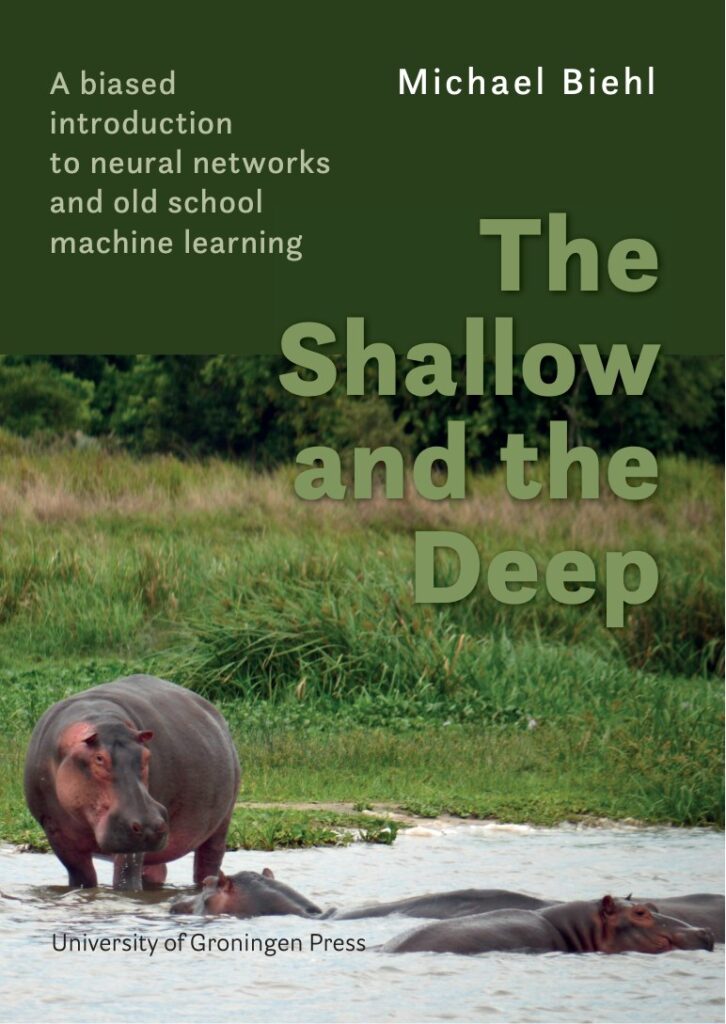
The Shallow and the Deep: A biased introduction to neural networks and old school machine learning
Not rated yetRate this bookMichael Biehl’s lecture notes develop the mathematical foundations of neural networks and classical machine learning. The emphasis is on supervised learning, especially classification, rather than an encyclopedic account of recent artificial-intelligence applications.
Free reading is available at the official source. Opens in a new tab.
 Free
About this book
About this book
Published by the University of Groningen Press in 2023, this book grew from postgraduate teaching in neural networks and computational intelligence. Biehl explains the deliberate selectivity of his approach: understanding relatively simple models can reveal principles that are obscured when learners begin with ready-made software.
The verified contents move from biological inspiration and learning scenarios to perceptrons, nonlinear classifiers, feed-forward networks, distance-based methods, model evaluation, and preprocessing. An optimization appendix supports the mathematical development. This guide concentrates on the preface and the opening discussion of the relationship between biological and artificial networks.
Book summary
Chapter-by-chapter summaries
1. From neurons to networks
Biehl begins with the biological inspiration behind artificial neural networks while emphasizing that an engineering model is not a detailed reconstruction of a brain. Neurons, synaptic interactions, and firing-rate descriptions provide a vocabulary for thinking about adaptable information processing. Activation functions translate combined inputs into a unit’s response, while changes in connections provide a mathematical representation of learning. Hebbian ideas connect simultaneous activity with strengthened interactions. The discussion then distinguishes recurrent arrangements, including attractor networks, from layered feed-forward architectures. These arrangements differ in how information travels and whether the system maintains an evolving internal state. The chapter establishes a recurring principle: a model should retain the features useful for its task, and its simplifying assumptions should remain visible.
2. Learning from example data
The second chapter organizes machine learning by the information available during training. Supervised learning uses examples paired with desired responses, supporting classification and numerical prediction. Unsupervised learning investigates unlabelled observations without a teacher supplying the correct answer for each case. This distinction changes both the learning objective and the way success can be assessed. Biehl also examines the relationship between machine learning and statistical modelling through regression and related examples. The approaches often construct similar mathematical objects even when their traditions or preferred explanations differ. Rather than treating the fields as competitors, the chapter argues for understanding their complementary contributions. The important questions concern assumptions, the information extracted from observations, and performance beyond the particular data used for fitting.
3. The Perceptron
The perceptron provides a deliberately simple setting for examining classification. A weighted combination of inputs is compared with a threshold, creating a linear boundary between two classes. This geometry makes linear separability the central condition behind the classical learning problem. Training rules change the weights when examples are misclassified, and the convergence discussion explains why successful fitting depends on the assumptions about the data. The chapter develops distinctions between storing observed labels and learning a rule that generalizes. Version-space reasoning describes the hypotheses compatible with examples, while stability and margin concepts distinguish among classifiers that all fit the training set. Connections with Adaline, AdaTron, and support vectors show how a basic model leads into broader optimization ideas. Its limitations become a resource for understanding more elaborate classifiers.
4. Beyond linear separability
Real observations may contain incorrect labels, corrupted measurements, or class boundaries that a single hyperplane cannot represent. This chapter therefore revisits the clean assumptions used in the perceptron analysis. Allowing classification errors changes the optimization problem; soft-margin approaches balance fitting with a preference for a robust boundary. Combining perceptron-like units introduces more expressive decision rules, but additional capacity also raises questions about complexity and learning. Support vector machines provide another route by representing nonlinear relationships through transformed features and kernels. The kernel construction connects a manageable computation with a potentially richer feature space. Biehl’s discussion keeps the choice of representation, optimization procedure, and control parameters in view. A more flexible method is useful only when its assumptions and practical consequences suit the problem.
5. Feed-forward networks for regression and classification
Layered networks with differentiable units can represent nonlinear relationships between inputs and outputs. The chapter explains their architecture and their role as function approximators, then turns from representational ability to the separate problem of learning suitable parameters. Backpropagation efficiently calculates derivatives needed by gradient-based training. Batch and stochastic procedures use those derivatives differently, and practical choices influence the optimization path. Cost functions must fit the task: predicting a numerical quantity and assigning class probabilities require different interpretations of error. Activation functions also affect what individual units can express and how a network is trained. The final discussion places shallow, deep, and convolutional arrangements in this broader framework. Expressive power alone does not guarantee effective learning or a clear explanation of why a trained system works.
6. Distance-based classifiers
This chapter classifies observations by comparing them with labelled examples or representative prototypes. Such systems offer a relatively transparent account of a decision: a new observation resembles one representative more closely than another. Learning Vector Quantization adapts prototype positions using training data rather than retaining every observation unchanged. The comparison itself is an important modelling decision. Euclidean distance can be convenient, but it may give inappropriate influence to certain features or fail to describe relevant similarity. Relevance learning and adaptive distance measures address that problem by changing how the feature space is evaluated. Biehl relates these methods to wider prototype-based learning while maintaining a distinction between supervised classification and unsupervised grouping. Interpretability depends on meaningful representatives and comparisons, not simply on using the word ‘distance’.
7. Model evaluation and regularization
Training performance is an incomplete measure of a learning system because the intended use involves new observations. Biehl examines underfitting, overfitting, bias, and variation across training samples to explain why increasingly flexible models do not automatically produce dependable predictions. Regularization techniques constrain effective complexity through mechanisms such as weight penalties, early stopping, pruning, shared weights, and dropout. Cross-validation separates model selection from an overly optimistic reading of training results. Evaluation also requires a metric appropriate to the question: overall accuracy may conceal important differences in class-specific errors. The discussion includes regression measures, classification measures, and receiver-operating-characteristic analysis. The chapter closes the distance between mathematical training objectives and practical judgment by emphasizing validation, interpretation, and the consequences of different errors.
8. Preprocessing and unsupervised learning
The final main chapter challenges the assumption that a useful dataset arrives ready for an algorithm. Inconsistent records, missing values, scaling differences, and unusual observations all require considered decisions. Cleaning should be reproducible and informed by the application, rather than adjusted to produce a preferred result. Normalization and transformations change the geometry seen by later methods. Dimensionality reduction, principal-component analysis, and related approaches seek more manageable representations, while clustering and vector quantization describe structure without supplied class labels. Density estimation and mixture models provide another way to characterize observations. The chapter also addresses imputation, sampling imbalance, and augmentation. These steps can materially influence the eventual findings, so they belong to the model’s evidential story rather than being treated as neutral housekeeping.
Appendix A. Optimization
The appendix supplies mathematical support for the learning procedures used throughout the book. Multivariable Taylor expansions connect local behavior with gradients and second derivatives, helping distinguish minima, maxima, and saddle points. Constrained problems introduce the additional conditions that a feasible solution must satisfy. Gradient-based methods then provide practical procedures for changing parameters in a direction intended to improve an objective. Variants include coordinate-based and stochastic approaches. The appendix is best understood as a bridge between a learning rule and the optimization problem it represents. It also signals that its presentation assumes suitable smoothness and other mathematical conditions, directing readers to more rigorous treatments when those conditions require closer examination.
Study instructions
- Begin by writing down the problem a model is meant to solve. Separate the input representation, the desired output, and the rule used to adapt the system.
- When a biological analogy appears, identify which feature the artificial model retains and which details it omits. Explain why that simplification might suit a particular task.
- Keep a derivation notebook as you continue into the technical chapters. Define every symbol, state assumptions before manipulating an equation, and test the result on a small example.
- Use the contents to plan a later route through evaluation and optimization. Distinguish topics announced there from arguments you have already worked through.
Questions for reflection
- What would be lost if an artificial network were judged only by its resemblance to a biological neuron?
- Why might a simpler classifier be useful for understanding a more elaborate system?
Sources and coverage
These original summaries draw on chapter introductions, selected explanatory passages, examples, and concluding material across the chapters or units listed above. They are a condensed study guide, rather than a page-by-page account of the complete text. Supplementary sections are identified separately.
About access & copyright
This page provides book information and study material. Full-text access is provided by the original publisher or authorised source; a listing does not grant permission to republish the book.
Read our Library Access & Copyright policyModel purpose
Relate an abstraction to the task it is designed to address.
Foundational understanding
Explain the book’s emphasis on classical supervised learning.
Mathematical reading
Track assumptions and notation before applying an algorithm.
Reader ratings & reviews
Share your thoughts
Your review helps other students choose the right resources.
KEEP LEARNING
Your next great read
Computer Science
Computer Systems Security: Planning for Success
Computer Systems Security: Planning for Success
View Computer Systems Security: Planning for Success — book Computer Science
Pro Git: Everything You Need to Know About Git (English)
View Pro Git: Everything You Need to Know About Git (English) — book Computer Science
Building User Interfaces for Modern Web Applications: React Programming
View Building User Interfaces for Modern Web Applications: React Programming — book Computer Science
Introduction to Data Science Using Python
View Introduction to Data Science Using Python — book Computer Science
Programming with Java
View Programming with Java — book Computer Science
Operating Systems and Infrastructure in Data Science
View Operating Systems and Infrastructure in Data Science — book Computer Science
Introduction to Computer Programming with Python
View Introduction to Computer Programming with Python — book Computer Science
Programming Differential Privacy
View Programming Differential Privacy — book Computer Science



