
 Computer Science
Textbook
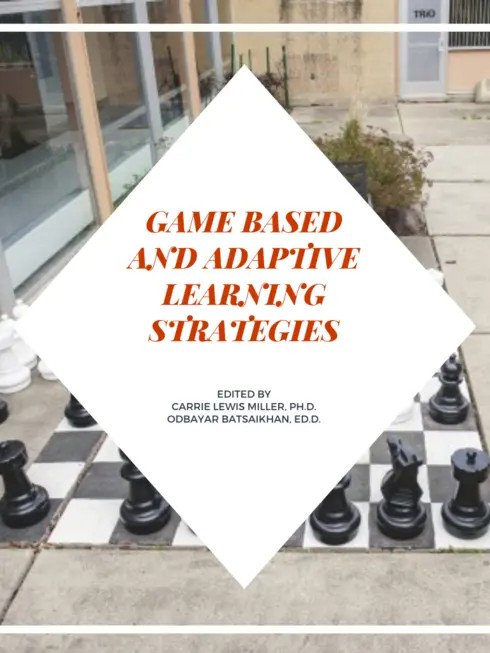
Game Based and Adaptive Learning Strategies
Not rated yetRate this bookGame Based and Adaptive Learning Strategies supports instructional designers and educators considering games, simulations, gamification, and adaptive learning. Its seven major chapters combine definitions, design questions, examples, and assignments. The…
Free reading is available at the official source. Opens in a new tab.
 Free
About this book
Game Based and Adaptive Learning Strategies supports instructional designers and educators considering games, simulations, gamification, and adaptive learning. Its seven major chapters combine definitions, design questions, examples, and assignments. The book’s recurring concern is fit: an engaging activity is educationally useful when its decisions, feedback, and assessment serve a learning need. This guide follows the downloaded edition’s seven-chapter organization and identifies the incomplete appendix separately. Platform examples describe the source’s publication context. Readers should use the design exercises to compare alternatives and justify a choice rather than assume a digital or game-like format automatically improves learning.
The detailed guide below follows the book’s chapter, unit, or section structure. Read it alongside the study instructions and the complete official text.
Book summary
Chapter-by-chapter summaries
Chapter 1: Overview of game-based and adaptive learning
The opening chapter distinguishes several approaches that are often grouped together. A game has rules, goals, feedback, and meaningful activity; gamification adds selected game elements to another experience; a simulation models a situation; adaptive learning changes a pathway in response to learner information. Differentiation and personalization introduce related but distinct questions about variation in instruction. The chapter also examines assumptions about gamers and asks learners to investigate actual preferences and practices. Its main contribution is vocabulary that supports design decisions. Before choosing a format, an educator should identify what learners need to do and what the experience will change in response to them. A label alone cannot establish that an activity is adaptive or that its challenges teach the intended skill.
Chapter 1 focus: Learners and the learning gap
The gamer-profile and related discussions encourage observation instead of treating learners as a uniform group. Enjoying one type of game does not establish a preference for every competitive or digital activity. Likewise, personalization requires more than allowing a choice of colors or avatars. A useful analysis identifies prior knowledge, motivation, access, and the specific gap the instruction addresses. This is a synthesis of the chapter’s design questions rather than a separate original chapter. It helps translate broad definitions into a defensible proposal: explain the learner need first, then show how the chosen mechanics or pathways respond to it.
Chapter 2: Games in education
Digital, serious, commercial, and nondigital games provide different opportunities and constraints. The chapter examines their possible educational roles alongside play theory. A commercial game may supply a useful problem or setting even when it was not designed for teaching, but an instructor must identify the relevant learning and provide appropriate framing. Nondigital games can support similar forms of interaction without requiring individual devices. The discussion encourages comparing the work learners actually perform with the objective of the course. Repeated success inside a game is not automatically evidence of transfer outside it. Selection should therefore consider rules, feedback, required knowledge, accessibility, and how the instructor will help learners interpret and apply the experience.
Chapter 2 focus: Comparing candidate games
A useful comparison separates educational purpose from entertainment value. Identify the decisions a learner makes, the evidence of improvement, the time needed to understand the rules, and the barriers to participation. Then compare the game with a simpler activity addressing the same objective. This does not dismiss play; it makes the reason for using it explicit. The source’s examples support asking whether practice, exploration, collaboration, or another function is needed. The final choice should be justified by that function and by the learning context rather than by the novelty of the product.
Chapter 3: Simulations
Simulations create a representation of a situation in which learners can act and observe consequences. High-fidelity and digital approaches differ in their equipment and resemblance to an actual setting, but realism is not the only criterion of value. The representation must preserve the relationships relevant to the learning objective. A simplified model can be effective when it makes those relationships clearer. The chapter connects simulation with contexts in which direct practice may be difficult, costly, or risky. Readers should distinguish performing successfully in a model from demonstrating competence in every real setting. Briefing, feedback, and reflection help learners connect what happened in the simulation with the knowledge or skill it was designed to develop.
Chapter 3 focus: Interpreting a simulated outcome
A simulation’s result depends on its model, rules, and selected conditions. Learners need opportunities to explain why an outcome occurred and what would change under another decision. Debriefing can expose a misunderstanding that a score conceals. An instructional plan should also identify what the simulation omits, since an omitted factor may matter in practice. This focus section draws together the chapter’s implications for design. It encourages treating the model as a deliberate representation to examine, not a complete reproduction of reality whose outputs need no interpretation.
Chapter 4: Gamification
Gamification introduces elements such as challenges, progression, choice, feedback, and badges into a learning experience. The chapter’s steps ask designers to rethink how tasks are framed and how learners can move toward a goal. Renaming an assignment or awarding points does not change the underlying learning by itself. The meaningful question is whether the structure supports useful effort, feedback, and opportunities to improve. Badging also requires a clear statement of what has been demonstrated. Readers should examine the relationship between reward and evidence rather than assume a visible achievement marker represents mastery. A strong design preserves the intellectual purpose of the course while making progress and participation understandable.
Chapter 4 focus: Rewards, evidence, and alternative routes
Different routes can allow learners to demonstrate a shared outcome through suitable formats, but equivalence needs planning. A podcast and a paper may both support explanation while requiring different technical effort. Assessment should identify the common intellectual criteria and any format-specific expectations. Similarly, a badge should describe the evidence behind it. This synthesis highlights a practical tension in gamification: flexibility can broaden participation, but unclear criteria can obscure what success means. Designers should make the connection between the challenge, feedback, and learning outcome visible before adding a reward structure.
Chapter 5: Virtual worlds
Virtual worlds, virtual reality, and augmented reality offer different relationships between the learner and a represented environment. The chapter compares their features and raises questions about equipment, participation, and digital safety. An immersive experience may support spatial understanding or role-based interaction, but immersion alone does not guarantee reflection or learning. Readers should identify what the environment enables that matters to the objective and what support learners require to use it. Access and social interaction are part of the design problem. The chapter’s examples are starting points for analysis in their publication context, not a current product recommendation or assurance that a particular platform remains available.
Chapter 5 focus: Access and participation
An environment should be evaluated from the perspective of learners with different devices, connections, physical needs, and familiarity with the medium. If participation depends on specialized equipment, an equivalent route may be necessary. Social features also require expectations about conduct, identity, and privacy. These considerations affect the learning opportunity rather than merely its administration. A design review should ask who can take part, what they can do once present, and how the instructor can observe relevant evidence of learning without collecting unnecessary information.
Chapter 6: Faculty showcase
The showcase identifies examples from engineering, business, and chemistry: an integrated game and escape-room context, an investor-entrepreneur simulation, and nomenclature card games. Their disciplinary variety demonstrates that game-like approaches can serve different kinds of work. The downloaded chapter provides brief showcase entries rather than full implementation instructions for each example, so it should not be read as a ready-to-teach lesson plan. Its value is comparative. Readers can ask what decisions and knowledge a learner would need in each setting and what evidence would demonstrate the intended outcome. A proposed adaptation still needs rules, materials, timing, assessment, and an explanation of how it fits the local course.
Chapter 7: Suggested assignments
The assignment sequence moves from investigating a gamer and identifying a learning gap to comparing products, creating a case, and designing an original experience. The instructional plan connects learner characteristics, objectives, implementation, and evaluation. This progression prevents design from beginning with a favorite technology and searching afterward for an educational justification. Research into related examples should inform the proposal, while the final rationale explains why its format serves the identified need. Readers should use the assignments cumulatively: findings from the profile and analysis should remain visible in the finished design. The result is a reviewable plan, not only an attractive game concept.
Source limitation: Appendix I
The downloaded edition’s Appendix I is labeled as an investor-group handout but contains a placeholder rather than the promised handout. It therefore provides no substantive additional instructions to summarize. Instructors using that showcase would need to consult the associated source material or create and validate their own supporting information. Identifying this limitation preserves the distinction between a featured idea and a complete implementation resource. It also reinforces the book’s broader design lesson: an educational activity needs the actual materials, rules, and evidence of learning required to make its proposed experience work.
Evaluate and design game-based learning by connecting mechanics and learner activity to educational outcomes.
Study instructions
- Begin with the overview and suggested learning outcomes. Distinguish games, simulations, gamification, virtual worlds, and adaptive approaches before choosing a design.
- For each example, identify what the learner does, what feedback they receive, and what concept or skill that activity is expected to develop.
- Compare the faculty showcase cases using the same criteria: audience, objective, mechanics, accessibility, assessment, and implementation demands.
- Design a small prototype that makes the target thinking necessary for progress. Avoid assuming that points, rewards, or participation alone demonstrate learning.
- Playtest the prototype, observe decisions, and collect evidence related to the objective. Use the suggested assignments and debriefing to explain what should be revised.
Practice and review task
Submit a prototype plan, playtest observations, and a revision memo connecting changes to learning evidence.
Questions for reflection
Does success in the game require the intended learning? How would you distinguish increased engagement from improved understanding?
Sources and coverage
The seven major chapters are covered with clearly labeled thematic study discussions. The downloaded appendix contains a placeholder rather than a substantive handout. These original summaries draw on review of the source text, including chapter or section introductions and selected explanations, examples, exercises, and concluding or review material. They are condensed study guides, not a page-by-page account or a replacement for the complete resource. Supplementary study discussions are identified separately.
About access & copyright
This page provides book information and study material. Full-text access is provided by the original publisher or authorised source; a listing does not grant permission to republish the book.
Read our Library Access & Copyright policyExplore the contents
Check the chapters covered in this edition.
Visit the official source
See reading, preview or purchase options.
Save for later
Keep this textbook in your saved collection.
Reader ratings & reviews
Share your thoughts
Your review helps other students choose the right resources.
KEEP LEARNING
Your next great read
Computer Science Computer Science
Relational Databases and Microsoft Access
View Relational Databases and Microsoft Access — book Computer Science
A Guide to MATLAB
View A Guide to MATLAB — book Computer Science
Introduction To MIPS Assembly Language Programming
View Introduction To MIPS Assembly Language Programming — book Computer Science
Java, Java, Java - Object-Oriented Programming
View Java, Java, Java - Object-Oriented Programming — book Computer Science
Think Java - How to Think Like a Computer Scientist
View Think Java - How to Think Like a Computer Scientist — book Computer Science
Think Python - How to Think Like a Computer Scientist (Downey)
View Think Python - How to Think Like a Computer Scientist (Downey) — book Computer Science
High Performance Computing
View High Performance Computing — book Computer Science
Foundations of Computation
View Foundations of Computation — book Algorithms and Data Structures



