
 Computer Science
Textbook
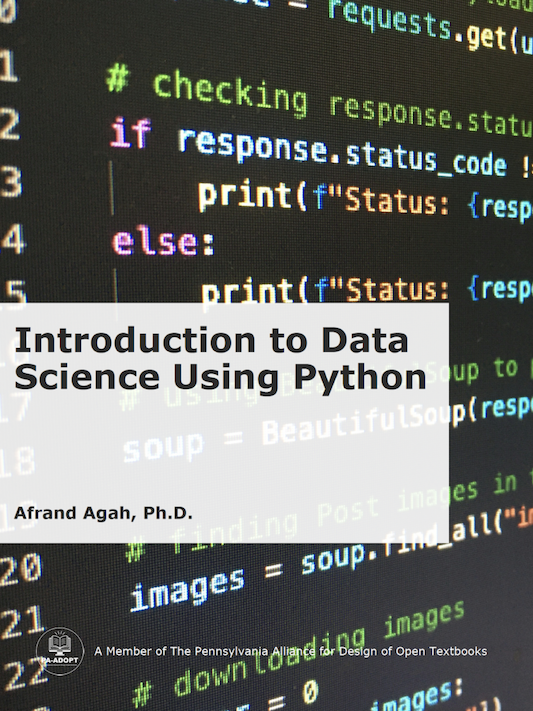
Introduction to Data Science Using Python
Not rated yetRate this bookAfrand Agah’s introductory resource connects Python programming foundations with a later introduction to the machine-learning and statistical ideas used in data science.
Free reading is available at the official source. Opens in a new tab.
 Free
About this book
Afrand Agah’s introductory resource connects Python programming foundations with a later introduction to the machine-learning and statistical ideas used in data science.
This page introduces the source edition and offers a focused reading route. Use the linked original resource for the complete text, references, activities, and the author’s full explanation. The overview below is limited to the sections identified in the coverage note.
Contents and further reading
Consult the official book or repository page for the resource’s contents and publication information. Open the source PDF to read the complete available edition.
Sources and coverage
This original overview is based on Preface and selected opening programming sections (PDF sheets 4 and 8–10), with publisher metadata and contents checked; the first edition was published in 2024 and the linked file was updated in December 2025. It is not a whole-book review. The verified source PDF contains 117 PDF sheets, including preliminary or repository pages; this may differ from its printed pagination. The source retains its own authorship, rights notices, and any separately credited third-party material.
Book summary
Afrand Agah’s Introduction to Data Science Using Python begins with programming fundamentals and progresses to arrays, graphics, packages, graph theory, machine learning, and statistics. Its fifteen chapters provide a bridge into data-oriented work rather than a complete treatment of every data-science method. The linked source is the first-edition file updated in December 2025.
Chapter-by-chapter summaries
Chapter 1: Installing Python
Installation establishes a reproducible place to run examples. The important distinction is between writing source code and executing it in an interpreter or development environment. Recording the environment helps make later errors interpretable rather than treating every failure as a problem in the algorithm.
Chapter 2: Introduction to Programming
Values, variables, expressions, and basic operations introduce computation as an explicit sequence of instructions. The chapter builds the vocabulary needed to describe what a program stores and changes. A useful reading habit is to predict intermediate values rather than looking only at the final printed result.
Chapter 3: Decision Structures
Conditions allow a program to select among possible actions. Correct behavior depends on both the test and the branch associated with its outcome. The chapter develops the ability to translate a verbal distinction into an explicit logical decision and to test what happens at a boundary.
Chapter 4: Repetitions
Loops apply a procedure repeatedly, often while a variable or collection changes. Understanding initialization, continuation, and termination prevents accidental infinite repetition or omitted cases. The chapter also prepares the reader to see data processing as systematic work over many observations rather than a sequence written separately for each item.
Chapter 5: Functions
Functions organize reusable computation around inputs, a task, and a result. They make a program easier to test because a behavior can be examined independently. The central design question is what one function should be responsible for, not simply how to reduce the number of repeated lines.
Chapter 6: Recursion
A recursive solution reduces a problem to a related smaller problem. The base case and the progress toward it must both be clear. Tracing a small example exposes the difference between the order of calls and the order in which results become available.
Chapter 7: File Access
Files allow information to persist beyond one execution. Reading and writing require attention to representation, ordering, and the distinction between stored text and the values a program uses. This chapter connects programming fundamentals with the practical need to acquire and preserve data.
Chapter 8: Lists
Lists organize multiple values in a collection that can be accessed and processed systematically. Indexing, iteration, and changes to the collection require a consistent model of its contents. The chapter develops data-structure reasoning that later supports tabular and numerical work.
Chapter 9: Arrays
Arrays introduce a representation suited to numerical collections. Their organization and operations should be understood in relation to the quantities being represented. The transition from general lists to array-oriented work helps explain why data-science tools use structures that support consistent shapes and numerical operations.
Chapter 10: Plotting Graphs
A graph makes a numerical relationship visible, but the result depends on the choice of variables, scale, and labels. Plotting is therefore both a programming task and an interpretive decision. The chapter encourages using visualization to examine data and communicate a relationship, not merely decorate an output.
Chapter 11: Object-Oriented Programming
Objects connect data with behavior and provide another way to organize programs. Classes describe a kind of entity, while individual objects hold particular state. The chapter extends program design beyond isolated functions and prepares learners to read the interfaces of packages built around objects.
Chapter 12: Using Python Packages
Packages provide existing implementations behind documented interfaces. Effective use requires understanding expected inputs, returned values, and assumptions. The chapter introduces an essential data-science habit: reuse reliable tools while retaining responsibility for checking that the tool answers the actual question.
Chapter 13: Python and Graph Theory
Graph structures represent relationships through nodes and connections. The chapter brings programming into problems where connectivity matters more than a simple ordered list. Learners should identify what each part of the graph represents before interpreting a computation performed on it.
Chapter 14: Python and Machine Learning
Machine learning uses data to construct a model for a task. The chapter introduces this relationship through Python tools. A model's output should be interpreted in terms of the data and objective used to build it, rather than assuming that executing a library call establishes accuracy or general applicability.
Chapter 15: Python and Statistics
Statistical tools connect numerical computation with descriptions and inferences about data. The programming result needs an explanation of the quantity calculated and its relevance to the question. This final chapter reinforces the distinction between obtaining a number and making a justified interpretation of it.
Study instructions
- Use a small dataset throughout the later chapters, retaining its source, variable definitions, and cleaning decisions.
- Trace control flow and function outputs by hand before running short examples.
- Explain each plot or model result in ordinary language, including what the input data cannot establish.
- Consult the appendix when a language detail blocks understanding, then return to the larger problem.
Sources and coverage
This original study guide follows the linked source edition and its chapters or explicitly identified sections. It condenses the main ideas and their relationships; examples and practice directions are for study alongside the complete text. Complete source edition.
About access & copyright
This page provides book information and study material. Full-text access is provided by the original publisher or authorised source; a listing does not grant permission to republish the book.
Read our Library Access & Copyright policyProgramming foundations
Build understanding through small, explainable programs.
Execution and output
Distinguish written instructions from their observed result.
Data-science preparation
Connect programming with mathematics and statistics.
Version awareness
Record the environment and check current installation guidance.
Reader ratings & reviews
Share your thoughts
Your review helps other students choose the right resources.
KEEP LEARNING
Your next great read
Computer Science Auditing / Audits
Internal Auditing: A Practical Approach
View Internal Auditing: A Practical Approach — book Cognitive studies
Cognitive Science as String Manipulation
View Cognitive Science as String Manipulation — book Auditing / Audits
Auditing Information Systems
View Auditing Information Systems — book Computer Science
Eloquent JavaScript: A Modern Introduction to Programming
View Eloquent JavaScript: A Modern Introduction to Programming — book Business
Workplace Software and Skills
View Workplace Software and Skills — book Business
Principles of Data Science
View Principles of Data Science — book Computer Science
Introduction to Python Programming
View Introduction to Python Programming — book Computer Science
Introduction to Computer Science
View Introduction to Computer Science — book Computer Science



