
 Computer Science
Textbook
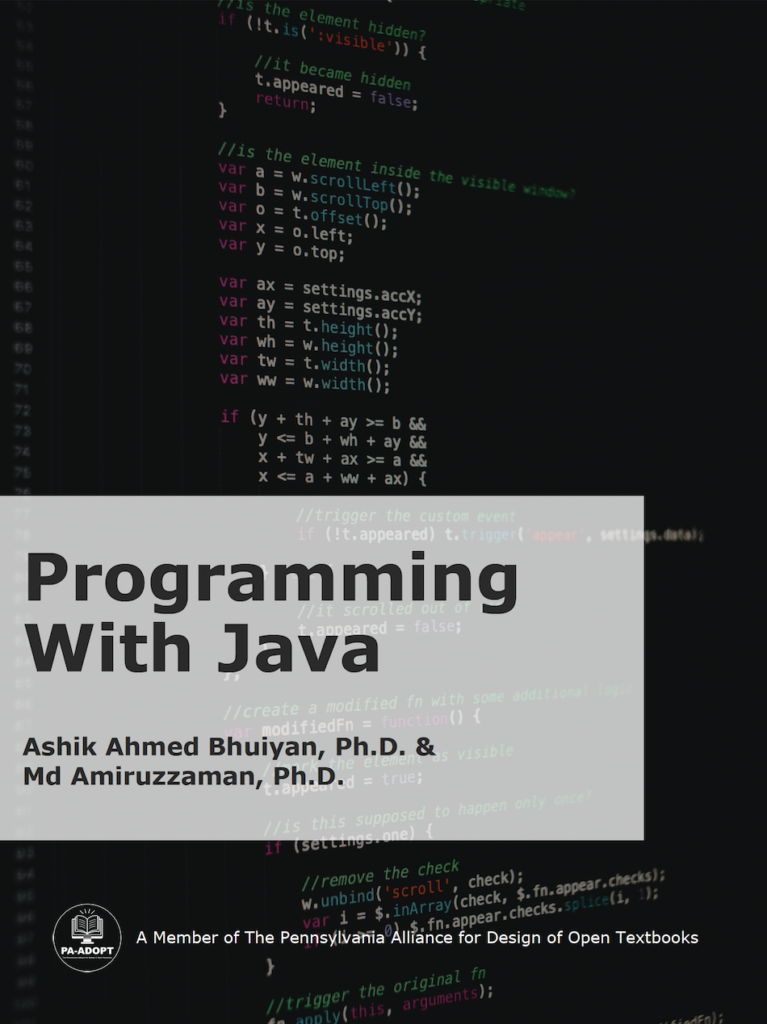
Programming with Java
Not rated yetRate this bookAn introductory Java textbook that begins with programs, source code, variables, and identifiers before progressing through a structured sequence of programming topics.
Free reading is available at the official source. Opens in a new tab.
 Free
About this book
An introductory Java textbook that begins with programs, source code, variables, and identifiers before progressing through a structured sequence of programming topics.
This page introduces the source edition and offers a focused reading route. Use the linked original resource for the complete text, references, activities, and the author’s full explanation. The overview below is limited to the sections identified in the coverage note.
Contents and further reading
Consult the official book or repository page for the resource’s contents and publication information. Open the source PDF to read the complete available edition.
Sources and coverage
This original overview is based on selected introductory explanations of source code and variables (PDF sheets 10 and 12–13), with contents checked. It is not a whole-book review. The verified source PDF contains 159 PDF sheets, including preliminary or repository pages; this may differ from its printed pagination. The source retains its own authorship, rights notices, and any separately credited third-party material.
Book summary
Programming with Java by Ashik Ahmed Bhuiyan and Md Amiruzzaman introduces programming through control flow, strings, methods, arrays, objects, and files. The second-edition source organizes these foundations into seven chapters. The sequence is best read cumulatively: later examples rely on being able to explain what a statement does, how values change, and which part of a program owns a responsibility.
Chapter-by-chapter summaries
Chapter 1: Introduction
The opening establishes the language and environment in which a Java program is written and executed. Basic program structure, values, and operations introduce the relationship between source instructions and observable behavior. The important habit is to trace a small program rather than judge understanding only by whether it compiles. Environment setup and the program's logic are related but different sources of difficulty.
Chapter 2: Control Statements and Loops
Conditional statements choose among actions, while loops repeat work under a defined condition. The chapter develops the reasoning needed to translate a verbal task into explicit control flow. Initialization, boundary conditions, and termination all affect correctness. Testing an ordinary example is insufficient when an empty case, equal boundary, or final iteration could behave differently.
Chapter 3: String
Strings represent and support operations on text. Their treatment requires attention to character positions, comparisons, and the distinction between a representation and its intended meaning. The chapter connects text processing with earlier control flow: a program may inspect, select, or transform parts of a string through a systematic procedure rather than a separate instruction for each possible input.
Chapter 4: Methods in Java
Methods divide computation into named responsibilities with defined inputs and results. This organization supports reuse and makes reasoning about a program more manageable. A clear method needs an account of what it expects and what it produces. The chapter shifts the reader from following one long sequence toward constructing smaller units whose behavior can be tested and explained.
Chapter 5: Arrays
Arrays organize multiple values under an indexed structure. Iteration becomes a way to apply an operation across the collection, while indexing creates new boundary conditions to check. The chapter helps learners connect the shape of stored data with an algorithm. A calculation over an array should specify which elements are included and how intermediate results are accumulated.
Chapter 6: Introduction to Classes and Objects
Classes describe a kind of entity through related state and behavior; objects are particular instances. The chapter introduces a design perspective beyond a set of unrelated methods. Readers should distinguish a class definition, an individual object's values, and the method call acting on that object. This makes ownership and responsibility visible in the program's organization.
Chapter 7: File Handling
Files connect a program with information that persists outside its execution. Reading, interpreting, and writing data are separate tasks that need to be coordinated. The chapter brings earlier ideas together: text representation, loops, methods, and data structures all become part of a practical processing workflow. A successful run should preserve the intended meaning and ordering of the stored information.
Study instructions
- Trace a short example by recording each changed variable before running it.
- Build a small file-processing program and divide it into methods with clear responsibilities.
- Test empty, single-item, and boundary cases in loops and arrays.
- Explain one design using classes and compare it with a procedural version, identifying what the object organization clarifies.
Sources and coverage
This original study guide follows the linked source edition and its chapters or explicitly identified sections. It condenses the main ideas and their relationships; examples and practice directions are for study alongside the complete text. Complete source edition.
About access & copyright
This page provides book information and study material. Full-text access is provided by the original publisher or authorised source; a listing does not grant permission to republish the book.
Read our Library Access & Copyright policySource code
Connect written instructions with compilation and execution.
Variables
Explain names, types, and values separately.
Small experiments
Change one feature and inspect its effect.
Debugging
Record evidence rather than guess at a correction.
Reader ratings & reviews
Share your thoughts
Your review helps other students choose the right resources.
KEEP LEARNING
Your next great read
Computer Science Auditing / Audits
Internal Auditing: A Practical Approach
View Internal Auditing: A Practical Approach — book Cognitive studies
Cognitive Science as String Manipulation
View Cognitive Science as String Manipulation — book Auditing / Audits
Auditing Information Systems
View Auditing Information Systems — book Computer Science
Eloquent JavaScript: A Modern Introduction to Programming
View Eloquent JavaScript: A Modern Introduction to Programming — book Engineering & Technology
Aerospace Structures
View Aerospace Structures — book Business
Workplace Software and Skills
View Workplace Software and Skills — book Business
Principles of Data Science
View Principles of Data Science — book Computer Science
Introduction to Python Programming
View Introduction to Python Programming — book Computer Science



