
 Textbook
Abelian number fieldsTextbook
Number Fields
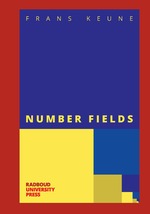
Not rated yetRate this bookFrans Keune's Number Fields develops algebraic number theory from rings of integers to class field theory. Twenty chapters in two parts connect ideals, units, prime splitting, geometry, analysis, local fields, reciprocity, infinite extensions, and idèles. The 2023 text assumes bachelor-level mathematics including some Galois theory. This guide follows its classical proof progression and pairs every chapter with an original study task.
Free reading is available at the official source. Opens in a new tab.
 Free
About this book
Frans Keune's Number Fields develops algebraic number theory from rings of integers to class field theory. Twenty chapters in two parts connect ideals, units, prime splitting, geometry, analysis, local fields, reciprocity, infinite extensions, and idèles. The 2023 text assumes bachelor-level mathematics including some Galois theory. This guide follows its classical proof progression and pairs every chapter with an original study task.
Chapter-wise summaries and study tasks
Integers in a Number Field
A number field is a finite extension of the rational numbers, and its ring of integers provides the setting for arithmetic within that field. Algebraic integrality is defined through monic polynomial equations, not by requiring coordinates in an arbitrary basis to be ordinary integers. Norm, trace, characteristic polynomials, and discriminants connect linear algebra with arithmetic structure. Integral bases describe the additive lattice of the ring of integers. Quadratic examples show how an apparently natural order can fail to be the full integer ring. Norm-Euclidean examples introduce computational division while preparing for the failure of principal-ideal behavior in more general fields.
Study task. For a quadratic field chosen from the chapter's examples, distinguish a power basis from an integral basis and compute trace, norm, and discriminant with every convention stated.
Dedekind Domains
Dedekind domains restore a form of unique factorization at the level of ideals even when elements do not factor uniquely. The chapter develops the conditions defining these domains, factorization of nonzero ideals, and the extension from integral to fractional ideals. Multiplication and inversion of fractional ideals make it possible to form an ideal class group by identifying ideals that differ by a principal fractional ideal. This group measures an obstruction to principal-ideal behavior. Keep the objects distinct: an element, the ideal it generates, and its ideal class carry related but different information. The abstract setting isolates the properties later used for rings of integers.
Study task. Trace an example of nonunique element factorization through its prime-ideal factorizations; explain exactly what becomes unique and how a principal ideal represents the identity class.
Rings of Integers of Number Fields
The arithmetic of rings of integers is examined through prime ideals, ideal norms, ideal classes, and ramification. Quotients by prime ideals are finite fields, linking prime splitting with residue-field arithmetic. The norm of an ideal counts a finite quotient and interacts with multiplication in ways that support calculation. Finiteness of the ideal class group turns an abstract obstruction into a finite arithmetic invariant. Ramification distinguishes repeated prime-ideal factors from other splitting behavior. Computations should use the full ring of integers and verify any hypotheses required by a polynomial-factorization method; reducing a convenient defining polynomial is not universally sufficient.
Study task. Factor a small rational prime in a source-supported quadratic example, calculate the relevant ideal norms, and distinguish splitting, inertia, and ramification.
Quadratic Number Fields
Quadratic fields offer a concrete setting in which ideals, lattices, continued fractions, units, and reciprocity can be connected computationally. In imaginary quadratic fields, lattice equivalence supports algorithms for ideal classes. In real quadratic fields, continued fractions help describe equivalence and locate a fundamental unit. The quadratic reciprocity law connects residue questions at different primes, while the discussion of the class group's 2-rank reveals further structural information. Real and imaginary cases require different reasoning, not merely a change of sign in a formula. Follow why an algorithm represents all relevant classes and why its stopping or reduction conditions are valid.
Study task. Work one imaginary quadratic ideal-class calculation and one real quadratic continued-fraction example from the exercises; explain the different roles of reduction and units.
Geometric Methods
Geometric methods embed a number field into a real vector space through its real embeddings and pairs of complex embeddings. Rings and ideals become lattices, allowing arithmetic questions to be approached through volume and convexity. Minkowski theory supplies bounds that make class-group searches finite and supports structural results. Dirichlet's unit theorem describes the finitely generated unit group, with rank determined by the field's real and complex places. Logarithmic embeddings and regulators connect multiplicative arithmetic with geometry. Track normalization choices and the treatment of complex places carefully, since a lost factor can change a bound or regulator calculation.
Study task. Determine the signature and predicted unit rank of several small fields, then apply a stated Minkowski bound to limit the ideals needed in a class-group calculation.
Localization of Dedekind Domains
Localization focuses arithmetic by making selected elements invertible and retaining information at selected primes. Discrete valuations record exponents in prime-ideal factorizations and translate divisibility into additive data. Localizing a Dedekind domain at a nonzero prime produces a particularly manageable local structure, while more general localizations allow different collections of primes to be ignored. The chapter connects this viewpoint with residue rings and number-field terminology. Localization is not the same operation as completion: one changes which denominators are permitted, while the other later adds limits. Understanding that distinction prevents confusion between related local constructions.
Study task. Describe an element's valuations before and after localization at a chosen prime; identify which elements become units and explain why no new limits have yet been added.
Extensions of Dedekind Domains
Extensions of Dedekind domains generalize prime splitting from rational integers to relative field extensions. Ramification indices and residue degrees describe how a prime changes in the integral closure. In Galois settings, decomposition and inertia groups relate arithmetic behavior to automorphisms, while ramification groups refine the analysis. Norms of fractional ideals and Frobenius automorphisms provide tools used throughout later chapters. Reduction of polynomials can also reveal information about Galois groups under appropriate conditions. Each statement has hypotheses involving separability, normality, or unramified primes; carrying those assumptions through a proof is as important as manipulating the resulting formulas.
Study task. For a suitable finite Galois example, relate prime factors, ramification index, residue degree, decomposition group, and inertia group; check the degree identity and Frobenius assumptions.
Analytic Methods
Analytic methods encode ideal arithmetic in counting functions and Dirichlet series. Lattice-point estimates connect geometry with the asymptotic distribution of ideals among classes. The Dedekind zeta function organizes ideals by norm and also admits an Euler-product interpretation through prime ideals. Convergence and limiting behavior require analysis, not merely formal rearrangement of infinite sums. Dirichlet density provides a way to discuss the size of prime sets, and the chapter develops a Frobenius density result within its argument. Distinguish this stage from the later full Chebotarev theorem and keep density notions separate from an unsupported claim about ordinary proportions.
Study task. Derive the formal connection between ideal factorization and an Euler product, then identify what convergence conditions justify the analytic manipulation.
Abelian Number Fields
Abelian number fields over the rationals admit a concrete description through cyclotomic fields. The Kronecker-Weber theorem places every finite abelian extension of the rationals inside a cyclotomic extension. Characters of finite abelian groups and Dirichlet characters then encode arithmetic information, including prime splitting. L-series, Gauss sums, class-number formulas, and cyclotomic units connect this description with analytic and computational tools. The chapter provides a special case that motivates general class field theory without making the later theory redundant. Separate a field, its Galois group, and its associated character group when following the correspondence.
Study task. Use a small cyclotomic example to relate an abelian Galois group, its characters, and unramified prime splitting; identify what changes when the base field is no longer rational.
Completions of Number Fields
An absolute value defines a notion of distance, making convergence and completion possible. Number fields have archimedean places arising from real or complex embeddings and nonarchimedean places related to prime ideals and valuations. Completion preserves arithmetic structure while providing limits needed for local analysis. The chapter studies completions of discretely valued fields, their extensions, and their relationship with a global field extension. A prime here has a broader place-theoretic role than an ordinary rational prime number. Keep equivalence classes of absolute values distinct from particular normalizations used for calculation.
Study task. Compare the real and p-adic completions of the rationals, explaining how a sequence can behave differently in the two metrics and how finite primes generalize in a number field.
Local Fields
Local fields in the chapter's characteristic-zero setting are complete discretely valued fields with finite residue fields. Their arithmetic can be studied through a uniformizer, the valuation ring, residue information, and the filtration of units. Finite extensions interact with ramification and residue-field degree. Logarithm and exponential series relate suitable parts of multiplicative and additive structure, but their convergence domains must be respected. Familiar real-variable identities cannot simply be applied to every local-field element. The chapter prepares the multiplicative groups and local tools needed in reciprocity theory by making these structures explicit.
Study task. Describe valuation, units, and principal units in a small local-field example; state the convergence restrictions before using logarithm or exponential to compare group operations.
Galois Modules
Galois groups act on many objects associated with an extension, including field elements, multiplicative groups, units, and ideals. Viewing them as modules organizes compatibility between the action and algebraic operations. The book develops the cohomology needed for cyclic groups rather than presupposing the full general machinery. Norm-like maps, differences under a generator, and transfer constructions help express obstructions and relations. These tools feed later comparisons between arithmetic group sizes and Galois groups. Students should specify whether a module is written additively or multiplicatively, because the same structural idea can appear in quite different notation.
Study task. For a cyclic action, write the norm and generator-difference maps in both notational conventions; explain the kernel or quotient measured by one cohomological construction.
Ray Class Groups and Dirichlet Characters
Ray class groups refine ideal class groups by incorporating congruence and sign conditions through a modulus. Dirichlet characters of a number field generalize the rational case and link these finite quotient structures with analytic L-series. Counting ideals in ray classes and the first fundamental inequality prepare the comparison with extension degrees. The Artin map connects suitable unramified prime ideals to automorphisms and extends multiplicatively. A modulus determines which ideals are admissible and which principal ideals are identified, so suppressing it can obscure the statement. This is the framework for reciprocity rather than the completed existence and classification theorem.
Study task. Compare an ordinary class group with a ray class group for a simple modulus; list the extra conditions and explain the domain and intended target of the Artin map.
Artin's Reciprocity Law
Artin reciprocity identifies the appropriate arithmetic quotient with the Galois group of an abelian extension. The chapter first establishes the needed equality in cyclic cases using the Galois-module calculations developed earlier. A local-global principle for norms in cyclic extensions appears as part of this progression. The proof then establishes a suitable modulus and the resulting reciprocity statement. Follow how surjectivity, kernel description, and equality of finite sizes contribute different pieces of the argument. Do not replace the precise ideal-theoretic quotient with the claim that an arbitrary class group equals an arbitrary Galois group.
Study task. Rewrite the reciprocity statement with its modulus, ideal group, norm subgroup, and Galois group labeled; diagram the earlier results needed to establish its kernel and isomorphism.
The Classification Theorem
The classification theorem completes the correspondence by proving existence of abelian extensions associated with the prescribed arithmetic data. Reduction steps lead to situations with enough roots of unity, where Kummer extensions can be used. Existence is a separate problem from showing that an already given extension has an Artin map. The chapter develops consequences including Chebotarev density, complete splitting, local Artin maps, and the Hilbert class field. These results connect prime behavior with field structure and ideal classes. Distinguish each correspondence's direction and the inclusion relationships involved instead of treating classification as a list of named theorems.
Study task. Explain the gap between reciprocity for an existing extension and an existence theorem; then describe how the Hilbert class field relates to the ideal class group under the book's conventions.
Local Class Fields and Symbols
Local class field theory organizes abelian extensions of a local field through its multiplicative group and norm subgroups. Local Artin maps connect this structure with the global maps already constructed. Norm-residue, Hilbert, and power-residue symbols encode specific arithmetic information in forms that lead to reciprocity formulas. A symbol's inputs, target, normalization, and field assumptions matter; similarly named symbols need not be interchangeable. The chapter derives classical reciprocity laws through this framework rather than treating them as unrelated coincidences. Trace where local statements are combined globally and where a product formula supplies the link.
Study task. Choose a source-supported symbol in a simple case, state its domain and target, and explain the role of the product formula in deriving a reciprocity relation.
Conductor and Discriminant
Conductors and discriminants both record ramification information but are different invariants. The different links local ramification structure with the discriminant, while conductor data arise through characters and reciprocity. The chapter examines ramification in subextensions and the relation between local Artin maps and ramification groups before proving the conductor-discriminant formula for abelian extensions. The formula expresses a field invariant through character conductors under precise conventions. Keep ideals in the extension field separate from ideals in the base field, and distinguish the finite part of a modulus from its archimedean conditions.
Study task. Construct a dependency diagram linking ramification groups, the different, discriminant, and character conductors; check the conductor-discriminant relation in a simple example covered by the source.
Zeta Function Relations
Zeta-function relations are studied through relations among norm elements in a finite group ring. For a Galois extension, intermediate fields inherit arithmetic structures whose relationships can reflect subgroup structure. The chapter connects norm relations with units, ideal-class information, and identities involving Dedekind zeta functions, then discusses Artin L-functions and exceptional group behavior. The central move is to translate a group-theoretic relation into an arithmetic or analytic statement. Not every apparent numerical resemblance between class numbers or zeta functions has that justification. Identify the extension, subgroups, fixed fields, and multiplicities before interpreting a relation.
Study task. Translate a small subgroup diagram into its fixed-field diagram, then explain how a stated norm relation induces a corresponding zeta-function relation.
Infinite Extensions of Number Fields
Infinite extensions require topology to preserve the useful correspondence between fields and groups. Products, topological groups, inductive and projective limits, and profinite groups supply the language for passing from finite systems to infinite ones. The Galois group of an infinite Galois extension carries a topology encoding finite subextensions; closed subgroups therefore matter in the correspondence. Duality introduces another way to organize compatible information. Simply taking an infinite union of familiar finite statements can lose the conditions that make them valid. Follow the direction of maps and compatibility requirements in every limiting construction.
Study task. Describe the Galois group of an increasing tower as an inverse limit of finite groups; explain why compatibility and closedness are essential rather than optional details.
Idèlic Class Field Theory
Adèles and idèles assemble information from all completions of a number field while imposing restricted-product conditions. The adèle ring organizes additive local data, and the idèle group and idèle class group organize multiplicative information modulo global elements. These constructions reformulate the earlier ideal-theoretic classification and connect local and global reciprocity in a common language. The restricted condition is essential: an unrestricted product would not represent the same arithmetic object. The final chapter is a bridge from the book's classical development to a more modern formulation, so compare the two descriptions carefully rather than assuming that new notation alone supplies a new theorem.
Study task. Build a glossary matching ideals, moduli, ray classes, local components, and idèle classes; explain how a local contribution enters the global reciprocity framework.
How to study this book
- Review field extensions, Galois theory, rings, modules, and linear algebra before starting; record unfamiliar topology and analysis prerequisites as they arise.
- For every theorem, write the hypotheses, objects, map, and conclusion separately before studying the proof.
- Maintain a dependency map connecting basic ideal theory with geometry, analytic methods, local constructions, and reciprocity.
- Work explicit quadratic or cyclotomic examples alongside abstract results, checking where an example relies on a special property.
- Attempt the source's exercises and reconstruct key proof steps without looking; distinguish an example, an algorithm, and a general theorem.
Questions for reflection
- Which factorization statement concerns elements and which concerns ideals?
- Where does the proof use the field being Galois, abelian, cyclic, or unramified?
- What changes when passing from global arithmetic to localization or completion?
- Which existence problem remains after a map has been constructed?
- How do idèles reorganize the earlier ideal-theoretic information?
Source edition and coverage
This guide covers the twenty numbered chapters of Frans Keune's Number Fields, version 2023-01, published by Radboud University Press. Part I contains nine basic algebraic-number-theory chapters; Part II contains eleven chapters developing class field theory and its idèlic formulation. The guide offers original orientation and exercises, not a reproduction of the book's proofs or a survey of current research. These are original study explanations and learning tasks. Read the complete book at the official source.
About access & copyright
This page provides book information and study material. Full-text access is provided by the original publisher or authorised source; a listing does not grant permission to republish the book.
Read our Library Access & Copyright policyExplore the contents
Check the chapters covered in this edition.
Visit the official source
See reading, preview or purchase options.
Save for later
Keep this textbook in your saved collection.
Reader ratings & reviews
Share your thoughts
Your review helps other students choose the right resources.
KEEP LEARNING
Your next great read
Textbook Algebra
Intermediate Algebra
View Intermediate Algebra — book Mathematics
Book of Proof
View Book of Proof — book Algebra
College Algebra
View College Algebra — book Applied
Introduction to Probability
View Introduction to Probability — book Calculus
Precalculus (Version 3, Corrected 2013 Edition)
View Precalculus (Version 3, Corrected 2013 Edition) — book Geometry and Trigonometry
College Trigonometry
View College Trigonometry — book Calculus
Whitman Calculus
View Whitman Calculus — book Calculus
Vector Calculus
View Vector Calculus — book Analysis



