
 Mathematics
AlgebraTextbook
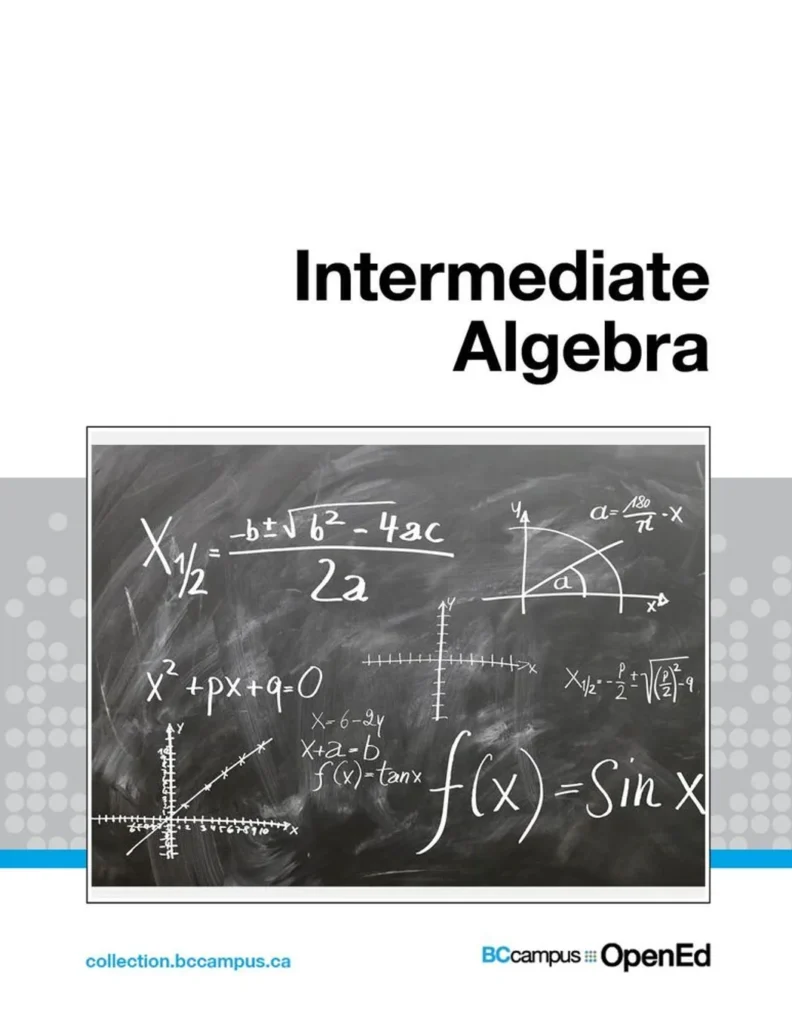
Intermediate Algebra
Not rated yetRate this bookTerrance Berg’s Intermediate Algebra builds fluency through eleven chapters, worked examples, applications, and mathematical puzzles. Its sequence moves from arithmetic review and linear relationships to polynomial structure, rational and radical expressions, quadratics, and functions. Three midterm-preparation blocks and a final-exam section support cumulative practice. This guide follows that complete arrangement and emphasizes explaining restrictions, choosing a method, and checking solutions rather than copying symbolic steps.
Free reading is available at the official source. Opens in a new tab.
 Free
About this book
Terrance Berg’s Intermediate Algebra builds fluency through eleven chapters, worked examples, applications, and mathematical puzzles. Its sequence moves from arithmetic review and linear relationships to polynomial structure, rational and radical expressions, quadratics, and functions. Three midterm-preparation blocks and a final-exam section support cumulative practice. This guide follows that complete arrangement and emphasizes explaining restrictions, choosing a method, and checking solutions rather than copying symbolic steps.
Chapter-wise summaries and study tasks
Chapter 1: Algebra Review
The opening review rebuilds the arithmetic and language needed for reliable algebra. Integers, fractions, operation order, and algebraic properties must be coordinated, especially when subtraction, negative signs, and grouping occur together. Terms, coefficients, factors, and expressions name different structures, so identifying the structure should precede applying a rule. Unit conversions use equivalent quantities to change representation without changing the underlying amount. Homework puzzles provide opportunities to turn verbal conditions into symbolic constraints. A correct numerical answer is more useful when the reader can explain why each transformation preserves the original expression and why the units of an application remain consistent.
Study task. Simplify one expression containing fractions and negative signs, naming the property used at each step. Solve a multistep conversion by arranging units to cancel, then use a puzzle to practice translating conditions.
Chapter 2: Linear Equations
Linear equations are solved by transformations that preserve their solution sets. Equations with fractions require denominator restrictions before clearing denominators, while formulas require keeping track of which quantity is being isolated. Absolute-value equations describe distance and may produce two cases; a negative required distance instead gives no solution. Variation problems connect proportional relationships with a constant whose value must be determined from data. The chapter’s increasingly complex examples reward an organized sequence: simplify each side, collect terms, isolate the unknown, and check in the original statement. A contradiction or identity can be a meaningful result rather than evidence that the algebra has failed.
Study task. Solve a fractional equation and an absolute-value equation, recording restrictions and cases. Rearrange a formula for a different variable and explain how substitution verifies the result.
Chapter 3: Graphing
Coordinates and graphs connect numerical locations with algebraic relationships. Midpoint and distance calculations describe geometry between points, while slope measures change in the vertical coordinate per unit horizontal change. Linear equations can be constructed from a point and slope or from two points, with different forms revealing different information. Parallel and perpendicular relationships require attention to slope conditions and the special case of vertical lines. Applications and the newspaper-delivery puzzle use these tools to organize constraints and interpret a solution. A graph should include axes, scale, and meaningful units; visual steepness without a stated scale is not a complete numerical comparison.
Study task. Construct a line from two points, find its intercepts, and write both point–slope and slope–intercept forms. Add a perpendicular line through a specified point and handle a vertical-line case separately.
Chapter 4: Inequalities
Inequalities describe sets of acceptable values rather than one required equality. Multiplication or division by a negative number reverses order, while addition of the same quantity does not. Compound statements combine conditions through intersection or union, and absolute-value inequalities translate distance limits into intervals or separated regions. In two dimensions, boundary lines or curves divide the plane into candidate regions whose inclusion depends on the inequality. Geometric applications and the oil-sharing puzzle ask readers to represent constraints before manipulating symbols. Endpoint inclusion and dashed versus solid boundaries matter because they distinguish a strict limit from one that permits equality.
Study task. Solve and graph an absolute-value inequality, then check an interior, exterior, and boundary value. Represent two planar constraints together and explain whether their overlap or combined regions express the intended conditions.
Midterm 1 Preparation
The first midterm-preparation block provides five versions for reviewing the opening part of the course. Its value is diagnostic: arithmetic, equation solving, graph interpretation, and inequality reasoning need to work together when a problem no longer announces its method. Repeating a test immediately can create familiarity without demonstrating transferable understanding. Instead, classify errors by cause, including sign handling, invalid transformations, missing restrictions, or a mistaken interpretation of the question. Rework an error from a clean page and explain the check that would have exposed it. Use another version only after the underlying misconception has been addressed.
Study task. Complete one preparation version without notes, then build an error log with one corrected explanation per error category. Use a different version to check whether the correction transfers to unfamiliar numbers.
Chapter 5: Systems of Equations
Systems require values that satisfy all equations simultaneously. Graphing displays intersections, substitution replaces one variable with an equivalent expression, and elimination combines equations to remove variables. These methods express the same common-solution requirement but vary in efficiency depending on the coefficients and arrangement. Three- and four-variable systems extend the logic through systematic reduction. A system can be inconsistent or dependent, so the number of solutions should be interpreted before presenting a final tuple. Monetary problems and game puzzles show how choosing variables and writing independent constraints are often the hardest steps in a successful solution.
Study task. Solve the same two-variable system by substitution and elimination, checking both original equations. Translate a monetary scenario into a system and explain what a redundant or contradictory equation would mean.
Chapter 6: Polynomials
Polynomial operations depend on exponent rules and the distinction between terms and factors. Negative exponents represent reciprocals under nonzero-base conditions rather than automatically negative values. Addition combines like terms, multiplication distributes across all terms, and division can reveal quotient and remainder structure. Special products provide recognizable patterns, while Pascal’s triangle connects binomial coefficients with repeated expansion. Scientific notation supports comparisons across scale. Mixture applications require a model for the conserved quantity before polynomial manipulation becomes useful. Readers should resist applying a product rule to a sum or canceling pieces that are not common factors of an entire numerator and denominator.
Study task. Expand a binomial power using Pascal’s triangle and verify a lower-degree case by multiplication. Divide a polynomial and reconstruct it from divisor, quotient, and remainder; include a restriction when negative exponents appear.
Chapter 7: Factoring
Factoring reverses multiplication to expose an expression’s multiplicative structure. A greatest common factor should be considered before grouping, trinomial methods, or special-product patterns. Quadratics with different leading coefficients require appropriate strategies, and a proposed factorization should always be expanded to check it. The zero-product property solves an equation only after one side is a product equal to zero. Age problems connect algebraic roots with contextual restrictions, so a symbolic candidate may not be an acceptable answer. Increasing difficulty in the chapter encourages method selection and pattern recognition without implying that every polynomial factors neatly over the integers.
Study task. Factor a set of expressions that require different strategies, explaining why each strategy fits. Solve one resulting quadratic equation and reject any contextually impossible age after checking the original story.
Midterm 2 Preparation
The second midterm block supports cumulative work after systems, polynomial operations, and factoring. Different versions help separate understanding from memory of a single answer sequence. A useful review connects representations: a factored quadratic explains roots, a system describes simultaneous constraints, and a polynomial identity must hold for every permitted input. Before timing practice, ensure that essential procedures are accurate and that the conditions for each rule are understood. When reviewing, locate the first invalid step rather than merely replace the final answer. This turns a practice test into evidence about which concepts need further study.
Study task. Attempt one version and annotate each problem with the chosen method and its conditions. Redo incorrect items with changed coefficients, then check the new result independently by substitution or expansion.
Chapter 8: Rational Expressions
Rational expressions are quotients of polynomials with excluded inputs wherever an original denominator is zero. Factoring permits cancellation of common factors, but a canceled restriction remains part of the original expression’s domain. Addition and subtraction require a common denominator; multiplication and division require attention to factors and reciprocals. Complex fractions can be simplified by a common-denominator strategy. Rational equations may generate inadmissible candidates when denominators are cleared, making an original-equation check essential. Speed, distance, and time applications add units and physical restrictions that narrow the algebraic possibilities.
Study task. Simplify a rational expression while preserving its original excluded values. Solve a rate problem with a rational equation, state units, and check whether each candidate keeps all original denominators nonzero.
Chapter 9: Radicals
Radicals and rational exponents are related representations whose real-number conditions must be respected. Even roots require nonnegative radicands in real arithmetic, and a principal square root is not an unrestricted positive-or-negative operation. Like radicals can be combined after simplification; products, quotients, and denominator rationalization require separate rules. Mixed indices demand a common representation before convenient simplification. The optional complex-number material expands the number system when real roots are unavailable. Work-rate applications translate contributions per unit time into equations, while the pattern puzzle asks readers to test a conjecture rather than infer a general rule from one numerical coincidence.
Study task. Simplify an even-root expression involving a variable and explain where an absolute value is needed. Solve a joint-work problem with labeled rates, then compare a real-number restriction with an optional complex-number extension.
Chapter 10: Quadratics
Quadratic methods connect algebraic solutions with graphs and equivalent equation forms. Completing the square reveals a vertex structure and leads to the quadratic formula, while substitution can transform some higher-looking equations into quadratic form. Radical equations require checking after squaring because that operation can introduce candidates that do not satisfy the original. Selected exponential equations can be handled through matching powers or an appropriate substitution. Graphing by vertex and intercepts links roots, symmetry, and turning points. Constructing an equation from roots reverses the usual task, and applications require distinguishing mathematical roots from physically meaningful values.
Study task. Solve a quadratic by completing the square and by the quadratic formula. Graph it with the vertex and intercepts, then check a separate radical equation in its unsquared original form.
Midterm 3 Preparation and Sample Questions
The third midterm-preparation block consolidates rational expressions, radicals, and quadratic reasoning alongside earlier skills. These topics share a need to record restrictions before transformations and to check candidates afterward. A solution can be algebraically fluent yet invalid because a denominator vanished or squaring changed the solution set. Use the sample versions to practice choosing between factoring, clearing denominators, substitution, and quadratic methods. Successful review includes an explanation of why a method applies, not only how to execute it. Timed work is most informative after systematic accuracy has been established through untimed corrections.
Study task. Complete a version with a separate restrictions column. Mark every step that can introduce or remove solutions, then verify final candidates and use another version to test the revised checking habit.
Chapter 11: Functions
Functions assign one output to each allowed input, giving a framework for operations, inverses, and mathematical models. Composition requires compatible domains, and inverse functions reverse an input–output relationship only when the relevant one-to-one condition holds or a domain is restricted. Exponential and logarithmic functions describe inverse relationships with base and domain conditions. Compound interest connects repeated multiplicative growth with a financial model whose assumptions should be stated. Trigonometric functions and the sine and cosine laws extend functional reasoning to angles and triangles. The closing puzzle encourages a playful application while preserving the need for a valid mathematical explanation.
Study task. Compare a function’s inverse with its reciprocal using explicit examples and domain statements. Model compound growth, then solve a triangle using an appropriate law and explain why the available measurements justify that choice.
Final Exam Preparation
The final-exam section offers two cumulative versions that bring the book’s skills together. Preparation should move from isolated procedure drills to mixed questions where the method must be selected independently. Build a compact map connecting equation types, graph features, restrictions, and checking methods. Use the practice result to decide what to revisit, rather than treating one score as a permanent judgment of ability. A complete solution communicates assumptions, intermediate reasoning, and the meaning of the answer. Comparing performance across the two versions can reveal whether conceptual repairs are durable or whether familiar-looking questions are still driving method choice.
Study task. Attempt a cumulative version, review every uncertain item even if its answer was correct, and write a targeted revision plan. Use the second version after revision and compare error categories rather than scores alone.
How to study this book
- Work through examples with the solution covered, then explain the rule behind each step before checking the text.
- Maintain a restrictions log for denominators, roots, logarithms, inverse functions, and applications.
- Use graphing or numerical substitution as an independent check, while retaining exact symbolic work where appropriate.
- Treat the puzzles as modeling exercises: define unknowns, express constraints, test a candidate, and explain why the solution fits.
- Use the three midterm blocks and final versions as spaced diagnostics rather than back-to-back answer memorization.
Questions for reflection
- Which transformation preserves equivalence, and which requires a later check?
- How does the form of an expression reveal the most efficient strategy?
- What additional restriction comes from a word problem beyond the algebraic equation?
Source edition and coverage
This guide follows Terrance Berg’s BCcampus Intermediate Algebra, published in 2020. It covers all eleven numbered chapters, the three midterm-preparation blocks, and final-exam preparation. It is distinct from the OpenStax books sharing the Intermediate Algebra title. These are original study explanations and learning tasks. Read the complete book at the official source.
About access & copyright
This page provides book information and study material. Full-text access is provided by the original publisher or authorised source; a listing does not grant permission to republish the book.
Read our Library Access & Copyright policyExplore the contents
Check the chapters covered in this edition.
Visit the official source
See reading, preview or purchase options.
Save for later
Keep this textbook in your saved collection.
Reader ratings & reviews
Share your thoughts
Your review helps other students choose the right resources.
KEEP LEARNING
Your next great read
Mathematics Mathematics
MTH 211: Calculus II
View MTH 211: Calculus II — book Mathematics
Mathematical Reasoning
View Mathematical Reasoning — book Mathematics
MAT 2420 Calculus II
View MAT 2420 Calculus II — bookMTH 225 Differential Equations
MTH 225 Differential Equations
View MTH 225 Differential Equations — bookFinite Mathematics
Finite Mathematics
View Finite Mathematics — bookMATH 25: PreCalculus
MATH 25: PreCalculus
View MATH 25: PreCalculus — bookMath 4B: Differential Equations
Math 4B: Differential Equations
View Math 4B: Differential Equations — bookMath 100: Liberal Arts Mathematics
Math 100: Liberal Arts Mathematics
View Math 100: Liberal Arts Mathematics — bookCalculus I: Differential Calculus



