
 Geometry and Trigonometry
CalculusTextbook
Precalculus
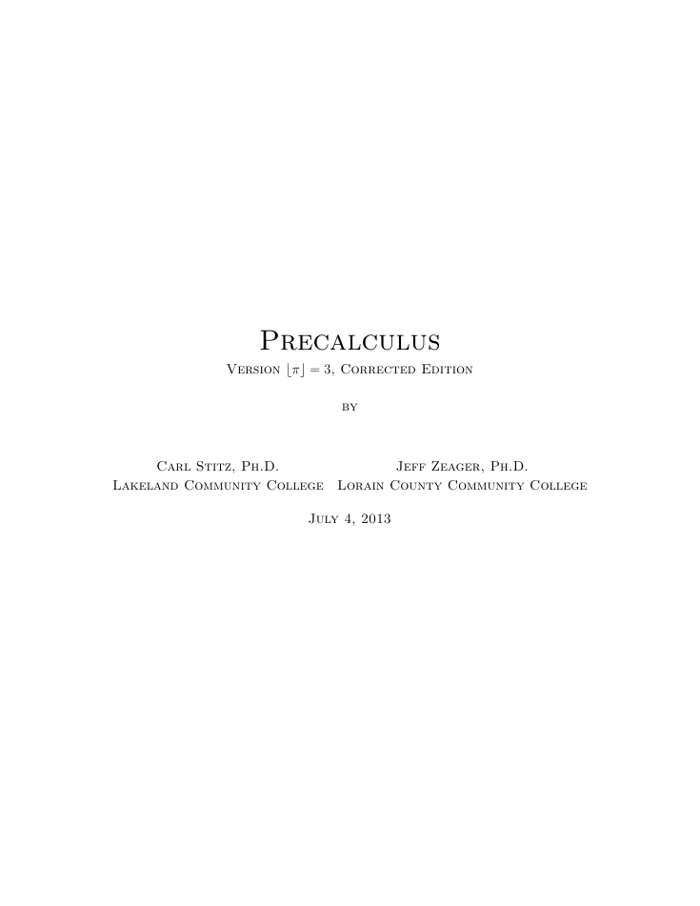
Not rated yetRate this bookPrecalculus by Carl Stitz and Jeff Zeager develops algebra and trigonometry through a functions-first approach. The linked PDF is Version floor(pi) = 3, Corrected Edition, dated July 4, 2013, and contains eleven chapters across 1,094 PDF pages. Its sequence moves from relations and function families through conics, systems, sequences, and trigonometry. The book repeatedly connects algebraic, graphical, numerical, and verbal representations, making it useful for learners preparing for calculus who need to explain why a method works. This guide covers every chapter and adds practice focused on interpretation and common errors. The cover displayed is the original title page from the linked corrected edition, replacing the catalog's blank cover image.
Read on the publisher’s website. Opens in a new tab.
 Free
About this book
Precalculus by Carl Stitz and Jeff Zeager develops algebra and trigonometry through a functions-first approach. The linked PDF is Version floor(pi) = 3, Corrected Edition, dated July 4, 2013, and contains eleven chapters across 1,094 PDF pages. Its sequence moves from relations and function families through conics, systems, sequences, and trigonometry. The book repeatedly connects algebraic, graphical, numerical, and verbal representations, making it useful for learners preparing for calculus who need to explain why a method works. This guide covers every chapter and adds practice focused on interpretation and common errors. The cover displayed is the original title page from the linked corrected edition, replacing the catalog's blank cover image.
Book summary
About this book
Precalculus by Carl Stitz and Jeff Zeager develops algebra and trigonometry through a functions-first approach. The linked PDF is Version floor(pi) = 3, Corrected Edition, dated July 4, 2013, and contains eleven chapters across 1,094 PDF pages. Its sequence moves from relations and function families through conics, systems, sequences, and trigonometry. The book repeatedly connects algebraic, graphical, numerical, and verbal representations, making it useful for learners preparing for calculus who need to explain why a method works. This guide covers every chapter and adds practice focused on interpretation and common errors. The cover displayed is the original title page from the linked corrected edition, replacing the catalog's blank cover image.
Chapter-by-chapter study guide
Chapter 1: Relations and Functions
The opening chapter establishes real-number sets, the coordinate plane, relations, function notation, arithmetic with functions, graphs, and transformations. A function assigns one output to each allowed input, while its domain states which inputs are permitted. A graph and a formula communicate related information but do not always make the same restrictions equally visible. Domain, range, intercepts, symmetry, and increasing or decreasing behavior provide a shared language for later chapters. Transformations require attention to operations inside and outside the function: changing the input and changing the output have different graphical effects. Composition and inverses receive fuller treatment later, so these foundations should be secure first.
Study application: Choose one formula, one table, and one graph. Decide whether each defines a function, state the domain, and explain the decision. Then compare a vertical shift with a horizontal shift of the same starting graph.
Chapter 2: Linear and Quadratic Functions
Linear functions model constant rates of change, while quadratic functions introduce changing rates and a turning point. Slope and intercepts have contextual meanings only when variables and units are specified. Absolute-value functions connect distance from a reference point with piecewise behavior. Completing the square, factoring, and graphing reveal different features of a quadratic. Inequalities require identifying intervals where an expression has the required sign; a list of roots alone is incomplete. Regression introduces fitting a function to observations, where a close fit within the data range does not automatically justify extrapolation or establish causation.
Study application: Model a simple revenue or height situation with a quadratic, identify its vertex and intercepts, and restrict the domain to meaningful inputs. Explain why an algebraically valid result may lie outside the model's practical domain.
Chapter 3: Polynomial Functions
Polynomial graphs are organized by degree, leading coefficient, zeros, and multiplicities. End behavior gives a broad outline, while local behavior near a zero depends on its multiplicity. The Remainder and Factor Theorems connect division with evaluating a polynomial and identifying factors. Rational-zero techniques help locate candidates, but a candidate is not a root until tested. Complex zeros and the Fundamental Theorem of Algebra complete the picture beyond visible real-axis crossings. Real-coefficient polynomials have conjugate pairs of nonreal zeros. Factoring and graph interpretation should reinforce one another instead of becoming unrelated procedures.
Study application: Construct a polynomial with one simple real zero, one double real zero, and one conjugate pair of nonreal zeros. Predict its degree, end behavior, and real-axis behavior before plotting it.
Chapter 4: Rational Functions
Rational functions introduce domain restrictions, discontinuities, asymptotes, and behavior determined by the interaction of numerator and denominator. A canceled factor can leave a hole because simplifying an expression does not restore an excluded input. Vertical asymptotes arise from remaining denominator zeros, while horizontal or other end behavior follows from degrees and division. Graphs may cross some asymptotes, so memorized prohibitions need care. Rational inequalities are solved by sign analysis across zeros and excluded values. Applications also require checking whether a mathematically allowed input is sensible in context.
Study application: Analyze a rational function with a common numerator–denominator factor. Record the original domain first, identify the hole and any asymptote, and use a sign chart to solve a related inequality.
Chapter 5: Further Topics in Functions
Composition makes the output of one function the input of another, requiring compatible domains. An inverse reverses a one-to-one function's input–output relationship and is different from a reciprocal. Restricting a domain can make an otherwise many-to-one function invertible. Radical and other algebraic functions add further restrictions and require careful checking after transformations such as squaring. Graphical reflection across the line y = x connects a function with its inverse. This chapter prepares learners for logarithms and inverse trigonometric functions by emphasizing what it means to undo an operation.
Study application: Compose two functions in both orders and compare domains. For a quadratic, choose a domain restriction, derive an inverse, and verify the relevant composition on that restricted domain.
Chapter 6: Exponential and Logarithmic Functions
Exponential functions model multiplicative change, while logarithms describe the inverse relationship between an exponent and its result. Logarithm laws follow from exponent rules and apply to products, quotients, and powers under appropriate domain conditions. They do not distribute over sums. Equations and inequalities require checking bases, monotonicity, and allowable arguments. Growth, decay, compound interest, and other applications connect parameters with units and time. A model's mathematical behavior should be distinguished from how long its assumptions remain plausible in a real setting.
Study application: Fit an exponential model to an initial amount and a later observation. Solve for a target time using logarithms, state units, and check that the solution satisfies the original model and domain.
Chapter 7: Hooked on Conics
Circles, parabolas, ellipses, and hyperbolas are related through geometric definitions and standard equations. Completing the square translates a general equation into a form that reveals centers, vertices, axes, and other features. A parabola's focus and directrix express equal distances; ellipses and hyperbolas use relationships involving two foci. Parameters can look similar while having different meanings across conics, so formulas should be tied to the definition. Sketching from geometric features provides a check on algebraic manipulation and helps connect equations with applications.
Study application: Rewrite a conic equation by completing the square, identify its type and key features, and sketch it. Verify one point using both the original equation and the standard form.
Chapter 8: Systems of Equations and Matrices
Systems express conditions that must hold simultaneously. Gaussian elimination and augmented matrices preserve the solution set through valid row operations. A system can have one solution, none, or infinitely many; a row of zeros and an inconsistent row convey different information. Matrix arithmetic has dimension requirements, and multiplication is generally not commutative. Inverses, determinants, and Cramer's Rule offer additional approaches with specific applicability conditions. Partial fractions prepare for later integration, while nonlinear systems and inequalities extend the graphical interpretation to intersections and regions.
Study application: Solve a three-variable system with row operations and annotate each operation. Interpret a free variable or inconsistency if it appears, then substitute a proposed solution into every original equation.
Chapter 9: Sequences and the Binomial Theorem
Sequences organize ordered numerical patterns, and summation notation describes sums without writing every term. Arithmetic and geometric patterns have different structures, so their formulas should be derived or checked before use. Mathematical induction proves a statement for all relevant integers by establishing a base case and a valid implication from one case to the next. Checking several examples is useful exploration but is not the same as proof. The Binomial Theorem connects coefficients with combinatorial structure and systematic expansion. Indexing and endpoints are central to accurate calculations.
Study application: Compare an arithmetic and a geometric savings pattern, write each in sequence and summation notation, and verify the first few terms. Explain the separate roles of the base case and inductive step in a proof.
Chapter 10: Foundations of Trigonometry
Angles, radian measure, the unit circle, and the six circular functions establish a coherent foundation for trigonometry. Coordinates connect sine and cosine, while reciprocal and quotient relationships define the other functions and their restrictions. Identities express equality over a shared domain; solving an equation asks which inputs satisfy a condition. Graphs reveal periods, amplitudes, shifts, and asymptotes. Inverse trigonometric functions require restricted ranges because the original periodic functions are not globally one-to-one. Equations and inequalities require complete solution sets or a stated interval, with attention to excluded values and extraneous results.
Study application: Use the unit circle to justify exact values in different quadrants. Solve one trigonometric equation on a specified interval and in general form, explaining why the inverse-function output alone does not list every solution.
Chapter 11: Applications of Trigonometry
The final chapter applies sinusoids, the Laws of Sines and Cosines, polar coordinates, polar graphs, conics, complex numbers, and vectors. Choosing a triangle method depends on the information given; the ambiguous sine-law case can have zero, one, or two triangles. Polar coordinates are nonunique, and a negative radius or changed angle can describe the same point. Trigonometric forms simplify certain complex-number operations, while vector components separate magnitude and direction. Dot products and projections quantify directional relationships. Modeling requires interpreting the result and checking conventions, not simply inserting numbers into a formula.
Study application: Model a periodic observation with amplitude, midline, period, and phase. Then solve a non-right triangle and explain which law applies. For a vector, compare its magnitude with its projection onto a chosen direction.
Study instructions
- Work through the function chapters before trigonometry unless you can already explain domains, transformations, inverses, and algebraic restrictions confidently.
- For every new function family, create algebraic, graphical, numerical, and verbal representations and explain how each reveals different information.
- Record domain restrictions before simplifying, canceling factors, taking logarithms, or squaring an equation. Check final solutions in the original expression.
- Use sign charts for polynomial and rational inequalities; distinguish zeros from excluded values.
- Calculate exact values before decimal approximations where possible. State angle units and calculator mode explicitly.
- Use the book's answers only after attempting the work. When a result differs, locate the first incorrect assumption and redo the exercise without looking.
- Maintain a cumulative error log and revisit one algebra problem, one graph interpretation, and one application from earlier chapters each week.
Questions for reflection
- Why does cancellation leave a domain restriction in place?
- How is an inverse different from a reciprocal?
- What distinguishes verifying examples from proving a statement by induction?
- Why can a triangle problem have two valid answers?
- How can four representations reveal different errors in the same model?
Sources and edition coverage
Coverage follows the complete July 4, 2013 corrected PDF, Version floor(pi) = 3, across all eleven numbered chapters. PDF file pages differ from printed page numbers. Chapters 10–11 also form the separately issued College Trigonometry text, retaining their original numbering. The authentic title-page cover from this PDF is used because the catalog image is blank. This is an original study guide. Read the linked textbook for its full explanations, evidence, worked examples, exercises, and references. The study applications above are new practice suggestions, not quoted textbook exercises.
About access & copyright
This page provides book information and study material. Full-text access is provided by the original publisher or authorised source; a listing does not grant permission to republish the book.
Read our Library Access & Copyright policyExplore the contents
Check the chapters covered in this edition.
Visit the official source
See reading, preview or purchase options.
Save for later
Keep this textbook in your saved collection.
Reader ratings & reviews
Share your thoughts
Your review helps other students choose the right resources.
KEEP LEARNING
Your next great read
Geometry and Trigonometry Calculus
Whitman Calculus
View Whitman Calculus — book Calculus
Vector Calculus
View Vector Calculus — book Analysis
Basic Analysis: Introduction to Real Analysis, Volume I
View Basic Analysis: Introduction to Real Analysis, Volume I — book Calculus
 for the Life Sciences: A Modeling Approach, Volume 2
View Calculus for the Life Sciences: A Modeling Approach, Volume 2 — book Applied
Introductory Statistics
View Introductory Statistics — book Applied
 Discrete Structures
View Applied Discrete Structures — book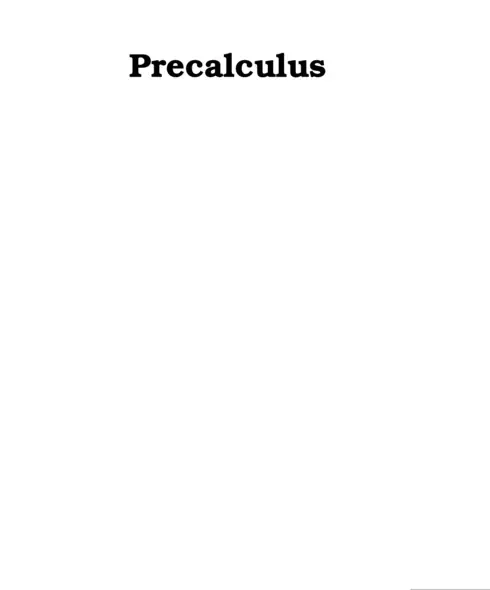 Calculus
Precalculus
View Precalculus — book Algebra
Linear Algebra
View Linear Algebra — book Applied



