
 Calculus
Textbook
Whitman Calculus
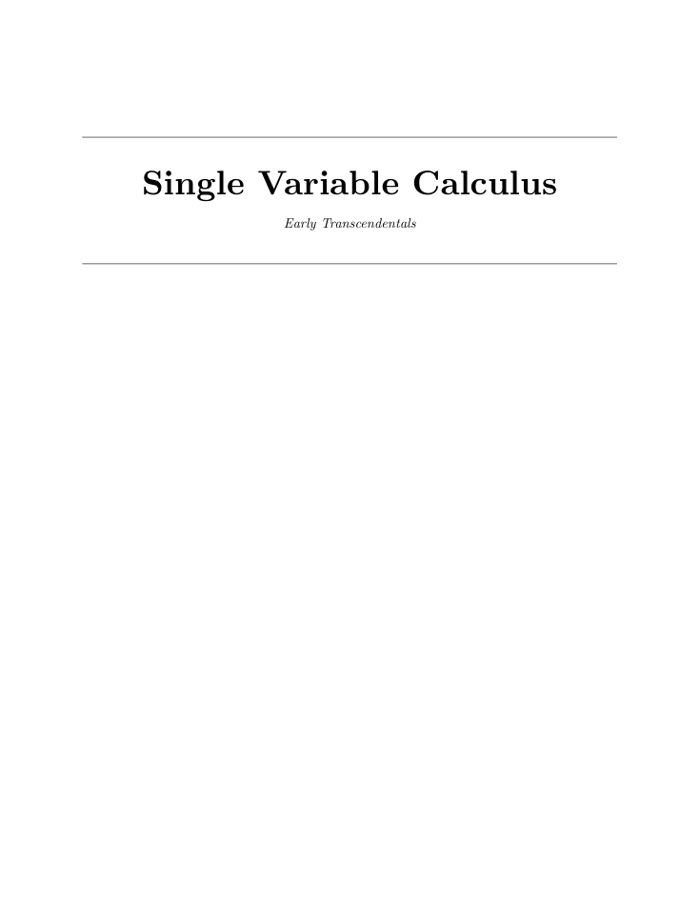
Not rated yetRate this bookWhitman Calculus provides a concise introduction to single-variable differential and integral calculus. The linked PDF is titled Single Variable Calculus: Early Transcendentals and was compiled on September 8, 2026. Its eleven chapters run from analytic geometry through derivatives, integrals, polar and parametric descriptions, and infinite series. David Guichard is the principal author; the source acknowledges foundational notes by Neal Koblitz and additional contributions and adapted material. This guide follows the actual linked single-variable file rather than the separate multivariable text. It is designed for learners with secure algebra, functions, and trigonometry who want to connect procedures with limits, rates, accumulation, and approximation. The cover is the authentic title page from this PDF.
Read on the publisher’s website. Opens in a new tab.
 Free
About this book
Whitman Calculus provides a concise introduction to single-variable differential and integral calculus. The linked PDF is titled Single Variable Calculus: Early Transcendentals and was compiled on September 8, 2026. Its eleven chapters run from analytic geometry through derivatives, integrals, polar and parametric descriptions, and infinite series. David Guichard is the principal author; the source acknowledges foundational notes by Neal Koblitz and additional contributions and adapted material. This guide follows the actual linked single-variable file rather than the separate multivariable text. It is designed for learners with secure algebra, functions, and trigonometry who want to connect procedures with limits, rates, accumulation, and approximation. The cover is the authentic title page from this PDF.
Book summary
About this book
Whitman Calculus provides a concise introduction to single-variable differential and integral calculus. The linked PDF is titled Single Variable Calculus: Early Transcendentals and was compiled on September 8, 2026. Its eleven chapters run from analytic geometry through derivatives, integrals, polar and parametric descriptions, and infinite series. David Guichard is the principal author; the source acknowledges foundational notes by Neal Koblitz and additional contributions and adapted material. This guide follows the actual linked single-variable file rather than the separate multivariable text. It is designed for learners with secure algebra, functions, and trigonometry who want to connect procedures with limits, rates, accumulation, and approximation. The cover is the authentic title page from this PDF.
Chapter-by-chapter study guide
Chapter 1: Analytic Geometry
Lines, distances, circles, functions, and transformations supply the language used throughout calculus. Slope expresses a rate of change with units, and a function's domain determines where later limits and derivatives can be considered. Shifts and dilations alter a graph in predictable ways but require distinguishing changes to an input from changes to an output. Distance formulas and circle equations connect algebra with geometry. The chapter is brief, so learners who struggle with these ideas should review them deliberately rather than treating them as optional background. Calculus reasoning becomes harder when algebraic restrictions are overlooked.
Study application: Take a shifted and scaled function, identify its domain and intercepts, and describe the transformation in words. Give the slope of a line a contextual interpretation with units.
Chapter 2: Instantaneous Rate of Change — The Derivative
The derivative develops from slopes of secant lines toward an instantaneous rate through a limit. A derivative at a point and a derivative function are related but distinct objects. Limits describe behavior near a value and need not equal the function's value there. Continuity and differentiability have different requirements, and a corner or other irregularity can prevent a derivative even when the function is continuous. The chapter establishes why a limiting process is needed before introducing efficient rules. Understanding the difference quotient gives meaning to later symbolic calculations.
Study application: Estimate a slope from nearby points, then derive it from the limit definition for a simple function. Compare the estimate with the exact derivative and explain the role of the shrinking interval.
Chapter 3: Rules for Finding Derivatives
The power, linearity, product, quotient, and chain rules convert derivative calculations into systematic steps. Recognizing the expression's structure is essential: a product is not differentiated by multiplying derivatives, and a composition requires the derivative of the outer function evaluated at the inner function. Several rules may be needed in one expression. Simplification can reduce work, but algebraic changes must respect the original domain. These rules are tools grounded in the limit definition, not unrelated recipes. Their usefulness is greatest when each intermediate step remains understandable.
Study application: Differentiate an expression combining a product and composition. Annotate which rule applies at each stage and compare the result with a numerical slope estimate at one allowed input.
Chapter 4: Transcendental Functions
Trigonometric, exponential, logarithmic, and inverse-function derivatives extend the toolkit beyond algebraic expressions. The chapter connects special limits with derivative formulas and develops logarithmic and related techniques. Radian measure matters for the familiar trigonometric derivative rules. Implicit relationships require differentiating dependent quantities with attention to the chain rule. Domain and inverse-range restrictions remain important when evaluating formulas. These functions model qualitatively different behavior, so interpreting a derivative's sign or magnitude should be tied to the underlying growth, decay, or periodic process.
Study application: Differentiate a mixed exponential–trigonometric function and an implicitly defined relation. State the relevant domain restrictions and explain where an extra chain-rule factor enters.
Chapter 5: Curve Sketching
First and second derivatives reveal increasing and decreasing behavior, local extrema, and concavity. Critical points are candidates requiring analysis, not automatic maxima or minima. An inflection point requires a change in concavity rather than merely a zero second derivative. End behavior, asymptotes, and limits complete the picture beyond local features. The chapter includes L'Hôpital's Rule for suitable indeterminate limit forms; it is not a general license to differentiate every numerator and denominator. Combining sign charts with the original function produces a more reliable sketch than plotting a few points alone.
Study application: Build first- and second-derivative sign charts for a function and justify every claimed extremum or inflection point. Check an end-behavior limit and explain whether L'Hôpital's Rule applies.
Chapter 6: Applications of the Derivative
Optimization translates a practical goal into a function on an appropriate domain, then considers critical points and relevant boundaries. Related rates differentiate a relationship among changing quantities before substituting a particular instant. Newton's Method approximates roots through tangent-line updates and depends on a suitable starting value and local behavior. Linear approximation uses a tangent line near a known point. The Mean Value Theorem connects average and instantaneous rates under specified continuity and differentiability conditions. Across these applications, setting up the problem correctly matters as much as taking the derivative.
Study application: Solve a constrained optimization problem by defining variables, domain, and endpoint checks. For a related-rates problem, label changing quantities and constants before differentiating the relationship.
Chapter 7: Integration
Integration develops through accumulation and limiting sums, then connects with antidifferentiation through the Fundamental Theorem of Calculus. A definite integral is a signed accumulation; an indefinite integral describes a family of antiderivatives. Area and net area differ when a function changes sign. The theorem provides an efficient way to evaluate many definite integrals while also explaining how accumulation functions change. Limits of integration and units are part of the meaning, not decoration. The constant of integration belongs to an indefinite result and is handled differently in a definite evaluation.
Study application: Interpret an integral of a changing rate with units. Calculate net accumulation and total positive area separately for a function that crosses the axis, explaining the difference.
Chapter 8: Techniques of Integration
Substitution reverses a chain-rule pattern, integration by parts reverses a product-rule pattern, and trigonometric methods exploit identities or geometric substitutions. Rational functions may need division and partial fractions before integration. Numerical methods provide approximations when a convenient antiderivative is unavailable or data are given directly. Choosing a method requires examining structure rather than trying formulas randomly. A successful symbolic result can be checked by differentiation, while a numerical approximation should be interpreted with its assumptions and error behavior. Changing variables in a definite integral also requires changing bounds or returning to the original variable consistently.
Study application: For several integrals, choose a method and explain the structural clue before calculating. Differentiate one answer and compare two numerical approximations obtained with different subdivision sizes.
Chapter 9: Applications of Integration
Integrals model areas between curves, motion, volumes, average values, work, centers of mass, probability, arc length, and surface area. Each formula comes from adding small contributions with appropriate geometry or units. Signed velocity gives displacement, while total distance needs attention to direction changes. Cross-sectional area and shell methods use different decompositions of a solid. Improper integrals introduce limiting behavior at unbounded intervals or singularities. Probability densities accumulate probability through integrals and must satisfy normalization conditions. The chapter's breadth rewards understanding the construction of a differential contribution instead of memorizing disconnected formulas.
Study application: Set up a volume using a clearly drawn slice or shell, identifying thickness and bounds. In a motion example, calculate both displacement and total distance and explain where the sign changes matter.
Chapter 10: Polar Coordinates, Parametric Equations
Alternative descriptions can make curves simpler even when they are not graphs of a single function of x. Polar calculus relates radius and angle to slopes and areas, while parametric equations express coordinates through a common parameter. Differentiation requires relating the rates of change of coordinates rather than treating the parameter as an ordinary horizontal variable. Tracing direction, repeated points, and zero denominators need attention. A geometric point can have several polar representations, so limits and intervals should match the intended trace. These methods extend earlier derivative and integral ideas rather than replacing them.
Study application: Trace a parametric curve over a stated interval, mark direction, and locate a horizontal or vertical tangent using the coordinate derivatives. Explain why the same geometric curve can be traversed at different speeds.
Chapter 11: Sequences and Series
A sequence is an ordered list; a series concerns the limit of its partial sums. Terms approaching zero are necessary for convergence of a series but are not sufficient. Integral, comparison, alternating, ratio, and root tests apply under different conditions. Absolute and conditional convergence distinguish important behavior, while power series require an interval of convergence with endpoints checked separately. Taylor representations and approximations connect derivatives with polynomial models and error considerations. The central habit is choosing a test for a reason and stating its conditions, rather than treating every inconclusive result as divergence.
Study application: Compare a convergent and divergent series whose terms both approach zero. Determine a power series' radius and examine endpoints separately, then use a Taylor approximation with an explicit statement of where it is being applied.
Study instructions
- Review algebraic simplification, domains, trigonometry, and function transformations before beginning. Write exact expressions until a numerical approximation is needed.
- Connect each derivative calculation with slope or rate and each integral with accumulation. Carry units through applications.
- For optimization and related rates, draw the situation and define variables before differentiating. Check boundaries and physical restrictions.
- State the conditions for theorems and convergence tests. An inapplicable or inconclusive test does not settle the problem.
- Check antiderivatives by differentiation and compare symbolic results with numerical or graphical estimates where useful.
- Keep displacement and total distance, signed area and area, sequence limits and series convergence, and local and absolute extrema distinct.
- Attempt exercises independently and keep a record of the first incorrect reasoning step, then revisit it after a delay.
Questions for reflection
- Why can a function be continuous without being differentiable?
- How does the Fundamental Theorem connect rates with accumulation?
- Why must optimization include a domain and boundary analysis?
- Why do terms approaching zero fail to guarantee series convergence?
- What changes when the same curve is described parametrically?
Sources and edition coverage
Coverage follows the 320-page linked Single Variable Calculus: Early Transcendentals PDF compiled September 8, 2026, not the separate multivariable volume. David Guichard is the principal author; front matter acknowledges Neal Koblitz, H. Jerome Keisler material, Albert Schueller, Barry Balof, Mike Wills, and other exercise sources. The catalog's 2010 entry is historical; this guide identifies the actual linked compilation. Its original title page is used as the cover. This is an original study guide. Read the linked textbook for its full explanations, evidence, worked examples, exercises, and references. The study applications above are new practice suggestions, not quoted textbook exercises.
About access & copyright
This page provides book information and study material. Full-text access is provided by the original publisher or authorised source; a listing does not grant permission to republish the book.
Read our Library Access & Copyright policyExplore the contents
Check the chapters covered in this edition.
Visit the official source
See reading, preview or purchase options.
Save for later
Keep this textbook in your saved collection.
Reader ratings & reviews
Share your thoughts
Your review helps other students choose the right resources.
KEEP LEARNING
Your next great read
Calculus Geometry and Trigonometry
College Trigonometry
View College Trigonometry — book Calculus
Vector Calculus
View Vector Calculus — bookBasic Analysis: Introduction to Real Analysis
Basic Analysis: Introduction to Real Analysis
View Basic Analysis: Introduction to Real Analysis — bookCalculus for the Life Sciences: A Modeling Approach
Calculus for the Life Sciences: A Modeling Approach
View Calculus for the Life Sciences: A Modeling Approach — book Applied
Introductory Statistics
View Introductory Statistics — book Applied
 Discrete Structures
View Applied Discrete Structures — book Calculus
Precalculus
View Precalculus — book Algebra
Linear Algebra
View Linear Algebra — book Applied



