
 Abelian number fields
Textbook
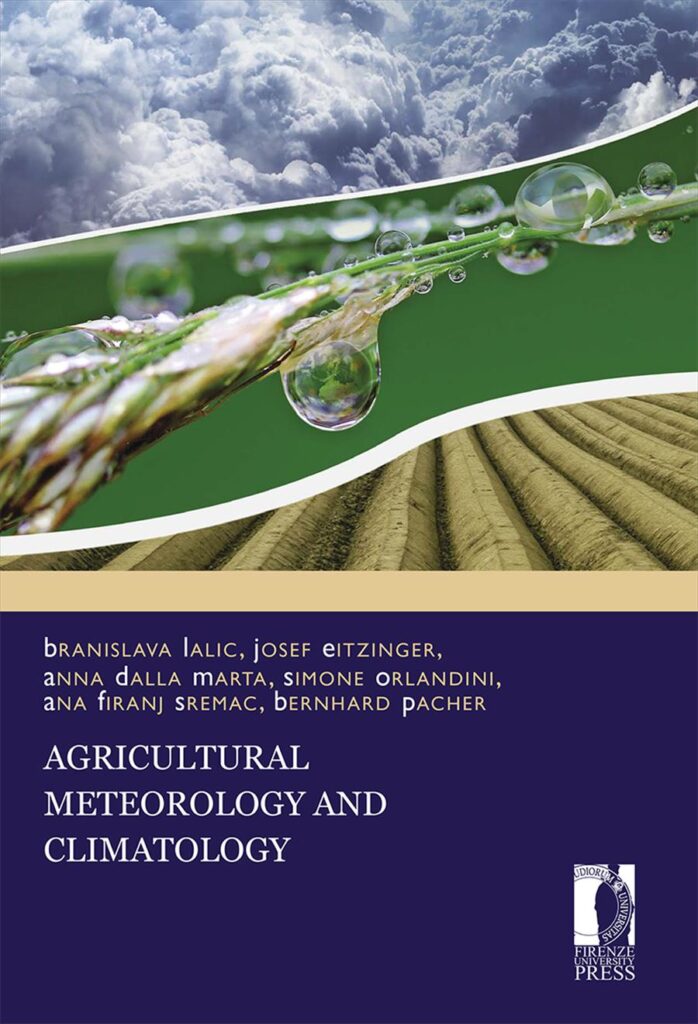
Agricultural Meteorology and Climatology
Not rated yetRate this bookAgricultural Meteorology and Climatology explains the exchanges linking weather, climate, soil, and crops. Branislava Lalic, Josef Eitzinger, Anna Dalla Marta, and coauthors develop fourteen chapters from atmospheric composition and energy balance through water, phenology, extremes, risk, models, measurement, and remote sensing. This guide also covers the numerical-practice section and emphasizes units, scale, field evidence, and uncertainty.
Free reading is available at the official source. Opens in a new tab.
 Free
About this book
Agricultural Meteorology and Climatology explains the exchanges linking weather, climate, soil, and crops. Branislava Lalic, Josef Eitzinger, Anna Dalla Marta, and coauthors develop fourteen chapters from atmospheric composition and energy balance through water, phenology, extremes, risk, models, measurement, and remote sensing. This guide also covers the numerical-practice section and emphasizes units, scale, field evidence, and uncertainty.
Chapter-wise summaries and study tasks
Chapter 1 Origin and composition of the atmosphere
The opening chapter treats the atmosphere as a changing mixture whose composition both influences and is influenced by life. Its origin, vertical organization, major constituents, and variable components provide the foundation for later discussions of radiation, heat, and water. For agriculture, gases are not merely background: carbon dioxide participates in photosynthesis, oxygen supports respiration, and pollutants can affect plant processes. Vegetation also changes atmospheric exchanges through growth, respiration, and other biological activity. The important connection is reciprocal rather than one-directional. Distinguish a gas's concentration from the rate at which it enters or leaves a system, and keep the relevant spatial and temporal scale explicit.
Study task. Draw an atmosphere-vegetation exchange diagram, separating stocks from fluxes; explain two plant responses to atmospheric composition and two ways vegetation changes its surroundings.
Chapter 2 Energy balance of the atmosphere
Radiation transfers energy through the atmosphere and between the surface and its surroundings. Shortwave solar input and longwave terrestrial emission have different sources and interactions, while reflection, absorption, and transmission determine how much energy reaches a crop. The energy balance organizes these exchanges and connects them with heating and evaporation. Plants respond to radiation through photosynthesis, development, and potential stress, but their canopies also modify radiation through shading, interception, and surface properties. A radiation measurement must be interpreted with its units, interval, location, and orientation. Incoming energy is not identical to energy absorbed by a canopy or available for a specific biological process.
Study task. Construct a labeled daily radiation budget for a hypothetical canopy; convert a constant flux to energy over a stated interval and identify the simplifications involved.
Chapter 3 Soil and air temperature
Soil and air temperatures emerge from energy transfer and material properties rather than simply tracking sunshine. Heat capacity, conductivity, moisture, surface cover, and depth affect the magnitude and timing of soil heating and cooling. Air temperature varies with mixing and exchanges near the surface. These conditions influence germination, development, metabolism, and injury, with responses depending on crop and growth stage. Vegetation in turn alters temperature through shade, evapotranspiration, and changes to surface exchange. Distinguish heat as transferred energy from temperature as a state variable, and avoid assuming that a screen-level air observation represents the temperature experienced by every leaf or seed.
Study task. Compare hypothetical daily temperature curves for bare and covered soil at two depths; explain differences in amplitude and timing using thermal properties and surface exchange.
Chapter 4 Air humidity
Humidity describes atmospheric water vapor through measures that answer different questions. Vapor pressure, relative humidity, specific or absolute humidity, dew point, and vapor-pressure deficit should not be treated as interchangeable. Relative humidity can change when temperature changes even without adding water vapor. Phase changes connect humidity with latent heat, condensation, evaporation, and the wider water cycle. For plants, atmospheric demand interacts with stomatal behavior, water supply, and disease conditions; vegetation also modifies local humidity through transpiration. Interpret a humidity reading in relation to temperature and the relevant process rather than assuming a single percentage directly expresses crop water stress.
Study task. Use two hypothetical air samples to distinguish relative humidity from actual vapor content; explain what vapor-pressure deficit adds to a discussion of plant-atmosphere exchange.
Chapter 5 Clouds and precipitation
Cloud formation depends on moisture, lifting, cooling, saturation, and atmospheric stability. Adiabatic processes help explain how moving air can cool without exchanging heat directly with its surroundings. Cloud types and precipitation processes connect the physical state of water with observed weather. Hydrometeors include more than rain, and deposits such as dew or frost involve different mechanisms from falling precipitation. Clouds alter radiation as well as water input, making their agricultural effects depend on timing, temperature, intensity, and crop condition. Vegetation can also influence exchanges relevant to cloud and rainfall processes. A rainfall total alone cannot describe infiltration, erosion, or the usefulness of water to a crop.
Study task. Compare a gentle rainfall and a short intense storm with the same total depth; explain likely differences in interception, infiltration, runoff, and crop effects.
Chapter 6 Atmospheric circulations and winds
Atmospheric motion reflects pressure-gradient forces, Earth's rotation, friction, and differences in heating. Global circulation, synoptic systems, local winds, and periodic breezes operate at different scales and interact with terrain and vegetation. Wind transports momentum, heat, and moisture, affecting crop water demand, pollination, mechanical damage, and conditions for field operations. Canopies and shelterbelts modify wind speed and turbulence rather than simply stopping air movement. Their effect depends on structure and location, so shelter design involves trade-offs and site-specific evidence. Connect an observed wind pattern to its driving scale before assuming a local management change can control it.
Study task. Sketch airflow around a hypothetical shelterbelt and identify expected benefits and possible drawbacks; separate the local modification from the larger-scale wind that drives it.
Chapter 7 Soil and water
The crop-soil water balance accounts for inputs, storage changes, and losses over a defined root zone and period. Precipitation or irrigation is divided among interception, infiltration, runoff, drainage, evaporation, and plant use. Soil texture, structure, rooting, and water-holding characteristics affect how much stored water is available rather than merely present. Evapotranspiration links the water balance with surface energy exchange. A simple balance is useful only when its boundaries, sign convention, and units are consistent. Unmeasured flows and uncertain root depth can produce a misleadingly precise result. Use calculations to expose assumptions and identify observations needed for a management decision.
Study task. Prepare a fictional weekly root-zone water balance with rainfall, irrigation, drainage, and evapotranspiration; calculate storage change and discuss the largest source of uncertainty.
Chapter 8 Phenology
Phenology studies the timing of recurring biological events and their environmental controls. Crop phases, pest development, and disease timing respond to combinations of temperature, day length, moisture, and other conditions. Thermal-time models provide a practical representation, but base temperatures, thresholds, and responses must suit the organism and purpose. Low temperatures can delay development or supply requirements such as chilling or vernalization, so warming does not have one uniform effect. Phenological observations help schedule operations and interpret agroclimatic change. Distinguish development through stages from accumulation of biomass, and compare modeled timing with observed stages before relying on a forecast.
Study task. Calculate simple accumulated degree days from hypothetical temperatures using a stated convention; compare predicted and observed stages and explain why parameters cannot be transferred blindly between crops.
Chapter 9 Extreme meteorological events
Extreme events create agricultural consequences through their timing, duration, intensity, and interaction with crop condition. Drought differs from a permanently dry climate, while heat, frost, hail, wind, heavy rain, and flooding present different mechanisms of injury. A weather threshold becomes meaningful only in relation to the exposed system and its susceptibility. Protection measures have practical limits, costs, and potential side effects. Early warning links monitoring and prediction with communication and an actionable response; issuing a forecast does not ensure that a farmer can use it. Examine compound events and growth-stage sensitivity rather than evaluating each hazard in isolation.
Study task. Create a fictional crop-stage hazard matrix for frost, heat, and water shortage; specify what a warning must communicate and what evidence is needed before choosing a response.
Chapter 10 Risk management
Risk management separates a hazard from the exposure and vulnerability that turn it into potential loss. The same weather event can produce very different outcomes across farms because crops, infrastructure, resources, and response capacity differ. Assessment identifies the event, affected assets or activities, probability or uncertainty, and consequences. Management options can reduce exposure, reduce vulnerability, share financial consequences, or improve preparedness. Adaptation addresses responses to climate-related conditions, while mitigation concerns reducing contributions to climate change. Climate-smart agriculture brings multiple objectives into discussion, but an option should still be tested for local suitability and trade-offs rather than accepted as a universal package.
Study task. Compare two fictional farms exposed to the same storm; separate hazard, exposure, and vulnerability, then evaluate two risk-reduction options and their costs.
Chapter 11 Agrometeorological models
Agrometeorological models represent selected processes in the soil-plant-atmosphere system, from simple indices to interacting crop simulations. Structure, inputs, parameters, scale, and intended use determine what a model can reasonably answer. Calibration adjusts a model using observations, while validation examines performance against appropriate evidence not simply reused to tune it. Weather extremes can expose weaknesses outside the conditions represented in development data. Crop, pest, disease, and agroclimatic models have different purposes, so accuracy must be assessed against the relevant decision. A model output is conditional on assumptions and input quality; numerical detail should not be mistaken for certainty.
Study task. Outline a crop-model evaluation using separate calibration and evaluation data, relevant performance measures, and an extreme-weather case; identify a scale mismatch that could undermine application.
Chapter 12 Climate, climate change and agriculture
Climate describes distributions and patterns over time, while weather concerns particular conditions and events. Classification and regionalization help organize differences but cannot capture every local feature. The chapter examines climate change through interactions among temperature, water, carbon dioxide, extremes, and agricultural systems. Effects vary by location, crop, management, and constraints; a change favorable for one process may intensify another risk. Impact studies combine climate and agricultural models and therefore carry several sources of uncertainty. Adaptation options involve water, soils, crop genetics, technology, and management, while mitigation considers agricultural emissions and sinks. Treat the book's 2018 scenarios and assessments as source-edition material rather than current projections.
Study task. Develop a fictional adaptation comparison for a water-limited farm, stating scenario assumptions, uncertainty, co-benefits, possible maladaptation, and the information needed for local evaluation.
Chapter 13 Measurement methods in agrometeorology
Measurement connects physical processes with usable observations. Sensor principles, instrument choice, calibration, exposure, installation, and maintenance all influence data quality. A weather station can produce consistent numbers while being unrepresentative of the field because of siting or surrounding obstructions. Research measurements and operational agricultural monitoring may require different resolution, accuracy, and support. Temperature, humidity, radiation, precipitation, wind, and other variables each have characteristic measurement issues. Document units, interval, location, height or depth, and instrument changes so that later comparisons remain interpretable. Quality control should distinguish a plausible unusual event from an instrument error rather than removing every extreme automatically.
Study task. Design a fictional station metadata sheet and maintenance plan; identify siting risks and checks for missing, impossible, or suspicious values without automatically deleting valid extremes.
Chapter 14 Remote sensing in agriculture
Remote sensing gathers information without direct contact using ground, airborne, or satellite platforms. Passive instruments observe reflected or emitted energy, while active instruments transmit energy and analyze its return. Vegetation and phenology applications depend on how signals relate to canopy properties, and microwave approaches offer different information about soil moisture. Spatial, temporal, and spectral resolution constrain what can be inferred. Cloud, background soil, canopy structure, and processing choices can affect an apparent crop signal. Remote observations are not direct substitutes for every field measurement; interpretation and validation connect a sensor product with the agricultural property of interest.
Study task. Compare an optical vegetation observation with a microwave soil-moisture product for a fictional monitoring problem; state resolution limits, likely confounders, and field-validation needs.
Numerical examples and answers
The numerical section applies the physical foundations through calculations related to the first seven chapters. It covers unit conversions and quantities associated with radiation, temperature, humidity, precipitation, wind, and water. Worked calculations help reveal whether a learner understands an interval, flux, storage, or rate rather than only a formula's symbols. Answers allow checking, but discrepancies should be traced through assumptions and units instead of corrected by copying a result. The associated spreadsheet materials mentioned by the source are supplementary resources, not a requirement for understanding dimensional reasoning. A defensible solution records the method and gives an appropriately precise answer.
Study task. Choose three exercises from different topic groups, solve them independently with dimensional checks, and use the source's answers to diagnose rather than conceal any error.
How to study this book
- Draw the relevant soil-plant-atmosphere system and label its boundaries before working with a balance equation.
- Keep a unit ledger distinguishing fluxes, accumulated amounts, concentrations, and storage; show every conversion.
- Connect each physical process to a crop response and a feedback from vegetation where the chapter supports one.
- Compare model predictions with appropriate observations and separate parameter uncertainty from measurement and scenario uncertainty.
- Use the numerical examples after the related theory, and evaluate proposed field actions using site-specific expertise and current observations.
Questions for reflection
- Is an apparent agricultural problem caused by the hazard, exposure, vulnerability, or a combination?
- Does the measurement represent the scale at which the decision is being made?
- Which assumptions connect a climate scenario or sensor signal with a crop outcome?
- Could an adaptation reduce one risk while worsening another?
Source edition and coverage
The guide follows the fourteen chapters and numerical-examples section of the 2018 Firenze University Press book by Branislava Lalic, Josef Eitzinger, Anna Dalla Marta, Simone Orlandini, Ana Firanj Sremac, and Bernhard Pacher. Its climate assessments, technology examples, and supplementary-resource references belong to that edition; the guide does not provide current site-specific forecasts or farm prescriptions. These are original study explanations and learning tasks. Read the complete book at the official source.
About access & copyright
This page provides book information and study material. Full-text access is provided by the original publisher or authorised source; a listing does not grant permission to republish the book.
Read our Library Access & Copyright policyExplore the contents
Check the chapters covered in this edition.
Visit the official source
See reading, preview or purchase options.
Save for later
Keep this textbook in your saved collection.
Reader ratings & reviews
Share your thoughts
Your review helps other students choose the right resources.
KEEP LEARNING
Your next great read
Abelian number fieldsEnvironmental Toxicology
Environmental Toxicology
View Environmental Toxicology — bookVaccination Programmes
Vaccination Programmes
View Vaccination Programmes — bookRelativistic Quantum Mechanics
Relativistic Quantum Mechanics
View Relativistic Quantum Mechanics — bookAerospace Structures
Aerospace Structures
View Aerospace Structures — book Language teaching and learning
In the Community: An Intermediate Reading and Writing Textbook
View In the Community: An Intermediate Reading and Writing Textbook — book Communication Studies
Technical Writing Essentials 2nd Edition
View Technical Writing Essentials 2nd Edition — book Language learning for academic, technical and scientific purposes
Technical Communication in Engineering: A Place-Based Approach
View Technical Communication in Engineering: A Place-Based Approach — book mathematical modelling
Ecosystem Modelling with EwE
View Ecosystem Modelling with EwE — book Dietetics and nutrition



