
 Mathematics
AppliedTextbook
Introduction to Probability
Not rated yetRate this bookIntroduction to Probability develops probability through examples, simulation, combinatorics, random variables, limit theorems, and stochastic processes. The linked Dartmouth PDF identifies itself as the CHANCE Project version dated 4 July 2006, based on Grinstead and Snell’s second edition, with Peter G. Doyle credited for that version. Twelve chapters move from discrete and continuous probability to generating functions, Markov chains, and random walks. This guide follows the complete 518-page file. Its central approach combines exact reasoning and computation while keeping the assumptions of a probability model visible.
Read on the publisher’s website. Opens in a new tab.
 Free
About this book
Overview
Introduction to Probability develops probability through examples, simulation, combinatorics, random variables, limit theorems, and stochastic processes. The linked Dartmouth PDF identifies itself as the CHANCE Project version dated 4 July 2006, based on Grinstead and Snell’s second edition, with Peter G. Doyle credited for that version. Twelve chapters move from discrete and continuous probability to generating functions, Markov chains, and random walks. This guide follows the complete 518-page file. Its central approach combines exact reasoning and computation while keeping the assumptions of a probability model visible.
How to study this book
Define the sample space, events, random variables, and assumptions before calculating. Use small cases or simulation to explore a conjecture, then distinguish that evidence from an exact derivation. Keep probability mass, density, distribution function, expectation, and observed frequency separate. Check boundary cases, normalization, units, and whether an answer lies in a valid range. For conditional problems, redraw the information structure instead of relying only on a formula. When applying a limit theorem, state its conditions and explain what the approximation concerns. Compare theoretical results with simulated variation rather than expecting every run to match an average.
Chapter and section study guide
Chapter 1 — Discrete Probability Distributions
Discrete models assign probability to countable outcomes and combine outcomes into events. Simulation helps explore frequencies, but a model still requires assumptions about the mechanism producing outcomes. Equal likelihood must be justified rather than inferred from a neat list. The chapter connects exact calculations with computational experiments and examples. Distinguish a random outcome from a random variable and a theoretical probability from an observed proportion. Check that probabilities are nonnegative and sum appropriately. A carefully defined sample space often resolves more difficulty than a complicated calculation.
Study application: Construct and simulate a small discrete model, comparing observed frequencies with exact probabilities and explaining finite-run variation.
Chapter 2 — Continuous Probability Densities
Continuous models use densities and intervals rather than assigning positive probability to each individual point. A density value is not itself an event probability; integration connects the function with areas and probabilities. Simulation provides intuition about the shape and accumulation of outcomes. The chapter develops the relationship among density, distribution, and sampling. Check support and normalization before applying a model. Distinguish a mathematical idealization from the precision of an actual measurement, and explain why an exact point can have zero probability without being logically impossible.
Study application: Normalize a simple density and calculate two interval probabilities, explaining why evaluating the density at a point is a different operation.
Chapter 3 — Combinatorics
Permutations, combinations, and card-shuffling examples develop methods for counting outcomes and studying random arrangements. The main challenge is matching the counting model with order, repetition, and restrictions. Two formulas that look similar can count different objects. The chapter connects combinatorial structure with probability while showing that not every complicated random process produces a uniform distribution. Explain why each outcome is counted once and why the probability assignment is justified. Small examples can expose overcounting before a general argument is attempted.
Study application: Solve a selection problem in two ways and use a small case to verify that order and repetition have been handled consistently.
Chapter 4 — Conditional Probability
Conditioning changes the information available and therefore the relevant probability model. Bayes’ rule, independence, and conditional distributions require careful attention to the events and their relationships. A reverse conditional is generally not the same as the original one, and a rare base rate can strongly affect an inference. Independence is a mathematical property to establish, not a synonym for events being unrelated in ordinary speech. The chapter develops reasoning that combines prior structure with new information. Tables and trees can clarify the calculation and prevent denominator errors.
Study application: Build a probability tree for an imperfect test and explain how the base rate affects the probability after a positive result.
Chapter 5 — Distributions and Densities
Named distributions provide reusable models for particular mechanisms and assumptions. Their parameters, support, and relationships matter more than recognizing a familiar formula. The chapter develops discrete and continuous families and ways to connect or transform them. A distribution should be selected because its structure matches the process, not because it fits a convenient calculation. Distinguish the probability model from observed data and examine whether independence or constant-rate assumptions are plausible. Compare families through their shapes and mechanisms as well as their means.
Study application: Match two practical random mechanisms with candidate distributions and state the assumptions that justify or weaken each choice.
Chapter 6 — Expected Value and Variance
Expectation summarizes a random variable through a weighted average, while variance describes spread around that mean. A long-run average need not be a likely individual outcome. Linearity of expectation is powerful because it does not require independence, whereas variance calculations involve additional relationships. The chapter connects moments with interpretation and useful inequalities. Check whether an expectation exists before using it and keep units consistent: variance has squared units. Explain what the summary reveals and what features of a distribution it can conceal.
Study application: Compute the expectation of a sum without assuming independence, then explain what extra information is needed for its variance.
Chapter 7 — Sums of Random Variables
Sums connect repeated experiments with distributions of totals. Convolution and related reasoning account for the combinations of component values, while independence determines which simplifications are valid. The chapter develops exact distributions and prepares for limit theorems. A sum’s distribution is not determined by its mean alone. Distinguish adding random variables from mixing between alternative distributions. Use small discrete examples to see how probabilities combine, then extend the logic carefully. Check the support and normalization of the resulting distribution.
Study application: Derive the distribution of a sum of two small discrete variables and compare independent and dependent versions of the same marginals.
Chapter 8 — Law of Large Numbers
The law of large numbers formalizes the stabilization of averages under suitable conditions. It does not promise that short runs will look balanced or that a particular next outcome compensates for earlier ones. The chapter connects sample averages with expectation and the interpretation of probability through repeated trials. Convergence statements require precision about what changes and what is being bounded. Simulation can illustrate the phenomenon while also showing variation between runs. Distinguish a theorem about averages from a claim that individual outcomes become less variable.
Study application: Simulate several running averages and explain why their stabilization does not make the next individual outcome predictable.
Chapter 9 — Central Limit Theorem
The central limit theorem describes the approximate distribution of appropriately standardized sums or averages under stated conditions. It concerns a distributional shape and scaling, not the claim that all original observations are normally distributed. The chapter connects exact models with normal approximations and their practical limitations. Centering and scaling must be correct, and an approximation can be poor in tails or at inadequate sample sizes. Compare the theorem with the law of large numbers: one concerns the behavior of averages around a limit, while the other describes their fluctuations.
Study application: Standardize a sum correctly and compare an approximate probability with an exact or simulated result, noting where the approximation is weakest.
Chapter 10 — Generating Functions
Generating functions encode probability sequences in an algebraic object that can simplify calculations involving sums, moments, and distributions. Their usefulness depends on understanding what coefficients and operations represent. Products can correspond to sums of independent variables, while derivatives reveal particular summaries under appropriate conditions. The chapter develops a bridge between combinatorial structure and probability. Avoid manipulating a series without tracking its probabilistic meaning or convergence where relevant. Use a small distribution to verify the correspondence before applying the method to a more complicated construction.
Study application: Construct a probability generating function, recover its probabilities, and use it to analyze a sum of independent copies.
Chapter 11 — Markov Chains
A Markov chain describes transitions among states when the next-state distribution depends on the current state in the specified way. Transition matrices, paths, classes, and long-run behavior connect local rules with system evolution. A stationary distribution and convergence to it are different claims requiring different conditions. The chapter develops finite-state examples and analytical methods. Define states so that the assumed memory property is credible. Check row or column conventions before multiplying matrices, and interpret a long-run result in the context of the chain’s structure.
Study application: Build a small transition matrix and distinguish a stationary distribution from the claim that every starting state converges to it.
Chapter 12 — Random Walks
Random walks connect repeated random steps with paths, hitting events, return behavior, and broader probabilistic structure. Boundary conditions and step rules determine the questions and results. The chapter brings together conditioning, counting, expectation, generating functions, and Markov reasoning. A path-level event differs from the distribution of position at one fixed time. Carefully identify whether the problem concerns reaching a boundary, returning, or remaining within a region. Use simulation to explore behavior while relying on explicit arguments for exact probabilities or expectations.
Study application: Compare a walk’s position after a fixed number of steps with its probability of ever reaching a boundary, explaining why they are different questions.
Reflection and review
- What assumption justifies equal likelihood or independence in your model?
- How do the law of large numbers and central limit theorem answer different questions?
- Which simulation result illustrates a theorem without proving it?
Source and edition notes
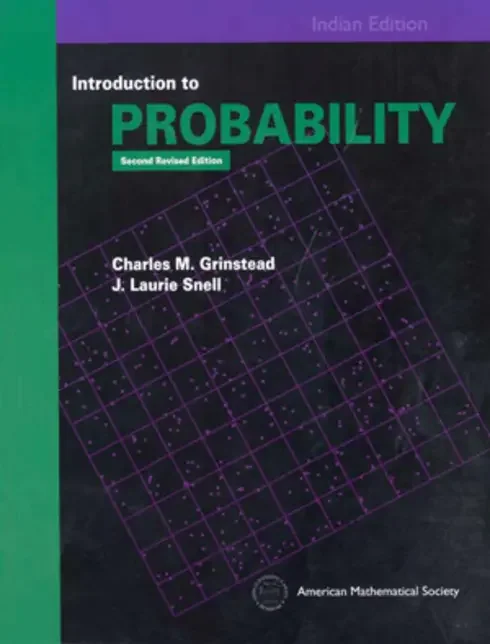
CHANCE Project version dated 4 July 2006, based on the second edition; twelve chapters, 518 PDF pages. The guide identifies the exact 4 July 2006 CHANCE version and its relationship to the second edition. The original catalog cover is used, and the full source PDF remains on Dartmouth’s site.
Book summary
Overview
Introduction to Probability develops probability through examples, simulation, combinatorics, random variables, limit theorems, and stochastic processes. The linked Dartmouth PDF identifies itself as the CHANCE Project version dated 4 July 2006, based on Grinstead and Snell’s second edition, with Peter G. Doyle credited for that version. Twelve chapters move from discrete and continuous probability to generating functions, Markov chains, and random walks. This guide follows the complete 518-page file. Its central approach combines exact reasoning and computation while keeping the assumptions of a probability model visible.
How to study this book
Define the sample space, events, random variables, and assumptions before calculating. Use small cases or simulation to explore a conjecture, then distinguish that evidence from an exact derivation. Keep probability mass, density, distribution function, expectation, and observed frequency separate. Check boundary cases, normalization, units, and whether an answer lies in a valid range. For conditional problems, redraw the information structure instead of relying only on a formula. When applying a limit theorem, state its conditions and explain what the approximation concerns. Compare theoretical results with simulated variation rather than expecting every run to match an average.
Chapter and section study guide
Chapter 1 — Discrete Probability Distributions
Discrete models assign probability to countable outcomes and combine outcomes into events. Simulation helps explore frequencies, but a model still requires assumptions about the mechanism producing outcomes. Equal likelihood must be justified rather than inferred from a neat list. The chapter connects exact calculations with computational experiments and examples. Distinguish a random outcome from a random variable and a theoretical probability from an observed proportion. Check that probabilities are nonnegative and sum appropriately. A carefully defined sample space often resolves more difficulty than a complicated calculation.
Study application: Construct and simulate a small discrete model, comparing observed frequencies with exact probabilities and explaining finite-run variation.
Chapter 2 — Continuous Probability Densities
Continuous models use densities and intervals rather than assigning positive probability to each individual point. A density value is not itself an event probability; integration connects the function with areas and probabilities. Simulation provides intuition about the shape and accumulation of outcomes. The chapter develops the relationship among density, distribution, and sampling. Check support and normalization before applying a model. Distinguish a mathematical idealization from the precision of an actual measurement, and explain why an exact point can have zero probability without being logically impossible.
Study application: Normalize a simple density and calculate two interval probabilities, explaining why evaluating the density at a point is a different operation.
Chapter 3 — Combinatorics
Permutations, combinations, and card-shuffling examples develop methods for counting outcomes and studying random arrangements. The main challenge is matching the counting model with order, repetition, and restrictions. Two formulas that look similar can count different objects. The chapter connects combinatorial structure with probability while showing that not every complicated random process produces a uniform distribution. Explain why each outcome is counted once and why the probability assignment is justified. Small examples can expose overcounting before a general argument is attempted.
Study application: Solve a selection problem in two ways and use a small case to verify that order and repetition have been handled consistently.
Chapter 4 — Conditional Probability
Conditioning changes the information available and therefore the relevant probability model. Bayes’ rule, independence, and conditional distributions require careful attention to the events and their relationships. A reverse conditional is generally not the same as the original one, and a rare base rate can strongly affect an inference. Independence is a mathematical property to establish, not a synonym for events being unrelated in ordinary speech. The chapter develops reasoning that combines prior structure with new information. Tables and trees can clarify the calculation and prevent denominator errors.
Study application: Build a probability tree for an imperfect test and explain how the base rate affects the probability after a positive result.
Chapter 5 — Distributions and Densities
Named distributions provide reusable models for particular mechanisms and assumptions. Their parameters, support, and relationships matter more than recognizing a familiar formula. The chapter develops discrete and continuous families and ways to connect or transform them. A distribution should be selected because its structure matches the process, not because it fits a convenient calculation. Distinguish the probability model from observed data and examine whether independence or constant-rate assumptions are plausible. Compare families through their shapes and mechanisms as well as their means.
Study application: Match two practical random mechanisms with candidate distributions and state the assumptions that justify or weaken each choice.
Chapter 6 — Expected Value and Variance
Expectation summarizes a random variable through a weighted average, while variance describes spread around that mean. A long-run average need not be a likely individual outcome. Linearity of expectation is powerful because it does not require independence, whereas variance calculations involve additional relationships. The chapter connects moments with interpretation and useful inequalities. Check whether an expectation exists before using it and keep units consistent: variance has squared units. Explain what the summary reveals and what features of a distribution it can conceal.
Study application: Compute the expectation of a sum without assuming independence, then explain what extra information is needed for its variance.
Chapter 7 — Sums of Random Variables
Sums connect repeated experiments with distributions of totals. Convolution and related reasoning account for the combinations of component values, while independence determines which simplifications are valid. The chapter develops exact distributions and prepares for limit theorems. A sum’s distribution is not determined by its mean alone. Distinguish adding random variables from mixing between alternative distributions. Use small discrete examples to see how probabilities combine, then extend the logic carefully. Check the support and normalization of the resulting distribution.
Study application: Derive the distribution of a sum of two small discrete variables and compare independent and dependent versions of the same marginals.
Chapter 8 — Law of Large Numbers
The law of large numbers formalizes the stabilization of averages under suitable conditions. It does not promise that short runs will look balanced or that a particular next outcome compensates for earlier ones. The chapter connects sample averages with expectation and the interpretation of probability through repeated trials. Convergence statements require precision about what changes and what is being bounded. Simulation can illustrate the phenomenon while also showing variation between runs. Distinguish a theorem about averages from a claim that individual outcomes become less variable.
Study application: Simulate several running averages and explain why their stabilization does not make the next individual outcome predictable.
Chapter 9 — Central Limit Theorem
The central limit theorem describes the approximate distribution of appropriately standardized sums or averages under stated conditions. It concerns a distributional shape and scaling, not the claim that all original observations are normally distributed. The chapter connects exact models with normal approximations and their practical limitations. Centering and scaling must be correct, and an approximation can be poor in tails or at inadequate sample sizes. Compare the theorem with the law of large numbers: one concerns the behavior of averages around a limit, while the other describes their fluctuations.
Study application: Standardize a sum correctly and compare an approximate probability with an exact or simulated result, noting where the approximation is weakest.
Chapter 10 — Generating Functions
Generating functions encode probability sequences in an algebraic object that can simplify calculations involving sums, moments, and distributions. Their usefulness depends on understanding what coefficients and operations represent. Products can correspond to sums of independent variables, while derivatives reveal particular summaries under appropriate conditions. The chapter develops a bridge between combinatorial structure and probability. Avoid manipulating a series without tracking its probabilistic meaning or convergence where relevant. Use a small distribution to verify the correspondence before applying the method to a more complicated construction.
Study application: Construct a probability generating function, recover its probabilities, and use it to analyze a sum of independent copies.
Chapter 11 — Markov Chains
A Markov chain describes transitions among states when the next-state distribution depends on the current state in the specified way. Transition matrices, paths, classes, and long-run behavior connect local rules with system evolution. A stationary distribution and convergence to it are different claims requiring different conditions. The chapter develops finite-state examples and analytical methods. Define states so that the assumed memory property is credible. Check row or column conventions before multiplying matrices, and interpret a long-run result in the context of the chain’s structure.
Study application: Build a small transition matrix and distinguish a stationary distribution from the claim that every starting state converges to it.
Chapter 12 — Random Walks
Random walks connect repeated random steps with paths, hitting events, return behavior, and broader probabilistic structure. Boundary conditions and step rules determine the questions and results. The chapter brings together conditioning, counting, expectation, generating functions, and Markov reasoning. A path-level event differs from the distribution of position at one fixed time. Carefully identify whether the problem concerns reaching a boundary, returning, or remaining within a region. Use simulation to explore behavior while relying on explicit arguments for exact probabilities or expectations.
Study application: Compare a walk’s position after a fixed number of steps with its probability of ever reaching a boundary, explaining why they are different questions.
Reflection and review
- What assumption justifies equal likelihood or independence in your model?
- How do the law of large numbers and central limit theorem answer different questions?
- Which simulation result illustrates a theorem without proving it?
Source and edition notes
CHANCE Project version dated 4 July 2006, based on the second edition; twelve chapters, 518 PDF pages. The guide identifies the exact 4 July 2006 CHANCE version and its relationship to the second edition. The original catalog cover is used, and the full source PDF remains on Dartmouth’s site.
About access & copyright
This page provides book information and study material. Full-text access is provided by the original publisher or authorised source; a listing does not grant permission to republish the book.
Read our Library Access & Copyright policyExplore the contents
Check the chapters covered in this edition.
Visit the official source
See reading, preview or purchase options.
Save for later
Keep this textbook in your saved collection.
Reader ratings & reviews
Share your thoughts
Your review helps other students choose the right resources.
KEEP LEARNING
Your next great read
Mathematics Mathematics
MTH 211: Calculus II
View MTH 211: Calculus II — book Mathematics
Mathematical Reasoning
View Mathematical Reasoning — book Mathematics
MAT 2420 Calculus II
View MAT 2420 Calculus II — bookMTH 225 Differential Equations
MTH 225 Differential Equations
View MTH 225 Differential Equations — bookFinite Mathematics
Finite Mathematics
View Finite Mathematics — bookMATH 25: PreCalculus
MATH 25: PreCalculus
View MATH 25: PreCalculus — bookMath 4B: Differential Equations
Math 4B: Differential Equations
View Math 4B: Differential Equations — bookMath 100: Liberal Arts Mathematics
Math 100: Liberal Arts Mathematics
View Math 100: Liberal Arts Mathematics — bookCalculus I: Differential Calculus



