
 Mathematics
AlgebraTextbook
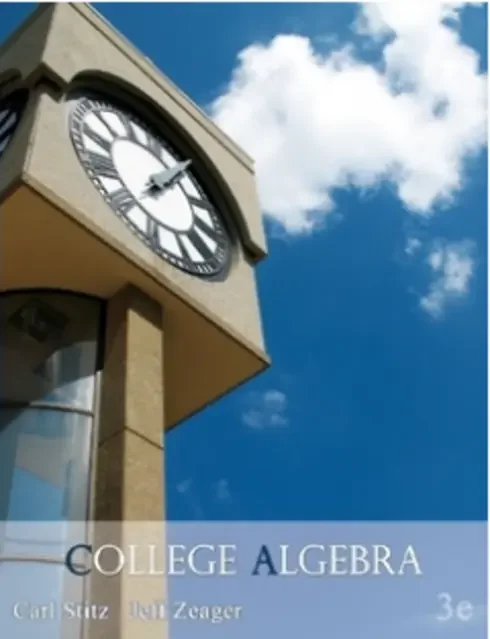
College Algebra
Not rated yetRate this bookCollege Algebra by Carl Stitz and Jeff Zeager develops algebra through functions, representations, and mathematical modeling. The linked corrected edition, dated 4 July 2013, contains nine chapters running from relations and functions to sequences and the binomial theorem. It is the algebra portion of the authors’ wider precalculus sequence, not a trigonometry volume. The guide follows that exact file and connects symbolic work with graphs, domains, and interpretations. A correct numerical result is only part of the task: readers should also explain why a method applies and whether the answer fits the original conditions.
Read on the publisher’s website. Opens in a new tab.
 Free
About this book
Overview
College Algebra by Carl Stitz and Jeff Zeager develops algebra through functions, representations, and mathematical modeling. The linked corrected edition, dated 4 July 2013, contains nine chapters running from relations and functions to sequences and the binomial theorem. It is the algebra portion of the authors’ wider precalculus sequence, not a trigonometry volume. The guide follows that exact file and connects symbolic work with graphs, domains, and interpretations. A correct numerical result is only part of the task: readers should also explain why a method applies and whether the answer fits the original conditions.
How to study this book
Use a four-step routine: identify the mathematical objects and restrictions, choose a representation, solve with justified steps, and check the result in the original problem. Keep symbolic, graphical, and numerical views connected. State domains before simplifying and mark excluded values when manipulating rational expressions or logarithms. Attempt exercises without copying worked examples, then use an error log to identify whether a mistake involved algebra, interpretation, or assumptions. Technology can test a conjecture, but explain the reasoning independently and distinguish a graphing window’s appearance from a proof.
Chapter and section study guide
Chapter 1 — Relations and Functions
Relations and functions organize inputs, outputs, domains, ranges, graphs, and notation. A function assigns exactly one output to each allowed input, but different representations emphasize different features. Domain restrictions arise from both algebra and context. The chapter introduces transformations and ways of reading behavior from graphs, giving later function families a common language. Distinguish a function from one of its values and a graph from the physical object modeled. An algebraically valid expression may still be inappropriate outside the situation’s meaningful domain.
Study application: Represent one function by a formula, table, graph, and verbal description, checking that all four use compatible domains.
Chapter 2 — Linear and Quadratic Functions
Linear functions describe constant rates of change, while quadratic functions introduce curvature and a turning point. Different quadratic forms reveal different features: roots, vertex, or coefficients. The chapter connects equations and inequalities with graphs and applications. Choosing a method should depend on the structure of the problem rather than habit. Check whether a calculated root belongs to the original context and whether a maximum or minimum is actually required. Distinguish the slope of a line from a quadratic’s changing rate across its domain.
Study application: Model a simple optimization problem quadratically and explain the meaning of its vertex, roots, and restricted domain.
Chapter 3 — Polynomial Functions
Polynomial behavior connects degree, leading coefficient, zeros, multiplicity, factorization, and end behavior. Algebraic tools and graph analysis reinforce one another: a factor gives a root, while its multiplicity helps explain local behavior. The chapter develops methods for locating and interpreting zeros without assuming every polynomial factors easily over the integers. Distinguish exact roots from numerical approximations. A graph can suggest where roots occur but may conceal multiplicity or distant behavior. Use structural information to produce a reasoned sketch and verify candidate solutions algebraically.
Study application: Sketch a polynomial from its factors, explaining intercepts, multiplicities, signs, and end behavior before checking with technology.
Chapter 4 — Rational Functions
Rational functions are ratios of polynomials with restrictions inherited from the denominator. Cancellation can simplify a formula while leaving an excluded input and possible hole. Vertical and horizontal or slant asymptotic behavior requires examining structure rather than assuming every undefined point behaves the same way. The chapter connects rational equations, inequalities, graphs, and applications. Multiplying by an expression can introduce invalid candidates if its zeros are not tracked. Sign charts and original-domain checks help preserve equivalence and distinguish a formal solution from an admissible one.
Study application: Compare a removable discontinuity and a vertical asymptote, then solve a rational equation while retaining all original exclusions.
Chapter 5 — Further Topics in Functions
Composition, inverse relationships, and additional function operations extend the earlier language. The order of composition matters, and the resulting domain depends on both the inner and outer functions. An inverse function requires an appropriate one-to-one relationship and exchanges the roles of inputs and outputs. Restricting a domain can make inversion possible, but the restriction must be stated. Connect formulas with graphs and contextual meaning. Verify inverse claims through composition rather than treating a swapped-variable calculation as sufficient by itself.
Study application: Find an inverse after a justified domain restriction and check both compositions on their proper domains.
Chapter 6 — Exponential and Logarithmic Functions
Exponential functions model multiplicative change, while logarithms express the inverse relationship and turn products into sums under valid conditions. The chapter connects laws, equations, graphs, and applications such as growth and decay. Bases, time units, and initial values must be interpreted consistently. Logarithmic arguments require positive values in the real setting, so algebraic candidates need checking. Distinguish a constant additive increase from a constant proportional increase. A model should be evaluated against its assumptions rather than extended indefinitely because its formula remains computable.
Study application: Compare linear and exponential models for the same initial value and explain how their assumptions change long-term predictions.
Chapter 7 — Hooked on Conics
Conic sections connect geometric definitions with algebraic equations. Circles, parabolas, ellipses, and hyperbolas have different characteristic relationships and graph features. Completing the square and selecting a useful form make centers, vertices, axes, and other parameters interpretable. The chapter develops movement between geometry and equations rather than memorizing unrelated templates. Check signs, orientation, and scaling before sketching. Contextual applications require explaining what distances or constraints the equation encodes. A plausible picture should be supported by the defining relationships and verified points.
Study application: Convert a conic equation to a useful standard form and explain how its parameters determine the graph.
Chapter 8 — Systems of Equations and Matrices
Systems express conditions that must hold simultaneously, and matrices organize operations on linear systems. Elimination preserves the solution set when performed correctly, while inconsistent or dependent equations reveal different geometric situations. The chapter connects symbolic methods with applications and interpretation. A matrix calculation is meaningful only when its entries and dimensions fit the problem. Distinguish a unique solution, no solution, and infinitely many solutions. Check the final result in the original equations and explain what it means for the modeled quantities.
Study application: Solve and classify three small systems, connecting row operations with the geometry of their solution sets.
Chapter 9 — Sequences and the Binomial Theorem
Sequences describe ordered patterns, while series combine terms through summation. Arithmetic and geometric structures involve different kinds of change and lead to different formulas. The chapter connects finite and infinite processes where appropriate and develops binomial coefficients and expansion. Indexing and starting values matter: a correct pattern with the wrong first index can give a wrong answer. Distinguish evidence from several terms from a general derivation. Use the structure of a problem to justify a formula and interpret convergence or a finite total in context.
Study application: Derive a finite geometric sum and use it in a contextual example, checking the index range and interpretation of each term.
Reflection and review
- Which algebraic manipulation could change the admissible domain?
- How do different forms of a function reveal different information?
- When did a graph help you detect an error without establishing the result by itself?
Source and edition notes
Version floor(pi) = 3, Corrected Edition, 4 July 2013; nine chapters, 716 PDF pages. The source identifies Version floor(pi) = 3, Corrected Edition, dated 4 July 2013. Chapter coverage and page count follow that file rather than the separate trigonometry text.
Book summary
Overview
College Algebra by Carl Stitz and Jeff Zeager develops algebra through functions, representations, and mathematical modeling. The linked corrected edition, dated 4 July 2013, contains nine chapters running from relations and functions to sequences and the binomial theorem. It is the algebra portion of the authors’ wider precalculus sequence, not a trigonometry volume. The guide follows that exact file and connects symbolic work with graphs, domains, and interpretations. A correct numerical result is only part of the task: readers should also explain why a method applies and whether the answer fits the original conditions.
How to study this book
Use a four-step routine: identify the mathematical objects and restrictions, choose a representation, solve with justified steps, and check the result in the original problem. Keep symbolic, graphical, and numerical views connected. State domains before simplifying and mark excluded values when manipulating rational expressions or logarithms. Attempt exercises without copying worked examples, then use an error log to identify whether a mistake involved algebra, interpretation, or assumptions. Technology can test a conjecture, but explain the reasoning independently and distinguish a graphing window’s appearance from a proof.
Chapter and section study guide
Chapter 1 — Relations and Functions
Relations and functions organize inputs, outputs, domains, ranges, graphs, and notation. A function assigns exactly one output to each allowed input, but different representations emphasize different features. Domain restrictions arise from both algebra and context. The chapter introduces transformations and ways of reading behavior from graphs, giving later function families a common language. Distinguish a function from one of its values and a graph from the physical object modeled. An algebraically valid expression may still be inappropriate outside the situation’s meaningful domain.
Study application: Represent one function by a formula, table, graph, and verbal description, checking that all four use compatible domains.
Chapter 2 — Linear and Quadratic Functions
Linear functions describe constant rates of change, while quadratic functions introduce curvature and a turning point. Different quadratic forms reveal different features: roots, vertex, or coefficients. The chapter connects equations and inequalities with graphs and applications. Choosing a method should depend on the structure of the problem rather than habit. Check whether a calculated root belongs to the original context and whether a maximum or minimum is actually required. Distinguish the slope of a line from a quadratic’s changing rate across its domain.
Study application: Model a simple optimization problem quadratically and explain the meaning of its vertex, roots, and restricted domain.
Chapter 3 — Polynomial Functions
Polynomial behavior connects degree, leading coefficient, zeros, multiplicity, factorization, and end behavior. Algebraic tools and graph analysis reinforce one another: a factor gives a root, while its multiplicity helps explain local behavior. The chapter develops methods for locating and interpreting zeros without assuming every polynomial factors easily over the integers. Distinguish exact roots from numerical approximations. A graph can suggest where roots occur but may conceal multiplicity or distant behavior. Use structural information to produce a reasoned sketch and verify candidate solutions algebraically.
Study application: Sketch a polynomial from its factors, explaining intercepts, multiplicities, signs, and end behavior before checking with technology.
Chapter 4 — Rational Functions
Rational functions are ratios of polynomials with restrictions inherited from the denominator. Cancellation can simplify a formula while leaving an excluded input and possible hole. Vertical and horizontal or slant asymptotic behavior requires examining structure rather than assuming every undefined point behaves the same way. The chapter connects rational equations, inequalities, graphs, and applications. Multiplying by an expression can introduce invalid candidates if its zeros are not tracked. Sign charts and original-domain checks help preserve equivalence and distinguish a formal solution from an admissible one.
Study application: Compare a removable discontinuity and a vertical asymptote, then solve a rational equation while retaining all original exclusions.
Chapter 5 — Further Topics in Functions
Composition, inverse relationships, and additional function operations extend the earlier language. The order of composition matters, and the resulting domain depends on both the inner and outer functions. An inverse function requires an appropriate one-to-one relationship and exchanges the roles of inputs and outputs. Restricting a domain can make inversion possible, but the restriction must be stated. Connect formulas with graphs and contextual meaning. Verify inverse claims through composition rather than treating a swapped-variable calculation as sufficient by itself.
Study application: Find an inverse after a justified domain restriction and check both compositions on their proper domains.
Chapter 6 — Exponential and Logarithmic Functions
Exponential functions model multiplicative change, while logarithms express the inverse relationship and turn products into sums under valid conditions. The chapter connects laws, equations, graphs, and applications such as growth and decay. Bases, time units, and initial values must be interpreted consistently. Logarithmic arguments require positive values in the real setting, so algebraic candidates need checking. Distinguish a constant additive increase from a constant proportional increase. A model should be evaluated against its assumptions rather than extended indefinitely because its formula remains computable.
Study application: Compare linear and exponential models for the same initial value and explain how their assumptions change long-term predictions.
Chapter 7 — Hooked on Conics
Conic sections connect geometric definitions with algebraic equations. Circles, parabolas, ellipses, and hyperbolas have different characteristic relationships and graph features. Completing the square and selecting a useful form make centers, vertices, axes, and other parameters interpretable. The chapter develops movement between geometry and equations rather than memorizing unrelated templates. Check signs, orientation, and scaling before sketching. Contextual applications require explaining what distances or constraints the equation encodes. A plausible picture should be supported by the defining relationships and verified points.
Study application: Convert a conic equation to a useful standard form and explain how its parameters determine the graph.
Chapter 8 — Systems of Equations and Matrices
Systems express conditions that must hold simultaneously, and matrices organize operations on linear systems. Elimination preserves the solution set when performed correctly, while inconsistent or dependent equations reveal different geometric situations. The chapter connects symbolic methods with applications and interpretation. A matrix calculation is meaningful only when its entries and dimensions fit the problem. Distinguish a unique solution, no solution, and infinitely many solutions. Check the final result in the original equations and explain what it means for the modeled quantities.
Study application: Solve and classify three small systems, connecting row operations with the geometry of their solution sets.
Chapter 9 — Sequences and the Binomial Theorem
Sequences describe ordered patterns, while series combine terms through summation. Arithmetic and geometric structures involve different kinds of change and lead to different formulas. The chapter connects finite and infinite processes where appropriate and develops binomial coefficients and expansion. Indexing and starting values matter: a correct pattern with the wrong first index can give a wrong answer. Distinguish evidence from several terms from a general derivation. Use the structure of a problem to justify a formula and interpret convergence or a finite total in context.
Study application: Derive a finite geometric sum and use it in a contextual example, checking the index range and interpretation of each term.
Reflection and review
- Which algebraic manipulation could change the admissible domain?
- How do different forms of a function reveal different information?
- When did a graph help you detect an error without establishing the result by itself?
Source and edition notes
Version floor(pi) = 3, Corrected Edition, 4 July 2013; nine chapters, 716 PDF pages. The source identifies Version floor(pi) = 3, Corrected Edition, dated 4 July 2013. Chapter coverage and page count follow that file rather than the separate trigonometry text.
About access & copyright
This page provides book information and study material. Full-text access is provided by the original publisher or authorised source; a listing does not grant permission to republish the book.
Read our Library Access & Copyright policyExplore the contents
Check the chapters covered in this edition.
Visit the official source
See reading, preview or purchase options.
Save for later
Keep this textbook in your saved collection.
Reader ratings & reviews
Share your thoughts
Your review helps other students choose the right resources.
KEEP LEARNING
Your next great read
Mathematics Mathematics
MTH 211: Calculus II
View MTH 211: Calculus II — book Mathematics
Mathematical Reasoning
View Mathematical Reasoning — book Mathematics
MAT 2420 Calculus II
View MAT 2420 Calculus II — bookMTH 225 Differential Equations
MTH 225 Differential Equations
View MTH 225 Differential Equations — bookFinite Mathematics
Finite Mathematics
View Finite Mathematics — bookMATH 25: PreCalculus
MATH 25: PreCalculus
View MATH 25: PreCalculus — bookMath 4B: Differential Equations
Math 4B: Differential Equations
View Math 4B: Differential Equations — bookMath 100: Liberal Arts Mathematics
Math 100: Liberal Arts Mathematics
View Math 100: Liberal Arts Mathematics — bookCalculus I: Differential Calculus



