
 Ethics
Academic Book
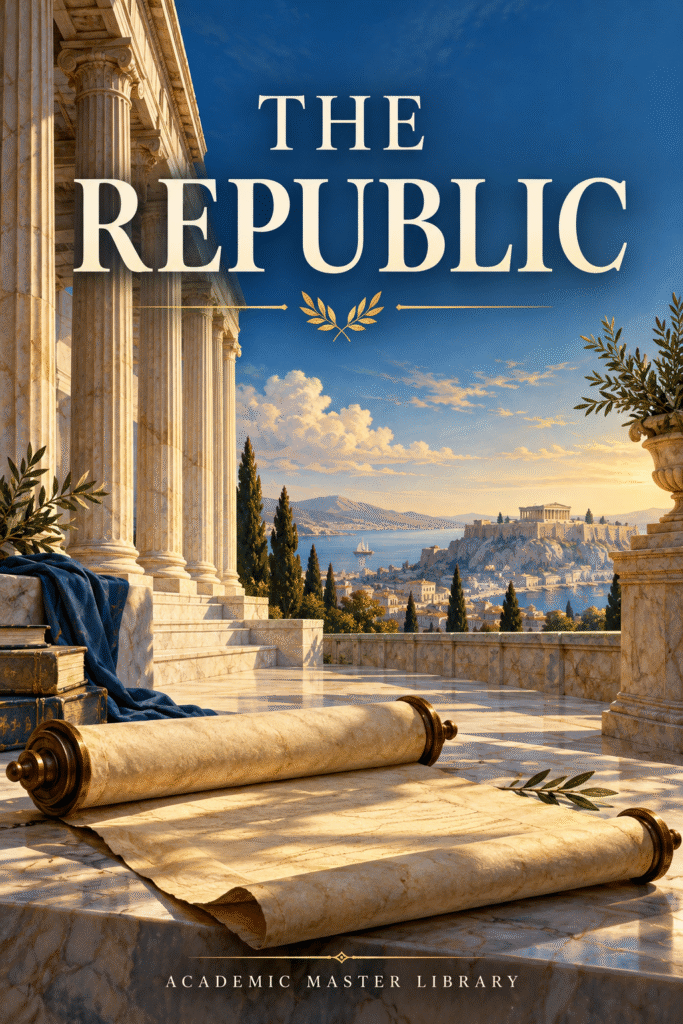
The Republic
Not rated yetRate this bookPlato’s dialogue examines justice, education, and political life through sustained questions and competing claims. This English edition uses Benjamin Jowett’s translation and includes a separate introduction and analysis. The study guide focuses on the opening of Book VII: the cave image, learning as reorientation, and the philosopher’s obligation to return to public life.
Read on the publisher’s website. Opens in a new tab.
 Free
About this book
The Republic is organized as a dialogue rather than a sequence of textbook explanations. Readers must follow the questions, concessions, images, and arguments exchanged by its speakers. Its ten books develop questions about justice, the organization of a city, and the formation of its citizens. The selected passage in Book VII connects education with a change in understanding and then asks how the person who acquires knowledge should relate to others.
This page links to Project Gutenberg eBook 1497, digitally released in 1998. Benjamin Jowett is the translator of the English text; Plato remains its author. The edition includes Introduction and Analysis, Persons of the Dialogue, and Books I–X. The introduction is editorial material and should be distinguished from the translated dialogue. The year and HTML ISBN identify Gutenberg’s digital publication. MIT’s undergraduate Literature and Ethical Values course assigns portions of The Republic, including Book VII; that reading list does not establish adoption of this particular translation. The guide covers selected opening passages of Books I and VII, not the entire dialogue.
The opening conversation offers a useful preparation for the later image of the cave. Socrates begins with Cephalus’s account of age, character, and wealth, then turns an account of peace of mind into a question about justice. A proposed definition is tested against an exception involving the return of weapons. The discussion shows why a familiar rule and an adequate explanation of a concept are not necessarily the same thing.
This dialogue form asks the reader to do more than collect memorable statements. Identify the proposition being considered, the person responsible for it, and the reason another speaker accepts or challenges it. A counterexample may show that a definition is too broad without supplying the final replacement. Keeping track of what has actually been established prevents a provisional statement from being mistaken for the settled conclusion of the whole work.
Academic Master’s study material connects that opening method with the selected passages in Book VII. The cave image asks how understanding changes, while the discussion of education and governing asks what a changed understanding requires in practice. These are connections between passages reviewed here. They do not imply that all the intervening arguments, or Jowett’s extensive editorial introduction, have been summarized on this page.
Book contents
Introduction and Analysis, Persons of the Dialogue, and ten books numbered I–X. The introduction is separate editorial material; book titles follow the source.
View the verified contents
- Introduction and Analysis
- Persons of the Dialogue
- Book I.
- Book II.
- Book III.
- Book IV.
- Book V.
- Book VI.
- Book VII.
- Book VIII.
- Book IX.
- Book X.
Book summary
Study overview of selected passages
Book VII opens with Socrates asking Glaucon to imagine prisoners unable to turn toward the source of the shadows they see. Their conditions limit what they can observe and what they regard as real. The image connects a familiar way of seeing with an account of how understanding can remain confined without the observer recognizing that limitation. It is a philosophical illustration, not a literal description of how all people learn.
Release initially brings pain, confusion, and a preference for the familiar shadows. Acclimatization occurs in stages before the former prisoner can look toward the sun. The return to the cave creates another difficulty: a person newly accustomed to the light may appear incompetent in the old setting. The passage therefore complicates any immediate equation of confidence, quick performance, and knowledge.
Socrates interprets education as turning an existing capacity in a different direction rather than simply inserting knowledge into a passive recipient. He also distinguishes the direction of intelligence from its sharpness: a clever person may put clear perception to harmful ends. Academic Master’s reading emphasizes that the argument concerns what understanding is directed toward as well as how effectively it operates.
The discussion then gives the ascent a political consequence. Those educated to govern must return and share public responsibilities, even when contemplation is more attractive to them. Socrates defends this obligation by appealing to the welfare of the whole city and the education it has supplied. Students should test that justification and distinguish it from personal preference. This selected-passage guide connects the cave image, learning, and civic duty without claiming to cover the rest of Book VII or all ten books.
Selected chapter and passage summaries
Book VII — The cave image and its interpretation
Socrates describes prisoners who mistake shadows for reality, the painful adjustment of a released prisoner, and the difficulty of returning to the cave. He relates the image to the movement toward knowledge and the good. The sequence makes learning gradual and initially disorienting. This guide covers the opening allegory and its interpretation, not a summary of all of Book VII.
Book VII — Education and the return to civic duty
The discussion describes education as reorienting an existing capacity and distinguishes intelligence from the ends it serves. Socrates then argues that those educated by the city must return to govern for its shared welfare. Glaucon raises the objection that this makes their lives less attractive. Students can identify the justification for the obligation and evaluate whether it answers that objection. Coverage stops within the opening discussion of rulers and public duty.
Further passage analysis
Book I — Cephalus, wealth, and a proposed definition of justice
Socrates’s visit leads to a conversation in which Cephalus attributes his experience of old age partly to character and partly to the advantages of wealth. Money, he argues, can help a good person avoid deception and leave debts unpaid neither to people nor to the gods. Socrates then tests the suggestion that justice consists in truthfulness and repayment. Returning weapons to a person no longer in a sound state of mind exposes an exception. The guide covers the opening conversation through Cephalus’s departure and the initial clarification with Polemarchus, not the remainder of Book I.
Reading the major connections
A definition and the test of a counterexample
Academic Master recommends separating a definition from an example of conduct that normally fits it. The weapons case does not establish that repayment is generally wrong. It challenges the claim that repayment is sufficient to identify justice in every circumstance. Students can state the proposed rule, explain why the exceptional case matters, and identify what remains unresolved after the objection. This makes the argumentative function of the example clearer than simply remembering its conclusion.
Experience, character, and material conditions
Cephalus’s account does not reduce a peaceful old age either to temperament alone or to money alone. Socrates raises the influence of wealth, and Cephalus qualifies its importance by connecting it with the character of the person who possesses it. An interpretation should preserve that qualification. Academic Master suggests examining where personal experience supports the claim and where the discussion moves toward a more general assertion that still needs testing.
Learning and discomfort
In the cave image, the familiar can appear clearer than what is newly encountered. Initial confusion therefore need not demonstrate that a new understanding is false. The reverse movement matters too: someone returning from the light may struggle to operate within the earlier setting. Students can compare these two kinds of disorientation before using the image to discuss education. Socrates’s interpretation supplies a philosophical argument about knowledge, not a guarantee that every uncomfortable belief is more accurate.
Knowledge and service to the city
The requirement that educated philosophers return to govern introduces an obligation that goes beyond personal intellectual achievement. Glaucon’s objection asks whether this deprives them of a better life. Socrates replies by appealing to the whole city and its role in their education. Academic Master suggests treating this as a claim that needs reasons: identify the beneficiary of education, the proposed duty, and the argument connecting them before evaluating its force.
Questions for discussion and written work
- What does Cephalus regard as wealth’s greatest benefit, and how does his answer depend on character?
- Why is the weapons example an objection to a definition rather than merely a disagreement about one action?
- What stages of adjustment appear in the cave image, and why do they matter to its interpretation?
- How does Socrates distinguish intelligence from a worthwhile direction for intelligence?
- Does the city’s provision of education justify compelling its philosophers to govern? Reconstruct the argument before assessing it.
Suggested argument-mapping approach
Write one sentence for the claim, one for the supporting reason, and one for the objection. Then identify the response and any point still assumed. Use the book number to locate the discussion and distinguish Jowett’s introduction from the translated dialogue. These exercises are Academic Master’s suggestions, not passages supplied by Plato.
Sources and coverage
This expanded selective guide is based on the opening of Book I from the visit to the Piraeus through the conversation with Cephalus, his departure, and the initial clarification of repayment with Polemarchus; and the opening of Book VII from the cave allegory through the discussion of education and the philosophers’ return to civic duty in Project Gutenberg eBook 1497. Edition information and the complete chapter structure were checked. The remaining text was not reviewed in full. This is selective study coverage, not an exhaustive chapter-by-chapter account.
Read the source text · Edition and format details · Course reading list
About access & copyright
This page provides book information and study material. Full-text access is provided by the original publisher or authorised source; a listing does not grant permission to republish the book.
Read our Library Access & Copyright policyAppearance and understanding
Trace the stages of the cave image before interpreting them.
Education as reorientation
Examine why Socrates rejects the picture of learning as simply adding knowledge.
Intelligence and purpose
Distinguish intellectual ability from the ends toward which it is directed.
Civic obligation
Evaluate the argument that educated philosophers should return to govern.
Reader ratings & reviews
Share your thoughts
Your review helps other students choose the right resources.
KEEP LEARNING
Your next great read
Ethics Ethics
The Secret Sharer
View The Secret Sharer — book Ethics
The Prince
View The Prince — book Ethics
Julius Caesar
View Julius Caesar — book Ethics
Utilitarianism
View Utilitarianism — book Ethics
Leviathan
View Leviathan — book Ethics
The Prince
View The Prince — book Ethics
Crime and Punishment
View Crime and Punishment — bookResearch Methods in Psychology
Research Methods in Psychology
View Research Methods in Psychology — bookWetlands Law: A Course Source



