
 Ethics
Academic Book
The Republic
Not rated yetRate this bookPlato’s dialogue invites readers to follow philosophical inquiry through exchanges between speakers and extended images. This Gutenberg text uses Benjamin Jowett’s English translation and contains ten books. The guide examines opening passages from Books I and VII, concentrating on conversation, experience, perception, and the difficulty of changing one’s understanding.
Read on the publisher’s website. Opens in a new tab.
 Free
About this book
The Republic presents philosophical questions through a dialogue whose speakers have different experiences and commitments. Its opening gives conversation a social setting before the familiar image of the cave later asks how perception can be mistaken for knowledge. Students can examine both how an argument is conducted and how an image helps express a claim that requires interpretation.
This entry links to Project Gutenberg eBook 150, released electronically on 1 July 1994, in Benjamin Jowett’s translation. Its prefatory notice identifies it as an early electronic file and points readers to an improved Gutenberg edition. The present page keeps the resource attached to this record; its digital year and HTML ISBN are recorded accordingly. Ten numbered books follow introductory material. No specific print-edition date or bibliographic page count is inferred.
MIT’s undergraduate Literature and Ethical Values course assigns selections from the work. That establishes academic use without confirming this particular electronic edition. The reading guide reviews the opening passages of Books I and VII, rather than either book in full. Speaker labels and the source’s early transcription should be kept in mind when checking wording against another translation.
Book contents
View the verified contents
- The Introduction
- BOOK I
- BOOK II
- BOOK III
- BOOK IV
- BOOK V
- BOOK VI
- BOOK VII
- BOOK VIII
- BOOK IX
- BOOK X
Read the full text at Project Gutenberg
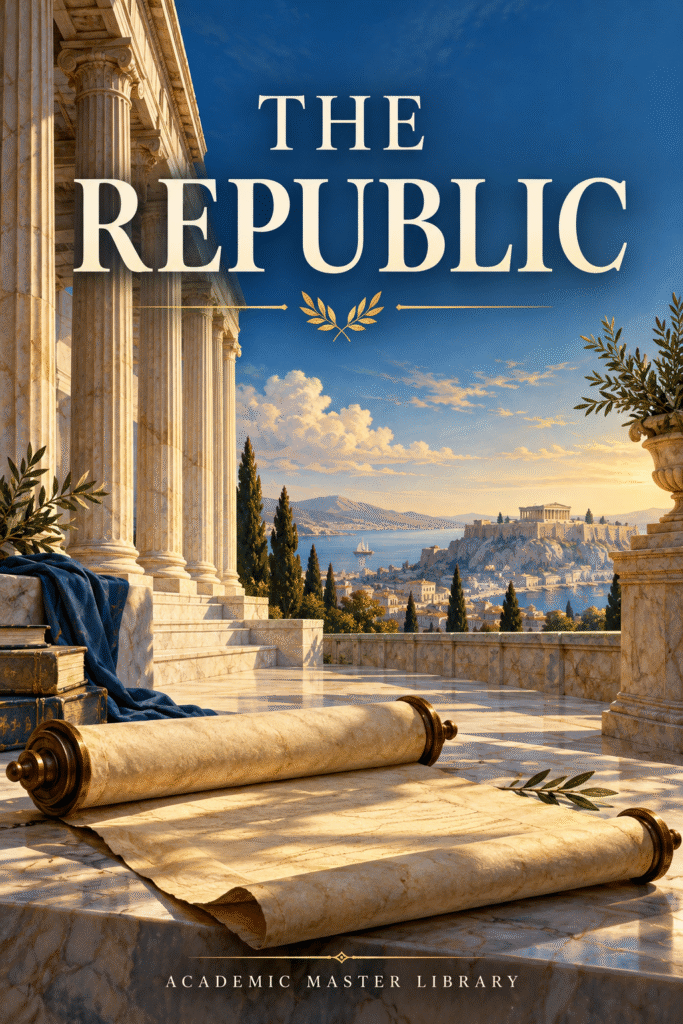
Cover design: original Academic Master library cover. The hosted PDF remains the edition described above.
Book summary
Study overview of reviewed passages
The two reviewed passages show inquiry beginning in ordinary conversation and developing through an elaborate comparison. Book I places Socrates among companions after a festival. Their invitation mixes playful insistence with the prospect of further conversation. Cephalus then discusses old age, describing how his interest in talk has grown as bodily pleasures have diminished. Socrates treats his experience as something worth questioning rather than as an opinion to be accepted without examination.
Cephalus argues that temperament helps explain whether old age feels burdensome. Socrates introduces wealth as another possible explanation for his comfort. The exchange does not simply replace one answer with another: Cephalus acknowledges that circumstances matter while maintaining that money cannot give a bad person peace. The passage offers a manageable example of an explanation being tested by considering what it leaves out.
Book VII begins with people whose restricted position makes shadows the only appearances available to them. Socrates asks Glaucon to imagine what would happen if a prisoner were released and forced toward the light. A change in access does not produce immediate understanding. Pain, confusion, resistance, and gradual adjustment separate the first exposure from the eventual ability to see more clearly.
The imagined return to the cave complicates the comparison further. Someone whose eyes have adapted to the upper world may initially perform badly in the earlier setting and attract ridicule. Socrates interprets the ascent in relation to understanding and the idea of the good. The passage therefore links the limits of familiar appearances with the difficulties of learning and communicating. Its claims belong to a philosophical exchange and should be analysed as arguments, not treated as an experimental account of vision.
Selected chapter and passage summaries
Book I — opening conversation
Socrates and Glaucon are drawn into a gathering at Polemarchus’s house. Cephalus welcomes conversation and explains why he does not share every complaint made by others of his age. His account gives importance to character, while Socrates asks whether wealth also makes his situation easier. The reviewed passage follows this testing of an explanation but stops before the later discussion of justice. It is a passage summary, not a summary of the whole first book.
Book VII — opening cave passage
The dialogue imagines prisoners limited to seeing shadows, a painful release into a brighter world, gradual adjustment, and a difficult return. Familiarity can make a restricted view seem authoritative, while unfamiliarity can make a better-informed person seem incompetent. Socrates explicitly relates the image to intellectual understanding and the good. The reviewed opening stops during the discussion of how different changes of condition produce bewilderment; later educational proposals in the book are not covered.
Further analysis — Academic Master
Testing explanations
Identify what Cephalus’s account explains and what Socrates’s wealth question adds. The exchange is useful for studying how a question can qualify a position without simply rejecting it. Preserve the distinction between a speaker’s claim and the dialogue’s further development.
Familiarity and understanding
In the cave comparison, repeated exposure and shared agreement can make an appearance feel secure. The movement toward light challenges that security before it offers a replacement. Consider why the passage emphasizes adjustment rather than presenting learning as instant possession of an answer.
The problem of return
The returning person’s difficulty prevents a simple equation between immediate performance and understanding. Compare the explanations available to the returning person and the prisoners. Their disagreement concerns how an unfamiliar response should be interpreted as well as what can be seen.
Questions for discussion and written work
These questions are Academic Master study prompts.
- How does Socrates complicate Cephalus’s account of a comfortable old age?
- Why does release from the cave initially produce discomfort?
- How do the prisoners interpret the returning person’s difficulties?
- Where does Socrates move from the imagined scene to an explicit philosophical interpretation?
Sources and coverage
Reviewed passages: approximately the first 1,300 words of Book I and the first 1,500 words of Book VII, including speaker labels. The full ten-book sequence and the early-file notice were verified. The rest of those books and Books II–VI and VIII–X are not summarized. Gutenberg identifies an improved edition as eBook 55201.
Source text and contents · Edition catalogue · Academic-use evidence
About access & copyright
This page provides book information and study material. Full-text access is provided by the original publisher or authorised source; a listing does not grant permission to republish the book.
Read our Library Access & Copyright policyDialogue as method
Follow how questions qualify an explanation.
Experience and circumstances
Distinguish character from material conditions in the opening exchange.
Perception and knowledge
Explain why familiar appearances can be misleading.
Learning and adjustment
Analyse the ascent and return without treating them as literal science.
Reader ratings & reviews
Share your thoughts
Your review helps other students choose the right resources.
KEEP LEARNING
Your next great read
Ethics Ethics
The Prince
View The Prince — book Ethics
Julius Caesar
View Julius Caesar — book Ethics
Utilitarianism
View Utilitarianism — book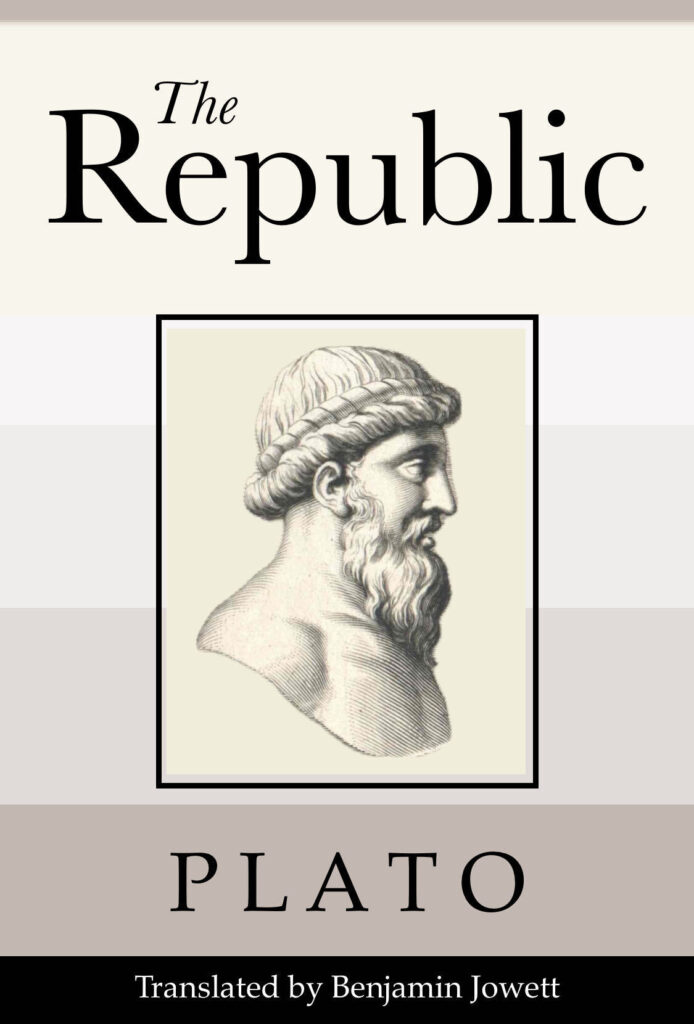 Ethics
The Republic
View The Republic — book Ethics
Leviathan
View Leviathan — book Ethics
The Prince
View The Prince — book Ethics
Crime and Punishment
View Crime and Punishment — bookResearch Methods in Psychology
Research Methods in Psychology
View Research Methods in Psychology — bookWetlands Law: A Course Source



