
 Ethics
Academic Book
Leviathan
Not rated yetRate this bookThomas Hobbes's Leviathan moves from perception and language to political authorization, then devotes substantial attention to Scripture, church power, and competing claims to obedience. The complete text has forty-seven numbered chapters followed by a Review and Conclusion. This guide restores the final chapter omitted from the earlier contents list. The argument's account of security should be tested alongside its distinctions between authorization, representation, natural right, and the continuing liberty to preserve one's life.
Read on the publisher’s website. Opens in a new tab.
 Free
About this book
Thomas Hobbes's Leviathan moves from perception and language to political authorization, then devotes substantial attention to Scripture, church power, and competing claims to obedience. The complete text has forty-seven numbered chapters followed by a Review and Conclusion. This guide restores the final chapter omitted from the earlier contents list. The argument's account of security should be tested alongside its distinctions between authorization, representation, natural right, and the continuing liberty to preserve one's life.
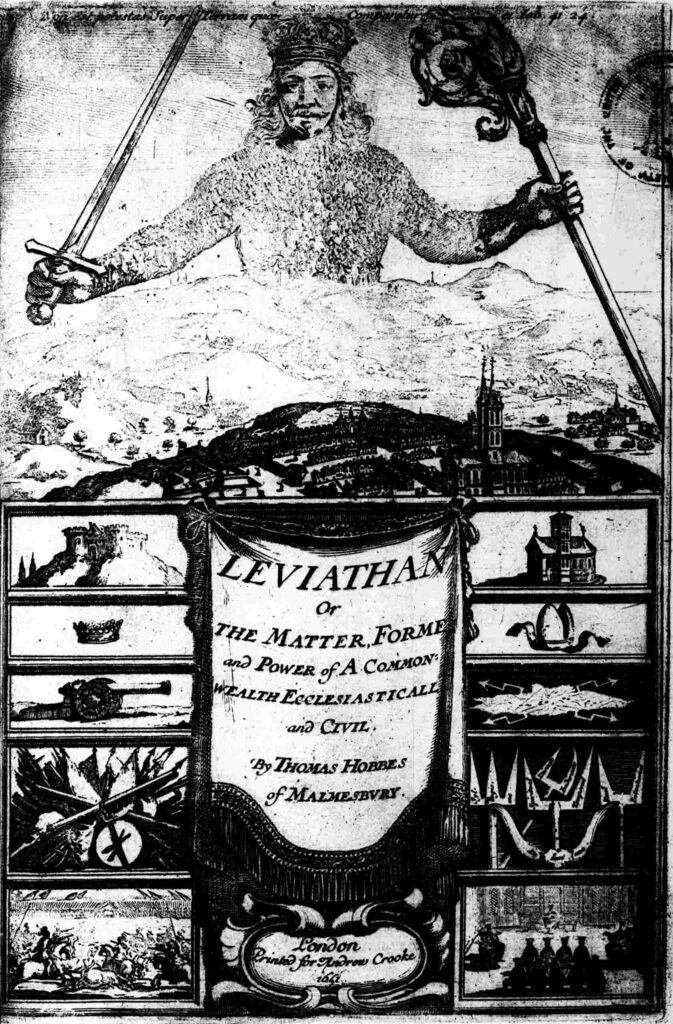
The title page reproduces a 1651 publication statement. Project Gutenberg released this digital edition in 2002; that date and its HTML ISBN identify the electronic publication. The transcriber explains that the e-text was prepared from Pelican Classics, itself based on the first edition, with adaptations to typography and marginal notes. MIT’s undergraduate Literature and Ethical Values course assigns an excerpt from the work. This supports academic use of Leviathan without establishing adoption of this exact digital edition.
Book contents
Four parts containing 47 chapters, preceded by the introduction and followed by A Review, and Conclusion. Historical spelling is retained in the verified titles.
View the verified contents
- THE INTRODUCTION
- PART I. OF MAN
- CHAPTER I.OF SENSE
- CHAPTER II.OF IMAGINATION
- CHAPTER III.OF THE CONSEQUENCE OR TRAYNE OF IMAGINATIONS
- CHAPTER IV.OF SPEECH
- CHAPTER V.OF REASON, AND SCIENCE.
- CHAPTER VI.OF THE INTERIOUR BEGINNINGS OF VOLUNTARY MOTIONS COMMONLY CALLED THE PASSIONS, AND THE SPEECHES BY WHICH THEY ARE EXPRESSED.
- CHAPTER VII.OF THE ENDS OR RESOLUTIONS OF DISCOURSE
- CHAPTER VIII.OF THE VERTUES COMMONLY CALLED INTELLECTUAL, AND THEIR CONTRARY DEFECTS
- CHAPTER IX.OF THE SEVERALL SUBJECTS OF KNOWLEDGE
- CHAPTER X.OF POWER, WORTH, DIGNITY, HONOUR AND WORTHINESS
- CHAPTER XI.OF THE DIFFERENCE OF MANNERS
- CHAPTER XII.OF RELIGION
- CHAPTER XIII.OF THE NATURALL CONDITION OF MANKIND, AS CONCERNING THEIR FELICITY, AND MISERY
- CHAPTER XIV.OF THE FIRST AND SECOND NATURALL LAWES, AND OF CONTRACTS
- CHAPTER XV.OF OTHER LAWES OF NATURE
- CHAPTER XVI.OF PERSONS, AUTHORS, AND THINGS PERSONATED
- PART II. OF COMMON-WEALTH
- CHAPTER XVII.OF THE CAUSES, GENERATION, AND DEFINITION OF A COMMON-WEALTH
- CHAPTER XVIII.OF THE RIGHTS OF SOVERAIGNES BY INSTITUTION
- CHAPTER XIX.OF THE SEVERALL KINDS OF COMMON-WEALTH BY INSTITUTION, AND OF SUCCESSION TO THE SOVERAIGNE POWER
- CHAPTER XX.OF DOMINION PATERNALL AND DESPOTICALL
- CHAPTER XXI.OF THE LIBERTY OF SUBJECTS
- CHAPTER XXII.OF SYSTEMES SUBJECT, POLITICALL, AND PRIVATE
- CHAPTER XXIII.OF THE PUBLIQUE MINISTERS OF SOVERAIGN POWER
- CHAPTER XXIV.OF THE NUTRITION, AND PROCREATION OF A COMMON-WEALTH
- CHAPTER XXV.OF COUNSELL
- CHAPTER XXVI.OF CIVILL LAWES
- CHAPTER XXVII.OF CRIMES, EXCUSES, AND EXTENUATIONS
- CHAPTER XXVIII.OF PUNISHMENTS, AND REWARDS
- CHAPTER XXIX.OF THOSE THINGS THAT WEAKEN, OR TEND TO THE DISSOLUTION OF A COMMON-WEALTH
- CHAPTER XXX.OF THE OFFICE OF THE SOVERAIGN REPRESENTATIVE
- CHAPTER XXXI.OF THE KINGDOME OF GOD BY NATURE
- PART III. OF A CHRISTIAN COMMON-WEALTH
- CHAPTER XXXII.OF THE PRINCIPLES OF CHRISTIAN POLITIQUES
- CHAPTER XXXIII.OF THE NUMBER, ANTIQUITY, SCOPE, AUTHORITY, AND INTERPRETERS OF THE BOOKS OF HOLY SCRIPTURE
- CHAPTER XXXIV.OF THE SIGNIFICATION OF SPIRIT, ANGEL, AND INSPIRATION IN THE BOOKS OF HOLY SCRIPTURE
- CHAPTER XXXV.OF THE SIGNIFICATION IN SCRIPTURE OF KINGDOME OF GOD, OF HOLY, SACRED, AND SACRAMENT
- CHAPTER XXXVI.OF THE WORD OF GOD, AND OF PROPHETS
- CHAPTER XXXVII.OF MIRACLES, AND THEIR USE
- CHAPTER XXXVIII.OF THE SIGNIFICATION IN SCRIPTURE OF ETERNALL LIFE, HELL, SALVATION, THE WORLD TO COME, AND REDEMPTION
- CHAPTER XXXIX.OF THE SIGNIFICATION IN SCRIPTURE OF THE WORD CHURCH
- CHAPTER XL.OF THE RIGHTS OF THE KINGDOME OF GOD, IN ABRAHAM, MOSES, HIGH PRIESTS, AND THE KINGS OF JUDAH
- CHAPTER XLI.OF THE OFFICE OF OUR BLESSED SAVIOUR
- CHAPTER XLII.OF POWER ECCLESIASTICALL
- CHAPTER XLIII.OF WHAT IS NECESSARY FOR A MANS RECEPTION INTO THE KINGDOME OF HEAVEN
- PART IV. OF THE KINDOME OF DARKNESSE
- CHAPTER XLIV.OF SPIRITUALL DARKNESSE FROM MISINTERPRETATION OF SCRIPTURE
- CHAPTER XLV.OF DAEMONOLOGY, AND OTHER RELIQUES OF THE RELIGION OF THE GENTILES
- CHAPTER XLVI.OF DARKNESSE FROM VAIN PHILOSOPHY, AND FABULOUS TRADITIONS
- A REVIEW, AND CONCLUSION
Book summary
Thomas Hobbes's Leviathan moves from perception and language to political authorization, then devotes substantial attention to Scripture, church power, and competing claims to obedience. The complete text has forty-seven numbered chapters followed by a Review and Conclusion. This guide restores the final chapter omitted from the earlier contents list. The argument's account of security should be tested alongside its distinctions between authorization, representation, natural right, and the continuing liberty to preserve one's life.
Complete chapter-by-chapter guide
Introduction
The commonwealth is compared to an artificial person whose construction can be understood through human capacities. The comparison establishes a method while raising a question the book must answer: how do many vulnerable people become one authoritative public actor?
Chapter 1 — Sense
Perception begins with the effects of external bodies on the senses. Hobbes rejects explanations that detach sensible appearances from bodily processes. His political argument will therefore begin with an account of human beings as embodied interpreters, not ready-made bearers of civic agreement.
Chapter 2 — Imagination
Imagination and memory continue after the immediate stimulus recedes. Dreams and apparitions receive an account that challenges untested claims of supernatural knowledge. The distinction matters politically because private experience can be offered as public authority without an adequate method of verification.
Chapter 3 — Trains of thought
Thought may wander or be directed toward a purpose. Experience supports expectation but does not establish certainty about future events. Prudence differs from demonstrative knowledge, qualifying the authority of people who claim that repeated observation guarantees a political prediction.
Chapter 4 — Speech
Names permit reasoning and communication, but ambiguity and abuse create error. Definitions become a condition of shared judgment. Political disagreement can persist because speakers use the same term for different things or conceal evaluative claims within apparently descriptive language.
Chapter 5 — Reason and science
Reason is presented through the reckoning of consequences from defined names. Mistakes arise when the process or its starting terms are unsound. The ambition to make political inquiry systematic therefore depends on discipline in language rather than confidence alone.
Chapter 6 — Passions
Appetite and aversion organize voluntary motion, while deliberation concerns competing tendencies toward action. Good and evil often name relations to desire rather than properties independently agreed by everyone. A commonwealth must address that plurality instead of assuming identical private evaluations.
Chapter 7 — Resolution
Discourses end in judgment or opinion, and different degrees of confidence must not be confused with knowledge. The chapter distinguishes belief resting on another's testimony from conclusions a person can establish through reasoning, preparing later questions about authority and revelation.
Chapter 8 — Intellectual virtues
Wit, judgment, acquired learning, and their defects are compared. Eloquence and rapid association do not automatically supply sound inference. The account also examines disordered thought in the period's vocabulary; its categories should be read historically rather than used as modern clinical diagnosis.
Chapter 9 — Kinds of knowledge
The classification separates knowledge of fact from knowledge of consequences and arranges fields of inquiry. Political reasoning receives a place within a larger account of organized understanding rather than being treated as a collection of inherited practical maxims.
Chapter 10 — Power and worth
Power includes resources, reputation, alliances, and capacities for future advantage. Worth is relational, depending on estimation rather than an entirely private assertion. Honor and dignity therefore connect public recognition with the unequal distribution of effective means.
Chapter 11 — Manners
Human dispositions are examined through desires for power, ease, reputation, and knowledge. Continuing competition arises partly because present security depends on future resources. Hobbes's account is not simply that everyone desires violence; different aims can generate mutually threatening conduct.
Chapter 12 — Religion
Fear, uncertainty, and the search for causes contribute to religious belief. The chapter examines how interpretations become organized through social authority. Distinguish an explanation of religion's human conditions from the later claims about which doctrines a Christian subject must accept.
Chapter 13 — The natural condition
Rough equality of vulnerability joins competition, distrust, and concern for reputation to produce insecurity without a common power. The state of war concerns a known disposition to conflict, not continuous fighting at every moment. Fear obstructs stable cooperation even where cooperation would benefit everyone.
Chapter 14 — Right, law, and covenant
Natural right is distinguished from a law directing conduct toward preservation. Seeking peace and laying down some liberties require reciprocal assurance. Covenants become intelligible only when people have adequate grounds to expect performance rather than merely reasons to prefer it.
Chapter 15 — Further laws of nature
Justice, gratitude, accommodation, equity, and related precepts support peace. Their practical force depends on security, because unilateral compliance can expose a person to destruction. The chapter links moral reasoning with the institutional conditions that make following it less dangerous.
Chapter 16 — Persons and representation
An actor can bear another's person when authorized, while the author owns the act. This vocabulary explains how a multitude may acquire a representative unity. The distinction is essential to the subsequent claim that sovereign action can be attributed to subjects.
Chapter 17 — Institution of commonwealth
Mutual fear and the desire for peace lead people to authorize a common representative. The covenant is among those instituting authority, not a contract in the same form between ruler and subjects. A public power supplies the assurance missing from private promises.
Chapter 18 — Sovereign rights
Hobbes derives extensive powers from authorization and the need to prevent renewed division. Judgment over doctrine, law, war, and public office is concentrated. Evaluate the derivation rather than treating effective coordination as an automatic proof that every claimed prerogative is necessary.
Chapter 19 — Forms and succession
Monarchy, aristocracy, and democracy differ by who represents the commonwealth. Hobbes favors monarchy through arguments about interests and counsel, while denying that popular labels for disliked government create additional constitutional forms. Succession becomes necessary to preserving institutional continuity.
Chapter 20 — Acquisition
Submission through fear can generate authority as well as institution by agreement. Paternal and despotic dominion are explained through protection and consent under constrained conditions. The argument tests how much voluntariness Hobbes requires when alternatives include immediate danger.
Chapter 21 — Subjects' liberty
Liberty concerns the absence of external impediments, and subjects retain freedom where law is silent. They cannot straightforwardly surrender the drive to resist threats to life. The chapter complicates a picture of obedience as unlimited psychological or moral submission.
Chapter 22 — Subordinate systems
Associations within the commonwealth differ by representation, legal status, and scope. Their authority remains limited rather than rivaling the sovereign. Organized cooperation is permitted, but independent centers of public command threaten the unity the earlier argument sought to establish.
Chapter 23 — Public ministers
Officials act within delegated powers and represent the commonwealth for particular purposes. Distinguishing office from private personality clarifies responsibility. A minister's claim is not established merely by prestige; the authorization and its limits must be identifiable.
Chapter 24 — Economic life
Resources, production, distribution, money, and colonies are treated through the commonwealth's maintenance. The bodily analogy makes material circulation a political necessity. Security requires more than punitive capacity: people must have workable means of sustaining their lives.
Chapter 25 — Counsel
Advice should aim at the recipient's good rather than the adviser's advantage. Reasoned explanation is distinguished from commands and manipulative exhortation. The chapter asks how a ruler can obtain information without allowing rhetoric or private interest to substitute for judgment.
Chapter 26 — Civil law
Law is tied to authorized public command and interpretation, while customary force depends on sovereign recognition. Natural and civil law are related within the system rather than entirely separate codes. Notice the importance of knowing who has authority to settle disputed meaning.
Chapter 27 — Crimes
An unlawful act is distinguished from inward thought alone, and ignorance, fear, intention, and circumstances affect evaluation. The account gives gradations rather than treating every transgression as identical. Read its distinctions within the earlier commitments about preservation and public assurance.
Chapter 28 — Punishment and reward
Punishment is connected to public authority and future obedience rather than private revenge. Rewards also shape conduct. The chapter requires readers to distinguish a punitive act from hostility or unauthorized injury, even when their bodily effects may resemble one another.
Chapter 29 — Causes of dissolution
Divided sovereignty, private claims to final judgment, inadequate resources, and rival institutions can weaken the state. The diseases metaphor makes political fragmentation appear a threat to common life. Ask which diagnoses follow from the argument and which assume the unity they defend.
Chapter 30 — Sovereign office
Protection includes instruction, equitable administration, and attention to material conditions, not merely survival of the ruler. Public education should explain the grounds of obedience. The chapter supplies responsibilities against which the earlier extensive powers can be critically measured.
Chapter 31 — God's natural kingdom
Hobbes distinguishes divine rule known through reason from a particular covenantal kingdom. Questions of honor, worship, and obligation connect theology with the limits of human knowledge. The transition prepares an argument about revelation without abandoning the earlier demand for intelligible authority.
Chapter 32 — Christian politics
Claims of revelation must be assessed through recognizable standards rather than private certainty alone. Hobbes asks how reason and accepted Scripture can bear on obedience. The problem is identifying a public rule where people claim incompatible access to divine command.
Chapter 33 — Scripture's authority
Authorship, transmission, canon, and interpretation are examined to distinguish a text's religious standing from the civil authority to declare its public use. The chapter's historical claims should be studied as Hobbes's argument, not uncritically treated as current biblical scholarship.
Chapter 34 — Spirit and inspiration
The meanings of spirit, angel, and inspiration are tested through scriptural usage. Hobbes resists vocabulary that licenses unintelligible assertions. Definitional work becomes politically consequential because obscure claims can support demands for obedience that subjects cannot evaluate.
Chapter 35 — God's kingdom in Scripture
Terms including holy, sacred, and sacrament are read in relation to covenant and public rule. Hobbes challenges an interpretation that turns every spiritual expression into an independent present jurisdiction. The argument repeatedly asks what kind of authority a passage actually establishes.
Chapter 36 — Prophecy
Different uses of the word of God and different claims of prophecy receive scrutiny. A person hearing another claim divine instruction does not thereby share the claimant's certainty. The distinction limits the automatic public force of private revelation.
Chapter 37 — Miracles
Extraordinary events and reports require attention to witnesses, interpretation, and purpose. Astonishment alone cannot settle who speaks for God. Hobbes's inquiry makes the acceptance of a miracle's public meaning inseparable from the institutions judging the account.
Chapter 38 — Salvation and the future
Eternal life, punishment, redemption, and the world to come are interpreted through Scripture. The chapter disputes doctrines that can increase present ecclesiastical control. Read its theology alongside the political consequences of promising rewards or threatening penalties beyond civil life.
Chapter 39 — The church
A church is considered as an assembly of believers, with distinctions about authorization and command. Hobbes rejects treating a universal religious description as proof of an independently governing earthly corporation. Unity of faith and unity of public jurisdiction are different claims.
Chapter 40 — Biblical political authority
The histories of Abraham, Moses, priests, and kings provide cases for divine covenant and human administration. Hobbes uses them to examine who could interpret and enforce commands. The narrative supports a theory of authority rather than serving as a neutral historical survey.
Chapter 41 — Christ's office
Christ's teaching and future kingdom are distinguished from a present coercive jurisdiction competing with civil government. The distinction lets Hobbes affirm religious allegiance while rejecting certain institutional claims made in its name.
Chapter 42 — Ecclesiastical power
The long examination of apostolic teaching, conversion, and church government challenges claims to coercive power independent of the commonwealth. Distinguish instruction and persuasion from command. The central question is whether a spiritual office authorizes a second earthly sovereign.
Chapter 43 — Necessary belief
Hobbes narrows what is necessary for reception into the kingdom of heaven while connecting faith with obedience. The argument seeks to reduce conflicts manufactured through multiplying compulsory doctrines. Evaluate whether this narrowing adequately protects religious conscience or primarily consolidates public authority.
Chapter 44 — Misinterpretation
The kingdom of darkness is introduced through errors that obscure scriptural meaning and support improper power. Hobbes's criticism is polemical and directed at institutions. Identify the specific interpretive move he attacks before accepting his larger classification of an opponent.
Chapter 45 — Demonology
Beliefs about spirits and inherited religious practices are examined as sources of confusion. The account links explanatory habits with authority over fear. Historical vocabulary and accusations should be attributed to Hobbes rather than repeated as neutral descriptions of communities.
Chapter 46 — Vain philosophy
Scholastic and other philosophical traditions are criticized for obscure terms and claims that undermine civil understanding. This is a dispute about methods as well as conclusions. Compare the criticism with Hobbes's own reliance on definitions and extended analogies.
Chapter 47 — Who benefits from darkness?
The final numbered chapter asks which institutions gain from the doctrines previously criticized. An explanation of error becomes an account of interests and organized power. Restoring this chapter matters because the work ends by examining beneficiaries, not merely mistaken propositions.
Review and Conclusion
Hobbes revisits the relation of protection, allegiance, conquest, and public teaching. The conclusion asks readers to assess an integrated system rather than detach one notorious phrase. It also leaves a crucial practical question: how can those dependent on protection recognize when its conditions no longer hold?
Study instructions
- Define natural right, natural law, covenant, authorization, actor, and author before using them interchangeably.
- Compare Chapters 13-16 with the derivation of sovereignty in 17-18.
- Read subjects' liberty alongside sovereign rights rather than treating either as the complete theory.
- Track the difference between teaching, persuasion, and coercive jurisdiction in the religious chapters.
- Attribute scriptural and historical claims to Hobbes when evaluating them.
- Ask of each alleged error who is said to benefit and what evidence supports that explanation.
Questions for reflection
- Does agreement under fear provide sufficient authorization for extensive rule?
- What obligations follow from protection that would not follow from the ruler's survival alone?
- Can a public system of interpretation avoid becoming the monopoly it criticizes?
Sources and coverage
This original study guide follows the complete work and includes its conclusion. Numbered chapters or books follow the linked edition. Where the work has no chapters, the reading movements are editorial aids. Interpretive questions and practice tasks are supplied for study rather than quoted from the author. Read the source edition. Consult its full text, examples, and references when developing an essay or solving a problem.
About access & copyright
This page provides book information and study material. Full-text access is provided by the original publisher or authorised source; a listing does not grant permission to republish the book.
Read our Library Access & Copyright policyPolitical insecurity
Trace how vulnerability and mistrust generate conflict in Hobbes’s argument.
War and peace
Distinguish continuing insecurity from the act of fighting.
Authorization
Examine how mutual covenants create a representative common power.
Critical reading
Test each argumentative step and separate Hobbes’s claims from your assessment.
Reader ratings & reviews
Share your thoughts
Your review helps other students choose the right resources.
KEEP LEARNING
Your next great read
Ethics Ethics
Regulating the new: Regulation, ethics, acceptance, legitimacy in the governance of technology
View Regulating the new: Regulation, ethics, acceptance, legitimacy in the governance of technology — book Ethics
The Republic (Jowett Translation, Gutenberg eBook 150)
View The Republic (Jowett Translation, Gutenberg eBook 150) — book Ethics
The Secret Sharer
View The Secret Sharer — book Ethics
The Prince (Luigi Ricci Translation, 1909 Edition)
View The Prince (Luigi Ricci Translation, 1909 Edition) — book Ethics
Julius Caesar
View Julius Caesar — book Ethics
Utilitarianism
View Utilitarianism — book Ethics
The Republic (Jowett Translation, Gutenberg eBook 1497)
View The Republic (Jowett Translation, Gutenberg eBook 1497) — book Ethics
The Prince (W. K. Marriott Translation)
View The Prince (W. K. Marriott Translation) — book Ethics



