
Teaching Early and Elementary STEM
Curriculum & InstructionTextbook
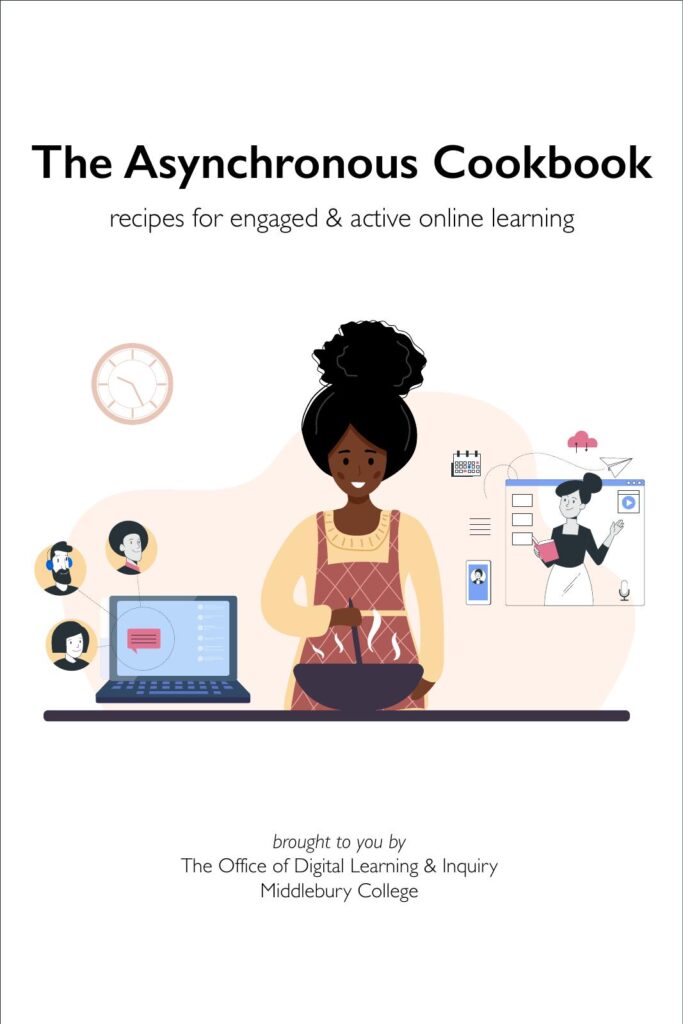
The Asynchronous Cookbook
Not rated yetRate this bookThe Asynchronous Cookbook offers activity ideas for online and blended courses where learners contribute at different times. Created by Middlebury College’s Office of Digital Learning & Inquiry, it emphasizes interaction among students and instructors. This guide explains its opening rationale and helps teachers plan a purposeful activity.
Read on the publisher’s website. Opens in a new tab.
 Free
About this book
This Middlebury College resource uses the format of a cookbook to organize concise learning-activity recipes. Its official online edition records publication on 20 May 2021. The linked downloadable file is a June 2023 export; an export date does not by itself establish a new edition or change the original publication year.
The verified contents group activities around team work, discussions, mapping, games, simulations and laboratories, writing and publishing, presentations, and class climate. The resource is intended for instructors adding asynchronous elements to in-person or blended teaching as well as those planning fully online courses.
The introduction treats interaction as central. Asynchronous learning here does not simply mean watching a recording alone: participation can unfold over time while still involving peers and the teacher. The opening also points to access, scheduling, and disciplinary differences that may influence the choice of activity.
Sources, access, and reading coverage
Official PDF title, licence, contributors and contents pages; introduction on printed pages 3–5; official Pressbooks description and publication date. Individual activity recipes have not been comprehensively reviewed. Reviewed 22 October 2026. The study guidance below is original Academic Master editorial material; it does not claim complete chapter coverage.
Official book information; official PDF; Open Textbook Library record. An authorized online reading edition is available through the official book link.
Cover credit: Original cover: The Asynchronous Cookbook, Office of Digital Learning & Inquiry, Middlebury College. Source: official Pressbooks edition.
Book summary
Guide to the reviewed material
The reviewed introduction defines asynchronous participation in terms of timing: students can contribute on their own schedules, commonly within a deadline. It distinguishes this from a purely self-paced training module and emphasizes activities designed for a learning community.
The authors explain why a mixture of synchronous and asynchronous opportunities can support participation when students face time-zone, internet, accessibility, or fatigue-related constraints. Their argument is for a considered combination of approaches, rather than assuming that one timing model always replaces the other.
The introduction also recognizes discipline-specific questions. Language learning, performance-based subjects, and laboratory work may require different arrangements. Its invitation is to identify the learning need first and then find a suitable recipe.
How to study this book
The following instructions are Academic Master editorial guidance.
State the learning outcome before choosing a platform or activity. Decide what students will produce, whom they will interact with, and how the interaction contributes to the outcome. A discussion board without a clear purpose is not automatically an active-learning design.
Plan the sequence as an initial contribution, a meaningful response, and a follow-up. Write directions that explain the deadline, expected form of participation, assessment criteria, and where to ask for help. Check whether the activity can be completed with the access arrangements available to your learners.
Pilot one recipe and inspect the resulting learning evidence. Ask whether students engaged with one another’s ideas or only completed isolated submissions. Use that observation to revise the task, and consult the original recipe for its detailed instructions before implementation.
Questions for reflection
- What learning outcome requires students to interact rather than work alone?
- Which access constraint could exclude a learner from the activity?
- How will the final follow-up use students’ earlier contributions?
About access & copyright
This page provides book information and study material. Full-text access is provided by the original publisher or authorised source; a listing does not grant permission to republish the book.
Read our Library Access & Copyright policyTiming
Distinguish asynchronous participation from isolation.
Interaction
Build purposeful exchanges into the task.
Access
Consider schedules, bandwidth, and accessibility.
Design
Choose activities in response to a learning outcome.
Reader ratings & reviews
Share your thoughts
Your review helps other students choose the right resources.
KEEP LEARNING
Your next great read
Curriculum & Instruction
Game Based and Adaptive Learning Strategies
Game Based and Adaptive Learning Strategies
View Game Based and Adaptive Learning Strategies — book Curriculum & Instruction
Technology in Schools
View Technology in Schools — book Curriculum & Instruction
Using Open Educational Resources to Promote Social Justice
View Using Open Educational Resources to Promote Social Justice — book Curriculum & Instruction
Intersections of Open Educational Resources and Information Literacy
View Intersections of Open Educational Resources and Information Literacy — book Curriculum & Instruction
The Art and Science of Teaching Agriculture: Four Keys to Dynamic Learning
View The Art and Science of Teaching Agriculture: Four Keys to Dynamic Learning — book Education
Conducting Mixed-Methods Research: From Classical Social Sciences to the Age of Big Data and Analytics
View Conducting Mixed-Methods Research: From Classical Social Sciences to the Age of Big Data and Analytics — book Education
Designing Arguments for Academic, Public, and Professional Audiences
View Designing Arguments for Academic, Public, and Professional Audiences — book Education
Action Research
View Action Research — book Education



