
Stability of Ships and Other Bodies
Earth SciencesTextbook
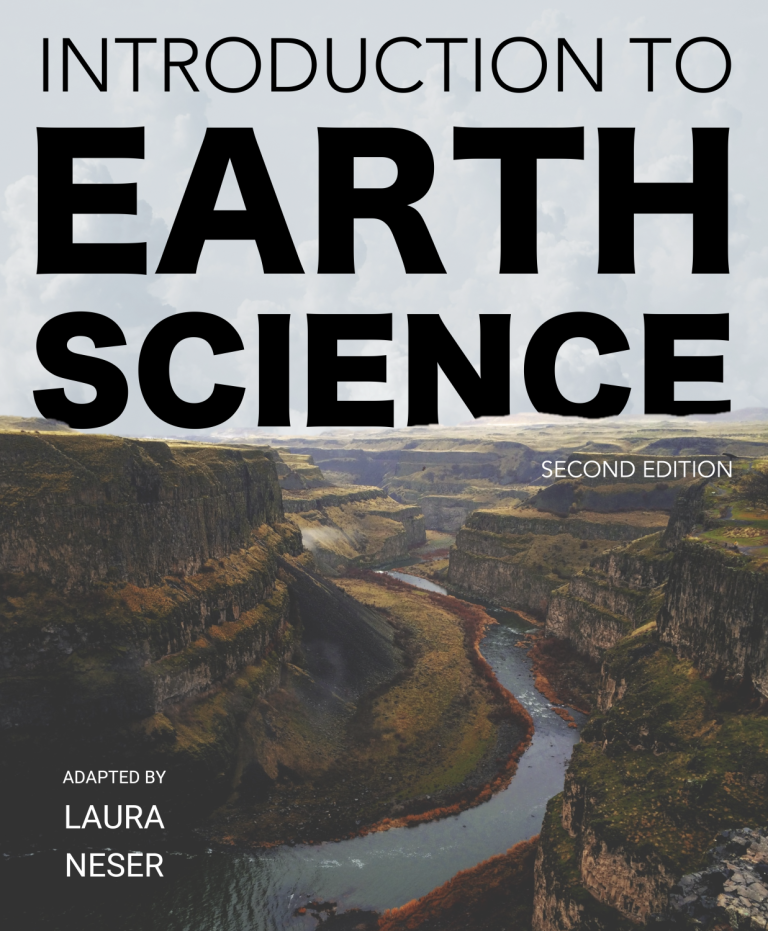
Introduction to Earth Science
Not rated yetRate this bookLaura Neser’s adapted Earth-science textbook introduces natural processes through scientific reasoning and a sequence of foundational topics. Its opening distinguishes evidence-based explanation from assumptions that cannot be tested.
Free reading is available at the official source. Opens in a new tab.
 Free
About this book
About this book
Introduction to Earth Science, adapted by Laura Neser, connects geology with water, weather, climate, resources, and the solar system. The second edition moves through seventeen chapters, beginning with scientific reasoning and plate tectonics before examining Earth materials and the processes that transform them. Its illustrations, embedded learning checks, and regional examples support an evidence-based account of an interconnected planet. The guide follows the actual chapter sequence and emphasizes mechanisms, the observations used to infer them, and the difference between geological processes and the risks those processes create for people.
The detailed guide below follows the book’s chapter, unit, or section structure. Read it alongside the study instructions and the complete official text.
Book summary
Chapter-by-chapter summaries
Chapter 1: Understanding Science
Earth science uses observations, testable explanations, and revision to investigate systems that often operate over enormous distances and times. The chapter distinguishes observations from interpretations and scientific evidence from unsupported assertion. It introduces Earth's internal structure and the difference between compositional layers and layers defined by mechanical behavior. Understanding those distinctions prevents treating the mantle as a uniform liquid or assuming that crust and lithosphere mean the same thing. Geological investigation often reconstructs events from traces rather than direct observation, but the resulting explanations can still be tested against independent evidence. Scientific models simplify complexity while remaining accountable to measurements and new discoveries.
Chapter 2: Plate Tectonics
The chapter follows the development from continental drift to plate tectonics by connecting continental patterns, ocean-floor evidence, magnetic records, earthquakes, and volcanism. Earth's lithosphere is divided into plates whose relative motion produces divergent, convergent, and transform boundaries. Different boundary settings explain why ocean basins open, oceanic lithosphere is subducted, mountain belts develop, and earthquakes cluster. Seafloor spreading and magnetic symmetry provide evidence that continents alone are not the moving units. The model also connects surface patterns with heat and movement within Earth. Identifying a boundary is most useful when it explains the associated rock types, deformation, topography, and distribution of geological hazards.
Chapter 3: Minerals
Minerals are naturally occurring crystalline solids with characteristic compositions and internal structures. The chapter connects atomic structure, bonding, and crystal arrangements to observable properties such as hardness, cleavage, fracture, streak, and luster. Identification depends on a combination of tests rather than color alone, because impurities and surface alteration can change appearance. Silicate minerals receive particular attention because they dominate much of Earth's crust, while nonsilicate groups illustrate other important chemical arrangements. Mineral properties provide clues to formation conditions and practical uses. Learning the relationship between structure and properties gives the reader a method for interpretation rather than a list of specimens to memorize.
Chapter 4: Igneous Processes and Volcanoes
Igneous rocks form when molten material cools and crystallizes. Cooling rate affects crystal size, while magma composition influences mineral content and behavior. Intrusive rocks preserve crystallization below the surface; extrusive rocks record material erupted at or near it. The chapter explains magma generation and evolution alongside volcanic forms and eruptive styles. Viscosity and dissolved gases help explain why some eruptions produce relatively fluid flows and others are highly explosive. Examples of volcanic landscapes connect the rock record with plate settings. Hazard interpretation requires considering more than lava, including ash, gases, and rapidly moving mixtures whose impacts depend on eruption conditions and nearby populations.
Chapter 5: Weathering, Erosion, and Sedimentary Rocks
Weathering breaks down or chemically changes existing material, erosion transports it, and deposition accumulates it in a new setting. These processes produce sediment that can become rock through compaction, cementation, or related changes. Grain size, sorting, rounding, mineral composition, and sedimentary structures preserve information about transport and depositional environments. Chemical and biological processes create additional sedimentary materials, so not all such rocks consist of fragments mechanically broken from older rocks. The chapter connects water chemistry, physical breakdown, and the development of layered deposits. Reconstructing an ancient environment requires combining several clues rather than treating one grain or structure as a unique signature.
Chapter 6: Metamorphic Rocks
Metamorphism changes existing rock under altered temperature, pressure, and fluid conditions without requiring complete melting. Minerals can recrystallize or react, and directed stress may organize them into foliation. Parent material matters: identical conditions acting on different original compositions need not produce the same rock. The chapter distinguishes metamorphic textures and grades and relates them to settings such as burial, mountain building, and heating near intrusions. Index minerals and mineral assemblages help constrain the conditions experienced by a rock. Metamorphism also completes another set of pathways in the rock cycle, showing that geological categories describe histories of transformation rather than permanently isolated kinds of material.
Chapter 7: Geologic Time
Relative dating establishes sequences using relationships such as superposition, cross-cutting features, and inclusions. Unconformities record missing intervals caused by nondeposition or erosion, making the geological record incomplete. Numerical dating adds estimates of age through radioactive decay when the material and assumptions are appropriate. Fossils assist correlation and reveal biological change, but fossil preservation is selective. The chapter combines these approaches to explain how scientists organize Earth's long history. A numerical age, stratigraphic relationship, and fossil assemblage answer different questions; their agreement strengthens an interpretation. The geological timescale is therefore a synthesis of multiple kinds of evidence rather than a chronology derived from a single method.
Chapter 8: Earth History
Earth's history links changes in the planet's surface, atmosphere, oceans, and life. The chapter moves from early Earth through major eons and eras, examining the emergence of stable crust, changes in oxygen, continental rearrangements, biological diversification, and extinction events. Fossils and rocks preserve uneven but complementary records of these developments. Plate tectonics changes habitats and ocean circulation, while biological activity can alter environmental conditions in return. The chapter encourages readers to interpret time as a sequence of interacting processes instead of memorizing dates alone. Major transitions are understood through their evidence, mechanisms, and consequences for later environments and organisms.
Chapter 9: Crustal Deformation and Earthquakes
Stress describes applied forces per area, while strain describes resulting deformation. Rocks may respond elastically, deform ductilely, or fracture, depending on material and conditions. Folds and faults reveal how crust has been compressed, extended, or sheared. Earthquakes release stored energy when movement occurs, producing seismic waves that reveal both the event and Earth's interior. The chapter distinguishes earthquake size from the intensity of shaking experienced at a location. Damage depends on depth, distance, local ground conditions, structures, and secondary hazards as well as magnitude. Geological understanding supports risk reduction, but recognizing an active fault does not provide a precise prediction of the next earthquake.
Chapter 10: Mass Wasting
Mass wasting is the downslope movement of material under gravity. Slope angle, material strength, water, weathering, and disturbance influence stability. Water can add weight and reduce resistance, so intense rainfall or changes in drainage may contribute to failure. The chapter distinguishes falls, slides, and flows, including rapid destructive events and slower movement that gradually damages infrastructure. Case examples show that slopes can fail repeatedly and that the consequences depend on where people build. Interpreting a slope requires considering both the process and its setting; a steep surface is not the only source of risk, and apparently inactive deposits may preserve evidence of past movement.
Chapter 11: Water
The water cycle connects precipitation, runoff, infiltration, storage, and return to the atmosphere. Streams erode, transport, and deposit sediment, producing channel forms and floodplain features that change with flow and setting. Groundwater moves through connected pore spaces and fractures, with permeability and hydraulic gradients controlling movement. Aquifers are not generally underground lakes, and replenishment does not necessarily match withdrawal. The chapter also explores interactions among water availability, landforms, human use, and contamination. Surface water and groundwater form linked systems, so altering one part of a watershed can affect downstream flow or subsurface storage. Floods and water shortages must be understood in that broader context.
Chapter 12: Earth's Coastlines and Oceans
Waves, tides, currents, sediment supply, and sea-level change continually reshape coasts. Erosion in one location may accompany deposition elsewhere, so beaches and shorelines belong to connected sediment systems. The chapter examines ocean-water properties, circulation, seafloor settings, and coastal landforms. Differences in temperature and salinity influence water density and contribute to large-scale circulation, while winds drive important surface movements. Coastal development changes exposure to hazards and can interfere with sediment transport. Understanding an individual beach or estuary therefore requires attention to processes beyond the visible shoreline, including upstream sediment delivery and changes in ocean conditions.
Chapter 13: Deserts and Glaciers
Deserts are defined by limited moisture rather than heat alone. Wind, episodic water flow, and weathering create characteristic landforms, with rare intense storms often doing substantial geomorphic work. Glaciers form where snow accumulation exceeds loss over time and ice begins to move. Erosion, transport, and deposition by ice produce features that allow reconstruction of former glaciated landscapes. Both settings illustrate how climate controls the agents and rates of surface change. A glacier's advance or retreat reflects its mass balance rather than a reversal in the direction of ice flow. The chapter connects present landforms with environmental conditions that may differ greatly from those of the past.
Chapter 14: Meteorology
Meteorology examines short-term atmospheric conditions and the processes producing them. The chapter introduces atmospheric structure, heating, pressure differences, moisture, cloud formation, and circulation. Air movement redistributes energy, while changes in temperature and pressure influence condensation and precipitation. Weather systems and severe storms develop from particular combinations of instability, moisture, and motion rather than from a single cause. Diagrams and examples connect local weather with broader circulation patterns. Forecasting applies physical understanding to incomplete observations of a changing system, which explains why forecasts have uncertainty. This chapter also establishes the timescale distinction needed for the following discussion: a weather event and a long-term climate pattern are related but different objects of analysis.
Chapter 15: Global Climate Change
Climate describes patterns over longer periods and is shaped by energy exchange, atmospheric composition, oceans, ice, land, and living systems. The chapter explains the greenhouse effect and examines evidence for past and present climatic change. Proxy records extend understanding beyond direct instrumental measurements, while multiple independent observations help distinguish sustained change from short-term variation. Feedbacks can amplify or damp an initial influence; they do not make every cause equally important. Human additions of greenhouse gases alter Earth's energy balance, with consequences for temperature, sea level, ecosystems, and other systems. The scientific task is to explain observed changes and evaluate future responses using evidence and physically grounded models.
Chapter 16: Energy and Mineral Resources
Resources result from geological processes but become usable supplies through technology, economics, access, and environmental decisions. The chapter examines energy sources and mineral concentrations, connecting their formation with methods of extraction and use. A deposit's existence is different from its practical recoverability. Fossil fuels, nuclear materials, and renewable energy systems have different geological connections and environmental tradeoffs. Mining and energy development can affect landscapes, water, ecosystems, and communities throughout a project's life. Evaluating a resource therefore requires more than measuring its abundance: demand, material quality, energy requirements, waste, and long-term consequences all shape what extraction means in practice.
Chapter 17: Origin of the Universe and Our Solar System
The final chapter places Earth in a broader cosmic history. Evidence from light and the distribution and movement of astronomical objects supports explanations of the universe's development. Stars produce and redistribute elements, while the solar system formed from a rotating cloud of material that condensed and accreted. Planetary differences reflect composition, distance from the Sun, collisions, internal evolution, and later surface processes. Comparing Earth with other bodies helps identify which features are common planetary outcomes and which require particular conditions. The chapter brings the book back to scientific inference: explanations of inaccessible places and ancient events are evaluated through observations, physical principles, and the consistency of independent evidence.
Study instructions
For a description of a landform or process, separate what was observed from the proposed explanation. Note the scale, units, location, and time frame of the evidence. Ask what additional observation could challenge the explanation.
Use the book’s figures together with their captions and surrounding text. Revisit foundational chapters when a later process depends on an unfamiliar material or term. Complete the source’s self-tests after reading rather than using them as a substitute for the explanation.
Questions for reflection
- Which part of a statement is observation and which is interpretation?
- What evidence could challenge the proposed explanation?
- Which foundational concept is needed to understand a later process?
The study suggestions and questions are independent Academic Master editorial material.
Sources and coverage
These original summaries draw on the source text, including chapter or section introductions and selected explanations, examples, exercises, and review material. They are condensed study guides, not a page-by-page account or a replacement for the complete resource. Additional synthesis sections are identified separately.
About access & copyright
This page provides book information and study material. Full-text access is provided by the original publisher or authorised source; a listing does not grant permission to republish the book.
Read our Library Access & Copyright policyEvidence
Separate observations and explanations.
Testing
Identify how a claim could be challenged.
Sequence
Connect foundational topics with later processes.
Representation
Read figures in context.
Reader ratings & reviews
Share your thoughts
Your review helps other students choose the right resources.
KEEP LEARNING
Your next great read
Engineering & Technology
Climate Lessons: Environmental, Social, Local
Climate Lessons: Environmental, Social, Local
View Climate Lessons: Environmental, Social, Local — bookTree Steward Manual
Tree Steward Manual
View Tree Steward Manual — bookFundamentals and Principles of Chemistry
Fundamentals and Principles of Chemistry
View Fundamentals and Principles of Chemistry — bookPlant Molecular Genetics and Bioengineering
Plant Molecular Genetics and Bioengineering
View Plant Molecular Genetics and Bioengineering — bookBotany in Hawaiʻi
Botany in Hawaiʻi
View Botany in Hawaiʻi — bookGeology Online Lab Activities: An Open Educational Resource for Community College Students and Instructors
Geology Online Lab Activities: An Open Educational Resource for Community College Students and Instructors
View Geology Online Lab Activities: An Open Educational Resource for Community College Students and Instructors — book Natural Sciences
Ecology for All!
View Ecology for All! — book Chemistry
Chemical Bonding and Organic Chemistry
View Chemical Bonding and Organic Chemistry — book Applied



