
Stability of Ships and Other Bodies
Natural SciencesTextbook
Conservation techniques
Not rated yetRate this bookConservation Techniques connects ecological science with the practical choices involved in environmental conservation. Marcia S. Meixler and Mark B. Bain organize thirteen techniques into four groups, helping readers consider the basis, limitations, and application of each. This guide introduces that framework and offers a comparative study method.
Free reading is available at the official source. Opens in a new tab.
 Free
About this book
About this book
Conservation Techniques connects ecological knowledge with decisions about managing species, habitats, and human–environment relationships. Marcia Meixler developed the text from work associated with Mark Bain. Thirteen chapters move from scientific practice and standards to rewilding, species recovery, monitoring, restoration, adaptive management, ecosystem services, and sustainability. This guide follows the complete source. Legal frameworks and policy examples describe the edition’s context rather than current compliance advice. The recurring learning task is to identify a technique’s purpose, evidence, assumptions, and limits, then judge whether it fits a particular conservation problem instead of treating every method as a universally applicable solution.
The detailed guide below follows the book’s chapter, unit, or section structure. Read it alongside the study instructions and the complete official text.
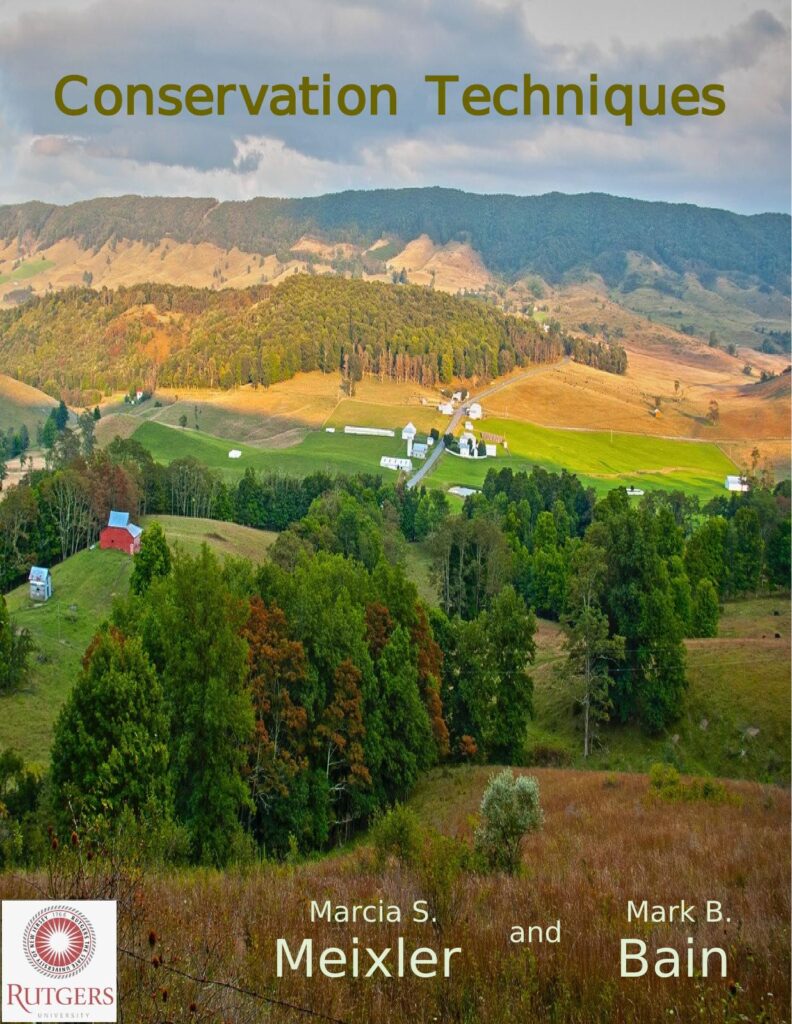
Cover credit: Cover photo: Highland County, Virginia, courtesy of Jane L. Bain. Authors: Marcia S. Meixler and Mark B. Bain. Rutgers University Library Press, 2022.
Book summary
Chapter-by-chapter summaries
Chapter 1: Science and practice
Conservation decisions often must be made before every uncertainty is resolved. The chapter compares the focused questions of scientific investigation with the broader responsibilities of practice. Evidence informs action, but values, constraints, and the need to choose also matter. Readers should distinguish uncertainty from a complete absence of knowledge and identify what additional information would actually change a decision. The chapter establishes a practical framework for the rest of the book: define the problem, examine alternatives and consequences, act on a defensible basis, and remain open to learning. Scientific rigor and useful action require connection rather than substitution of one for the other.
Chapter 2: Standards and criteria
Standards provide a reference against which conditions or actions can be judged, while criteria express the basis for that judgment. The chapter examines their usefulness and the circumstances that make standardization attractive. A threshold can support consistency but also conceal choices about acceptable conditions, uncertainty, and values. Readers should ask how the standard was derived and whether the category being assessed is sufficiently comparable. Meeting a numerical requirement is not automatically equivalent to achieving every ecological purpose. The chapter encourages interpreting a standard within its design and institutional setting rather than treating its existence as the end of the argument.
Chapter 3: National Environmental Policy Act
The chapter introduces environmental assessment through the United States NEPA framework as discussed in the source edition. Its educational focus is the relationship between proposed actions, alternatives, information, and decision processes. Readers should distinguish a process for considering effects from a guarantee of a particular environmental outcome. The details of law and implementation can change, so this guide does not present the chapter as current procedural instruction. Its transferable questions are what decision is being made, what consequences and alternatives are examined, who participates, and how the evidence informs the account given for the decision.
Chapter 4: Rewilding
Rewilding examines possibilities for restoring ecological processes and relationships, including roles played by species no longer present in a place. The chapter discusses different approaches and the complications of choosing reference conditions or analogs. Introducing an organism is not automatically equivalent to restoring a system. Readers should examine the intended process, evidence about likely effects, and risks for existing communities. Historical conditions and present constraints can point in different directions. The chapter makes rewilding a question of ecological reasoning and judgment rather than a simple instruction to remove human influence or recreate one chosen moment in the past.
Chapter 5: Endangered-species protection and recovery
Species protection connects population status, threats, policy mechanisms, and recovery actions. The chapter’s legal and institutional examples belong to its publication context, while its ecological questions remain useful. Readers should distinguish listing a species from changing the conditions responsible for its decline. Recovery requires attention to habitat, population processes, interactions, and practical implementation. A plan also needs criteria for judging progress. The chapter encourages tracing an action to a specific threat and expected response rather than assume protection on paper establishes a secure future. Evidence and uncertainty should remain visible in both diagnosis and evaluation.
Chapter 6: Biomonitoring
Biomonitoring uses organisms and biological communities to assess environmental conditions. The chapter compares this integrative evidence with narrower measurements and examines the development of biological indicators. A signal can reflect several influences, so interpretation requires reference conditions, suitable sampling, and attention to confounding factors. Readers should ask what the indicator measures and how reliably it responds to the concern of interest. One observed community difference does not identify every cause. The technique’s strength lies in connecting biological response with environmental assessment, while its limits require careful design and corroborating information.
Chapter 7: Habitat assessment
Habitat assessment relates environmental conditions to the needs of organisms and conservation priorities. The chapter examines quantification and modeling across different spatial scales. A measure useful for one species or purpose may not represent every aspect of biodiversity. Readers should distinguish observed use, inferred suitability, and demonstrated population benefit. Assumptions about scale and reference conditions influence the result. The chapter’s practical lesson is to define what the assessment is intended to support before collecting or combining scores. A precise-looking habitat value is meaningful only in relation to the ecological question and the evidence behind the model.
Chapter 8: Restoration
Restoration begins with judgments about damage, reference conditions, goals, and feasible change. The chapter examines historical perspectives and the difficulty of defining an appropriate target in an already altered world. A restored appearance does not necessarily establish recovery of the intended processes. Readers should connect interventions with measurable outcomes and consider the time required for change. Social, economic, and ecological constraints affect what can be achieved. The chapter treats restoration as a reasoned and revisable practice rather than a guarantee that a past condition can be recreated exactly through one technical recipe.
Chapter 9: Ecological engineering
Ecological engineering uses understanding of ecological processes to design or manage systems serving human and environmental purposes. The chapter connects this approach with limitations encountered in more narrowly framed interventions. Readers should ask which processes the design relies on, how they are expected to develop, and what maintenance or adaptation is required. A system’s biological components are not interchangeable mechanical parts. Performance depends on interactions and changing conditions. The technique therefore requires both design intent and evidence from operation, with attention to unintended consequences and the wider setting in which the intervention functions.
Chapter 10: Ecosystem-based management
Ecosystem-based management broadens attention beyond one species or isolated problem to connected ecological and human relationships. The chapter examines the principles and criteria used to describe this approach. Defining the relevant ecosystem and management boundary remains a choice with consequences. Readers should identify which interactions a plan includes and whether its institutions can coordinate across them. A broad label does not itself resolve tradeoffs. The chapter’s value is to make those connections explicit and encourage assessment of how actions in one part of the system affect other organisms, processes, and communities.
Chapter 11: Adaptive management
Adaptive management links decisions with deliberate learning under uncertainty. It requires more than trying something and changing direction when dissatisfied. Objectives, hypotheses or alternative explanations, monitoring, and a route for using the results need to be established. The chapter examines both the appeal of learning by doing and the difficulty of implementing it within real institutions. Readers should ask what evidence would distinguish alternatives and what decision would follow. Without that connection, monitoring can collect information without improving management. The technique treats uncertainty as something to organize and investigate, not simply acknowledge in a concluding paragraph.
Chapter 12: Ecosystem services
Ecosystem-services approaches connect ecological processes with benefits people receive. The chapter examines categories, valuation, and the relationship among natural, manufactured, and human capital. Monetary valuation can make some benefits visible but should not be mistaken for an exhaustive account of meaning or worth. Readers should identify whose benefits are counted, at what scale, and under what assumptions. A change can help one group while burdening another. The chapter encourages using the framework to clarify relationships and choices rather than assume every conservation question can be resolved by one aggregate value.
Chapter 13: Sustainability
The final chapter connects resource management with ecological, economic, and social considerations over time. It examines the development of sustainability ideas and the limitations of managing a resource through a narrow yield target alone. Readers should identify what is intended to persist, for whom, and under which changing conditions. A sustainable outcome cannot be established solely by one year’s production or a favorable indicator. The chapter brings the book’s techniques together as tools for particular purposes, each requiring evidence and judgment. Conservation becomes an ongoing practice of maintaining relationships and capacity while confronting uncertainty and competing interests.
Study instructions
The following instructions are Academic Master editorial guidance.
Choose one environmental challenge and identify its scale, affected ecological features, and decision makers. Then compare two relevant techniques using columns for scientific basis, intended outcome, required evidence, implementation constraints, and possible unintended effects.
When reading a case study, separate the setting and historical conditions from the general principle the authors illustrate. Ask what would have to be different before applying the same approach elsewhere. For regulatory chapters, record the jurisdiction and publication date rather than treating the 2022 discussion as current legal advice.
End a reading session by drafting a monitoring question: what observation would indicate progress or the need to revise the plan? Use the source’s chapter summary to check your understanding, then return to the evidence behind any point that remains uncertain.
Questions for reflection
- What makes a technique appropriate to a particular conservation challenge?
- How do restoration and ecological engineering differ in their starting assumptions?
- What evidence would justify revising a management plan?
Sources and coverage
All thirteen chapters are covered. Legal and policy material is described within the source edition, not as present compliance instructions. These original summaries draw on review of the source text, including chapter or section introductions and selected explanations, examples, exercises, and concluding or review material. They are condensed study guides, not a page-by-page account or a replacement for the complete resource. Supplementary study discussions are identified separately.
About access & copyright
This page provides book information and study material. Full-text access is provided by the original publisher or authorised source; a listing does not grant permission to republish the book.
Read our Library Access & Copyright policyChoice
Match a technique to the conservation problem.
Science and practice
Distinguish explanation from implementation.
Scale
Compare organism, habitat, and whole-system approaches.
Evaluation
Plan how outcomes will be monitored and interpreted.
Reader ratings & reviews
Share your thoughts
Your review helps other students choose the right resources.
KEEP LEARNING
Your next great read
Engineering & Technology
Climate Lessons: Environmental, Social, Local
Climate Lessons: Environmental, Social, Local
View Climate Lessons: Environmental, Social, Local — bookTree Steward Manual
Tree Steward Manual
View Tree Steward Manual — bookFundamentals and Principles of Chemistry
Fundamentals and Principles of Chemistry
View Fundamentals and Principles of Chemistry — bookPlant Molecular Genetics and Bioengineering
Plant Molecular Genetics and Bioengineering
View Plant Molecular Genetics and Bioengineering — bookBotany in Hawaiʻi
Botany in Hawaiʻi
View Botany in Hawaiʻi — bookGeology Online Lab Activities: An Open Educational Resource for Community College Students and Instructors
Geology Online Lab Activities: An Open Educational Resource for Community College Students and Instructors
View Geology Online Lab Activities: An Open Educational Resource for Community College Students and Instructors — book Natural Sciences
Ecology for All!
View Ecology for All! — book Chemistry
Chemical Bonding and Organic Chemistry
View Chemical Bonding and Organic Chemistry — book Applied



