
Elementary Calculus
MathematicsTextbook
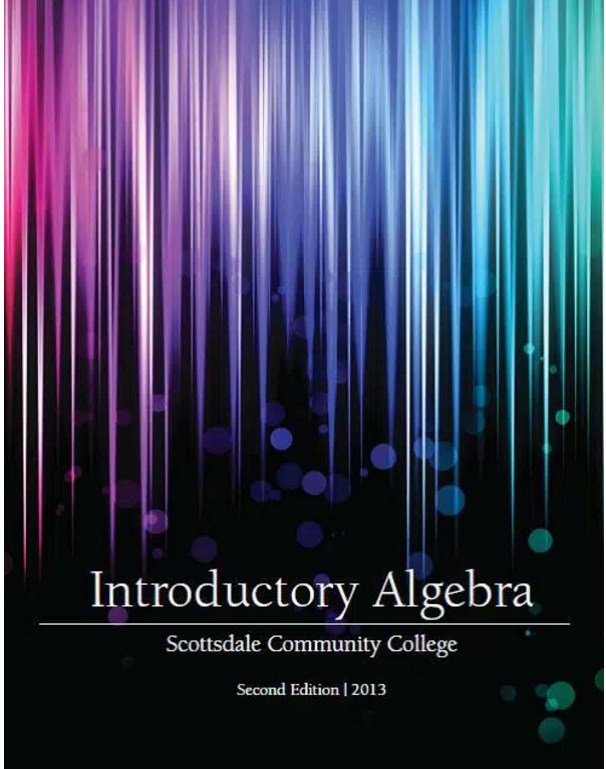
Introductory Algebra
Not rated yetRate this bookIntroductory Algebra builds algebraic learning on a review of arithmetic, number systems, and equivalent representations. The opening helps readers establish the vocabulary and fraction skills needed for later symbolic work.
Free reading is available at the official source. Opens in a new tab.
 Free
About this book
About this book
Introductory Algebra, by Anne Gloag, Andrew Gloag, and Melissa Kramer, builds from arithmetic through expressions, equations, inequalities, functions, and linear systems. The reviewed CK-12 PDF contains thirteen chapters and extensive practice. Its sequence repeatedly connects symbolic procedures with tables, graphs, and real situations. The guide below explains why the main procedures work, what their results mean, and where common errors arise. It follows the 2012 text distributed in the linked Spring 2013 course PDF; worked examples in these summaries are additional illustrations rather than copied exercises.
The detailed guide below follows the book’s chapter, unit, or section structure. Read it alongside the study instructions and the complete official text.
Book summary
Chapter-by-chapter summaries
Chapter 1: Arithmetic Review
The opening chapter organizes real numbers and reviews operations with signed rational numbers. Integers belong within the rational numbers, while irrational numbers cannot be expressed as a ratio of integers. A number line connects order, absolute value, and opposite values. Fraction operations require attention to denominators, and signed multiplication and division follow rules consistent with the distributive property. Order of operations gives expressions a shared interpretation, with parentheses making intended grouping explicit. The foundation matters later because algebraic transformations still rely on arithmetic. For example, a minus sign preceding a grouped expression affects every term inside it; overlooking that relationship creates errors that can persist through a longer equation.
Chapter 2: Introduction to Variables
Variables allow one expression to describe many possible values and relationships. The chapter distinguishes an expression, which represents a quantity, from an equation, which asserts equality. Patterns motivate general formulas, while combining like terms requires matching variable parts and exponents rather than merely spotting the same letter. The distributive property connects multiplication with addition and supports both expansion and later factoring. Adding and subtracting polynomials extends familiar arithmetic to sums of terms. A useful check is to substitute the same numerical value into an original and simplified expression: equal results do not prove an identity for all values, but unequal results immediately reveal an error.
Chapter 3: Polynomials and Exponents, Part 1
Exponents describe repeated multiplication, and product rules follow by counting common factors. Multiplying powers with the same base adds exponents, while raising a power to a power multiplies them. Polynomial multiplication applies the distributive property to every term in one factor and every term in the other. Special products, including a squared binomial and a sum times a difference, are recognizable patterns rather than unrelated formulas. The middle terms in a squared binomial explain why squaring a sum is not generally the same as adding the squares. Organizing intermediate terms before combining them makes the method reliable for expressions larger than two binomials.
Chapter 4: Polynomials and Exponents, Part 2
Quotient rules extend exponent reasoning to division, subject to nonzero denominators. A zero exponent and negative exponents are defined consistently with those rules: a negative exponent indicates a reciprocal, not a negative numerical value. Dividing a polynomial by a monomial can be handled term by term when the denominator is valid. The chapter encourages simplifying factors rather than canceling terms across addition. For instance, a common factor can cancel from a numerator and denominator, but one term in a sum cannot simply disappear against the denominator. Keeping restrictions visible prevents an algebraically shorter expression from being mistaken for an expression defined at every original or newly introduced value.
Chapter 5: Solving Equations
An equation is solved by finding values that make both sides equal. Inverse operations preserve equality when applied appropriately to both sides. The chapter progresses from one-step to two-step and multistep equations, including variables on both sides. Simplifying each side before isolating the variable often makes the structure clearer. A solution should be checked in the original equation, because an arithmetic or distribution error can produce a neat but incorrect result. The process is not merely moving symbols across an equals sign; each step expresses an equivalent relationship. This viewpoint also prepares readers to recognize equations with no solution or with every permissible value as a solution.
Chapter 6: Linear Equations: Real World Applications
Word problems require translating a situation into quantities and relationships before solving. The chapter develops equation writing, ratios, proportions, scale, indirect measurement, and percent problems. A ratio compares specified quantities, so their order and units matter. A proportion asserts equal ratios and can model similar figures or a constant relationship, but not every real situation is proportional. Percent means per hundred, making the reference amount essential: a percentage increase and a percentage of a final total may involve different bases. After solving, the numerical value must be interpreted in the original context and checked for reasonable size, units, and physical or practical restrictions.
Chapter 7: Literal Equations and Inequalities
Literal equations express relationships among several variables and can be rearranged to isolate a chosen quantity. The same equality-preserving reasoning applies, with attention to conditions under which division is allowed. Inequalities describe ranges of values rather than a single equality. Adding the same quantity preserves their direction, but multiplying or dividing by a negative quantity reverses it because order on the number line changes. Graphing solutions and using interval descriptions connect symbols with sets of values. A boundary point may be included or excluded depending on whether equality is permitted. The chapter's main distinction is between solving an equality and describing every value satisfying a comparison.
Chapter 8: Graphs and Graphing Linear Equations
The coordinate plane represents ordered pairs, making relationships visible. A linear equation in two variables corresponds to a set of points, and a graph displays that set rather than just one computed answer. The chapter considers clear graph construction, scales, labels, intercepts, and plotting methods. An x-intercept is found where the y-coordinate is zero, while a y-intercept is found where the x-coordinate is zero. These locations can make graphing efficient, although special cases require care. A good graph communicates units and relevant ranges as well as mathematical shape. Graphical estimates should be distinguished from exact values obtained algebraically.
Chapter 9: Introduction to Functions
A function assigns exactly one output to each input in its domain. Tables, rules, ordered pairs, and graphs can represent that relationship. Function notation names an output without indicating multiplication by the function's name. Evaluating a function means substituting an allowed input into its rule. The vertical-line test connects the definition with a graph: more than one intersection for a given input would represent multiple outputs. Domain and range describe allowable inputs and resulting outputs, which may be restricted by mathematics or context. The chapter establishes a language for analyzing relationships that later allows slope and linear models to be interpreted consistently.
Chapter 10: Linear Functions
Slope measures change in output per unit change in input and connects the geometry of a line with a contextual rate. Slope-intercept form identifies both the rate and the output at zero input. The chapter develops graphing from this form and interpreting graphs in applications. A positive slope represents increasing output as input increases; a negative slope represents a decrease. Horizontal and vertical lines require distinct interpretations, and a vertical line is not an ordinary function of the horizontal coordinate. In applications, the intercept may be a starting amount or a model parameter outside the observed range. Units help distinguish a slope from a total amount.
Chapter 11: More on Linear Functions
This chapter reverses the task of graphing by constructing equations from known information. A point and slope, or two appropriate points, can determine a line. Different algebraic forms emphasize different features while describing the same relationship. Linear inequalities in two variables describe regions, with a boundary line separating values that satisfy the inequality from those that do not. A test point helps identify the correct side, and the boundary is included only when equality is allowed. The chapter connects symbolic manipulation with graphical reasoning: rearranging an equation should preserve its line, while changing an equality to an inequality changes the kind of solution set.
Chapter 12: Systems of Linear Equations
A system asks for values satisfying several equations simultaneously. Graphically, two equations in two variables meet at a common point, coincide, or have no intersection. Substitution replaces one variable expression with an equivalent one; elimination combines equations to remove a variable. Choosing a method depends on the form of the equations rather than a universal preference. A solution must satisfy both original equations. Parallel distinct lines illustrate an inconsistent system, while equivalent equations describe infinitely many common points. In applications, the intersection can represent equal costs or another shared condition, but contextual restrictions may rule out an algebraic solution that uses negative time or an impossible quantity.
Chapter 13: Problem Solving
The final chapter brings together a general plan and several strategies: make a table, seek a pattern, guess and check systematically, work backward, use a graph, or apply a formula. A strategy is a way to expose structure, not a substitute for defining quantities and checking assumptions. Tables can reveal a relationship, but a few entries do not automatically prove it continues. Working backward reverses operations, while graphs can locate or estimate a solution before algebra verifies it. The chapter emphasizes interpreting and reviewing the answer after calculation. A successful solution explains the reasoning well enough that another reader can see why the method applies and whether the result addresses the original question.
Study instructions
Create a number-system diagram and place several examples in every category they satisfy. Explain each placement in a sentence. Include examples that help distinguish an integer from a rational number that is not an integer.
For fraction practice, use a diagram or a numerical check to explain why two representations are equivalent. Keep a record of mistakes and identify whether each arose from notation, arithmetic, or an invalid operation. Move to later algebra exercises after checking the prerequisite ideas your course requires.
Questions for reflection
- Why can a number belong to more than one category?
- What changes when a fraction is reduced, and what stays the same?
- How could a representation help check a symbolic step?
The study suggestions and questions are independent Academic Master editorial material.
Sources and coverage
These original summaries draw on the source text, including chapter or section introductions and selected explanations, examples, exercises, and review material. They are condensed study guides, not a page-by-page account or a replacement for the complete resource. Additional synthesis sections are identified separately.
About access & copyright
This page provides book information and study material. Full-text access is provided by the original publisher or authorised source; a listing does not grant permission to republish the book.
Read our Library Access & Copyright policyNumber systems
Explain relationships among categories.
Equivalence
Distinguish a value from its notation.
Representations
Connect fractions with concrete examples.
Practice
Identify the reason behind an error.
Reader ratings & reviews
Share your thoughts
Your review helps other students choose the right resources.
KEEP LEARNING
Your next great read
Calculus
Measure, Integration & Real Analysis
Measure, Integration & Real Analysis
View Measure, Integration & Real Analysis — bookOptimal, Integral, Likely Optimization, Integral Calculus, and Probability for Students of Commerce and the Social Sciences
Optimal, Integral, Likely Optimization, Integral Calculus, and Probability for Students of Commerce and the Social Sciences
View Optimal, Integral, Likely Optimization, Integral Calculus, and Probability for Students of Commerce and the Social Sciences — bookModeling, Functions, and Graphs
Modeling, Functions, and Graphs
View Modeling, Functions, and Graphs — bookTrigonometry
Trigonometry
View Trigonometry — bookIntermediate Algebra
Intermediate Algebra
View Intermediate Algebra — bookProgramming for Computations – Python: A Gentle Introduction to Numerical Simulations with Python 3.6
Programming for Computations - Python: A Gentle Introduction to Numerical Simulations with Python 3.6
View Programming for Computations - Python: A Gentle Introduction to Numerical Simulations with Python 3.6 — book Mathematics
MGF 1131: Mathematics in Context
View MGF 1131: Mathematics in Context — book Applied
COMPUTATIONAL PHYSICS: A Practical Introduction to Computational Physics and Scientific Computing (using C++)
View COMPUTATIONAL PHYSICS: A Practical Introduction to Computational Physics and Scientific Computing (using C++) — book Algebra



