
 Curriculum & Instruction
Textbook
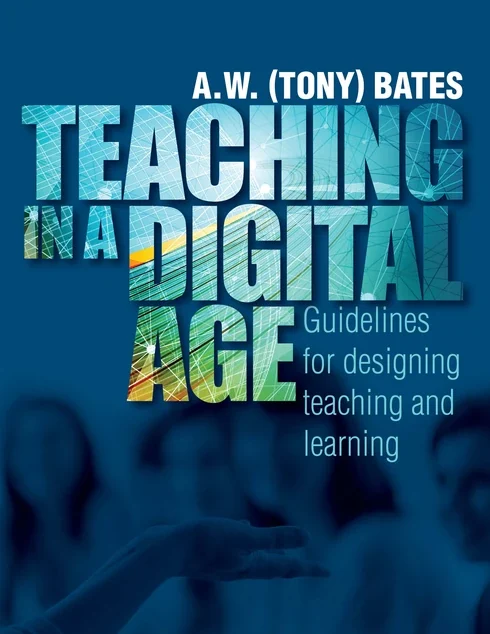
Teaching in a Digital Age: Guidelines for designing teaching and learning
Not rated yetRate this bookA. W. (Tony) Bates’s Teaching in a Digital Age connects educational goals, learning theories, teaching methods, media, and institutional support. This guide follows the linked second edition rather than silently replacing it with a later edition. Thirteen chapters and three appendices support decisions about designing a learning environment. The central question is what helps particular students learn particular things under real constraints, not which technology appears newest.
Read on the publisher’s website. Opens in a new tab.
 Free
About this book
A. W. (Tony) Bates’s Teaching in a Digital Age connects educational goals, learning theories, teaching methods, media, and institutional support. This guide follows the linked second edition rather than silently replacing it with a later edition. Thirteen chapters and three appendices support decisions about designing a learning environment. The central question is what helps particular students learn particular things under real constraints, not which technology appears newest.
Book summary
A. W. (Tony) Bates’s Teaching in a Digital Age connects educational goals, learning theories, teaching methods, media, and institutional support. This guide follows the linked second edition rather than silently replacing it with a later edition. Thirteen chapters and three appendices support decisions about designing a learning environment. The central question is what helps particular students learn particular things under real constraints, not which technology appears newest.
Chapter and section guide
1. Fundamental Change in Education
The opening chapter connects social, economic, and technological change with expectations of education. Bates asks what capabilities learners need and how established teaching arrangements respond. A new tool does not by itself demonstrate a new educational purpose. Students should distinguish a claim about changing circumstances from evidence that one instructional response is effective. This chapter establishes the context for evaluating goals and methods rather than assuming every familiar practice must be discarded.
Study application: Identify a change affecting one course and state the learning need it creates. Explain what evidence would justify changing a teaching activity rather than merely adding software.
2. Knowledge and Teaching
Views about knowledge influence what teachers ask students to do and how learning is assessed. The chapter compares learning theories and epistemological positions while connecting them with educational decisions. A method may emphasize transmission, construction, practice, inquiry, or participation for different reasons. Students should make those assumptions explicit before comparing technologies. A tool selected under one view of learning may be used very differently under another.
Study application: Analyze a short lesson by identifying what counts as knowledge and successful learning. Propose an alternative activity and explain the change in educational assumptions.
3. Campus-Focused Methods
Lectures, discussion, experiential approaches, and other campus-associated methods have different strengths and requirements. The chapter asks readers to connect a method with the intended learning rather than defend or reject it as a category. Class size, preparation, interaction, and available time affect what is feasible. Students should distinguish a method’s potential from the quality of one particular implementation. Combining methods requires a coherent learning sequence rather than variety for its own sake.
Study application: Compare a lecture and a discussion for one defined outcome. State what preparation and evidence of learning each would require.
4. Online-Focused Methods
Online teaching can reproduce classroom routines or use different designs for interaction and inquiry. Bates examines approaches including systematic design and collaborative learning. A design model organizes decisions but does not remove the need for professional judgment. Students should connect activities, feedback, and assessment with goals and learner needs. Moving content onto a platform is different from designing a usable learning experience.
Study application: Outline an online module with a goal, learning activity, feedback opportunity, and assessment. Explain how the pieces support one another rather than simply occupy the same page.
5. MOOCs
Massive open online courses vary in design, participation, and purpose. The chapter distinguishes forms of MOOCs and compares their educational and organizational implications. Large enrollment is not the same as sustained participation or demonstrated learning. Students should identify the intended audience, access conditions, support, and assessment before judging effectiveness. The edition’s examples and claims belong to its historical setting rather than a current platform comparison.
Study application: Evaluate a fictional MOOC proposal by purpose, learner preparation, interaction, assessment, and support. Explain which success measure would fit its stated purpose.
6. Effective Learning Environments
A learning environment includes the learners, content, activities, resources, feedback, and relationships supporting study. The chapter shifts attention from one delivery mechanism to the arrangement as a whole. Students should identify barriers and dependencies: an excellent activity may fail if learners cannot access materials or understand expectations. The design should make participation and progress possible for the actual audience, not an imagined uniformly prepared student.
Study application: Map a course environment and identify one mismatch among learner needs, activities, and support. Propose a change with a clear educational purpose.
7. Technology in Education
Media and technologies are related but not identical. The chapter develops a framework for thinking about how information and interaction are represented and delivered. A device can support more than one medium, and the same medium can be used through different technologies. Students should identify the educational function rather than evaluate a tool only by its features. This distinction makes later comparisons less dependent on brand names that change over time.
Study application: Describe a learning activity in terms of medium and function without naming a product. Then identify two technologies that could support it and the practical difference between them.
8. Pedagogical Differences among Media
Text, audio, video, computing, social media, and emerging forms support different kinds of representation and interaction. A medium’s value depends on the task and the way it is used. Adding several media can create useful alternatives or unnecessary cognitive and practical burdens. Students should state what each component contributes. The second edition’s treatment of emerging technologies is historical context, not a review of the latest products or capabilities.
Study application: Choose a difficult concept and compare two media for explaining it. Identify the learner action each supports and one limitation each leaves unresolved.
9. The SECTIONS Model
SECTIONS organizes decisions around Students, Ease of use, Costs, Teaching functions, Interaction, Organisational issues, Networking, and Security and privacy. These dimensions interact, and an attractive feature can be outweighed by access or support problems. The model is a structured inquiry rather than a mechanical score that guarantees the best choice. Students should document assumptions and distinguish a requirement from a preference.
Study application: Apply all eight dimensions to one fictional media choice. Identify a constraint that could rule out an otherwise attractive option and explain the evidence needed to assess it.
10. Modes of Delivery
Face-to-face, blended, and online arrangements should be selected in relation to students, learning activities, and available support. The chapter treats delivery as a design decision rather than a universal ranking. A campus meeting can be used for activities that benefit from presence while other work occurs elsewhere. Students should explain what each mode contributes and what coordination it requires. The institution’s existing timetable alone does not establish pedagogical necessity.
Study application: Design a blended sequence and justify which activities require shared physical presence. Identify how learners connect work across the different settings.
11. Open Education
Open resources and practices raise questions about access, reuse, adaptation, and participation. Free access does not automatically grant permission to modify a work, and a license does not guarantee educational suitability. The chapter connects open textbooks, research, data, and pedagogy with changing roles for teachers. Students should examine both the opportunity and the work required to evaluate, adapt, and maintain resources responsibly.
Study application: Assess one openly licensed resource for fit, accessibility, attribution, and permitted adaptation. Explain a reason an open resource might still require substantial preparation before teaching use.
12. Quality Teaching
Quality is developed through aligned goals, suitable activities, meaningful assessment, and a process of review. Bates emphasizes intentional design and teamwork rather than relying on a tool or checklist alone. Students should distinguish completion of design steps from evidence of learning. Feedback from learners and colleagues can identify problems that a designer did not anticipate. Evaluation should connect an observed issue with a specific revision and a way to assess its effect.
Study application: Create a quality-review plan for a short module. Include learning evidence, an accessibility check, learner feedback, and a defined revision decision.
13. Supporting Teachers
Sustained educational change requires professional development, specialist support, time, leadership, and institutional strategy. The chapter challenges the idea that each instructor must independently master every technical and design role. Students should identify the different expertise a course needs and how responsibilities can be shared. Support is most useful when connected with real teaching goals rather than offered as isolated software training.
Study application: Map the roles needed to develop a course and identify one support gap. Explain how an institutional action could address the gap without simply adding duties to the instructor.
Appendices and Activity Feedback
Media-selection questions, online-learning quality resources, independent reviews, and activity feedback extend the main chapters. Each serves a different purpose: a question prompts inquiry, a standard supports review, and feedback offers a comparison with an attempted response. Resource lists and interfaces can age. Students should use them alongside the chapter’s reasoning and independently check current availability and applicability.
Study application: Apply an appendix question to a real design choice and compare your answer with evidence from the course context. Record an unresolved question rather than force a premature conclusion.
Study instructions
- Begin with learners, learning goals, and the evidence an assessment should collect.
- State the learning theory or assumptions behind a proposed method.
- Use SECTIONS as an evidence-based comparison, documenting constraints and tradeoffs.
- Separate a medium’s educational function from the features of a named tool.
- Review the design with learners and colleagues and connect feedback with concrete revisions.
Practice and review task
Prepare a design brief for one module: learner profile, outcomes, activity sequence, media comparison, assessment, accessibility plan, support roles, and review method. Explain one appealing technology you rejected because it did not fit the learning context.
Questions for reflection
When does moving a course online change the learning design rather than only the location of materials? What evidence would show that a media choice improved learning rather than merely participation?
Sources and coverage
This original study guide follows Second edition, linked Pressbooks PDF. It draws on the source contents, chapter introductions, selected explanations and examples, and review material. It condenses the resource rather than replacing the full text; study applications are original exercises.
About access & copyright
This page provides book information and study material. Full-text access is provided by the original publisher or authorised source; a listing does not grant permission to republish the book.
Read our Library Access & Copyright policyExplore the contents
Check the chapters covered in this edition.
Visit the official source
See reading, preview or purchase options.
Save for later
Keep this textbook in your saved collection.
Reader ratings & reviews
Share your thoughts
Your review helps other students choose the right resources.
KEEP LEARNING
Your next great read
Curriculum & Instruction Curriculum & Instruction
Efficacious Technology Management: A Guide for School Leaders
View Efficacious Technology Management: A Guide for School Leaders — book Education
Trauma-Informed School Practices: Building Expertise To Transform Schools
View Trauma-Informed School Practices: Building Expertise To Transform Schools — book Cultural & Ethnic Studies
Knowing Home: Braiding Indigenous Science with Western Science
View Knowing Home: Braiding Indigenous Science with Western Science — book Curriculum & Instruction
Teaching Early and Elementary STEM
View Teaching Early and Elementary STEM — book Computer Science
Game Based and Adaptive Learning Strategies
View Game Based and Adaptive Learning Strategies — book Curriculum & Instruction
The Asynchronous Cookbook
View The Asynchronous Cookbook — book Curriculum & Instruction
Technology in Schools
View Technology in Schools — book Curriculum & Instruction
Using Open Educational Resources to Promote Social Justice
View Using Open Educational Resources to Promote Social Justice — book Curriculum & Instruction



