
 Social Sciences
EducationTextbook
Trauma-Informed School Practices: Building Expertise To Transform Schools
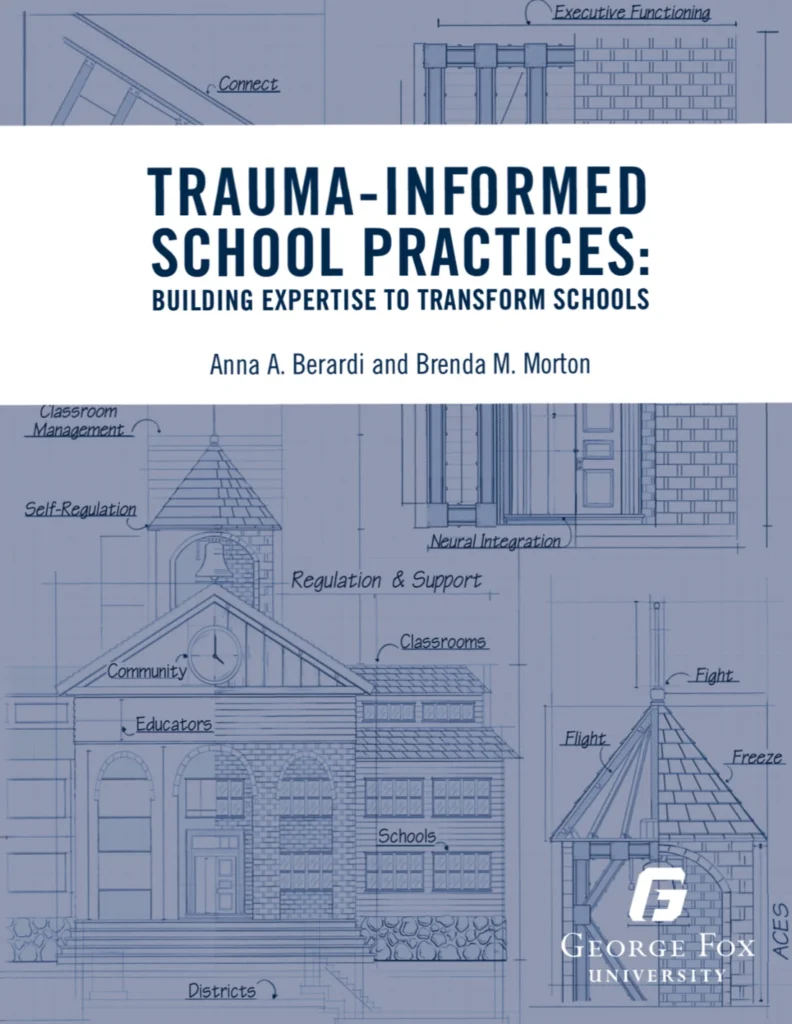
Not rated yetRate this bookAnna A. Berardi and Brenda M. Morton’s Trauma-Informed School Practices: Building Expertise to Transform Schools connects developmental and trauma-response concepts with the everyday work of educators. The 2019 text progresses through foundations, implementation, and sustainability in twelve chapters. Its tri-phasic model organizes connecting, coaching, and commencing as related processes supported by classrooms, families, schools, and districts. This guide follows the linked George Fox University edition. It explains an educational framework and its study activities; it does not turn observation of a student’s behavior into a diagnosis or substitute classroom strategies for specialist care.
Read on the publisher’s website. Opens in a new tab.
 Free
About this book
Anna A. Berardi and Brenda M. Morton’s Trauma-Informed School Practices: Building Expertise to Transform Schools connects developmental and trauma-response concepts with the everyday work of educators. The 2019 text progresses through foundations, implementation, and sustainability in twelve chapters. Its tri-phasic model organizes connecting, coaching, and commencing as related processes supported by classrooms, families, schools, and districts. This guide follows the linked George Fox University edition. It explains an educational framework and its study activities; it does not turn observation of a student’s behavior into a diagnosis or substitute classroom strategies for specialist care.
Book summary
Anna A. Berardi and Brenda M. Morton’s Trauma-Informed School Practices: Building Expertise to Transform Schools connects developmental and trauma-response concepts with the everyday work of educators. The 2019 text progresses through foundations, implementation, and sustainability in twelve chapters. Its tri-phasic model organizes connecting, coaching, and commencing as related processes supported by classrooms, families, schools, and districts. This guide follows the linked George Fox University edition. It explains an educational framework and its study activities; it does not turn observation of a student’s behavior into a diagnosis or substitute classroom strategies for specialist care.
Chapter-by-chapter summaries
Chapter 1: The State of Public Schools
School difficulties are introduced as concerns involving students, educators, families, and the surrounding system. The authors ask readers to reconsider explanations that focus exclusively on deliberate disobedience or weak academic motivation. A trauma-informed approach begins with curiosity about unmet needs, stress, relationships, and the conditions in which learning occurs. This does not establish one cause for every challenging behavior. Describe a school problem through observable events, then identify what remains unknown about its causes. The chapter prepares readers to seek a coordinated response instead of attaching a definitive personal label to a child from a brief encounter.
Chapter 2: Optimum Development and Academic Readiness
Developmental ideas explain why academic participation is connected with relationships, regulation, and opportunities for age-appropriate growth. The text draws on attachment and neural-integration frameworks to connect safety with readiness for higher-order learning. These are explanatory tools, not grounds for assuming that every student follows one identical developmental timetable. Identify what a classroom demand requires of attention, emotional regulation, communication, and social participation. Then consider which supports would make that demand more accessible. The chapter’s purpose is to expand educators’ understanding of readiness beyond subject knowledge alone and to make the learning environment part of that analysis.
Chapter 3: When Stress and Trauma Overwhelm Coping Resources
Stress responses can become disruptive when demands exceed available coping resources, particularly when adversity is persistent or inadequately supported. The chapter examines how trauma can affect functioning while emphasizing the importance of context and protective relationships. Exposure to adversity does not justify predicting one fixed outcome for an individual. Distinguish an event, a person’s response, and the resources available afterward. In a case discussion, identify what the educator knows directly and what would require a qualified assessment. This keeps the framework useful for compassionate educational planning without converting it into speculative clinical labeling.
Chapter 4: Trauma and Classroom Impact
Difficulties with attention, participation, relationships, and behavior can affect both an individual learner and the classroom’s functioning. The chapter connects earlier developmental concepts with patterns educators may encounter in school. A behavior’s impact can be documented even when its cause remains uncertain. Record the situation, observable action, adult response, and subsequent outcome before proposing an explanation. Ask whether routines, transitions, expectations, or social interactions increase the challenge. This perspective makes environmental change and relational support possible while retaining the need for clear boundaries and appropriate responses to immediate safety concerns.
Chapter 5: Trauma-Informed Response Best Practices
The chapter translates foundational concepts into principles for responding consistently and supportively. Predictability, attunement, relationship, regulation, and coordinated support guide the discussion. A strategy should fit the educational setting and the student’s needs rather than become a universal script applied regardless of context. Explain how a proposed response contributes to safety or learning, and consider how the student may experience it. Trauma-informed practice requires congruence between stated intentions and actual routines. A calm statement paired with an unpredictable or humiliating consequence can undermine the relationship the educator intends to strengthen.
Chapter 6: The Trauma-Informed School Practices Tri-Phasic Model
Phase I, Connecting, emphasizes attunement and the experience of being seen, heard, and valued. Phase II, Coaching, develops stabilization and social-emotional capacities through mentoring and practice. Phase III, Commencing, concerns increased engagement in executive functioning and developmental tasks, including academic learning. The phases are related and recursive rather than a one-time checklist that permanently sorts students. The model also operates across district, school, classroom, and educator levels. Apply it to a hypothetical case by identifying the support needed now and the evidence that would justify changing the plan. Do not treat visible compliance alone as proof of felt safety or stable self-regulation.
Chapter 7: Planning for Transition to Trauma-Informed School Practices
Implementation requires attention to district and school leadership, educator preparation, communication, resources, and existing routines. A classroom initiative can be weakened if the surrounding system uses incompatible expectations or responses. The chapter therefore treats change as a shared process rather than the private enthusiasm of one teacher. Map the stakeholders and the practices that would need review. Identify responsibilities, support, training, and feedback arrangements before announcing a school-wide program. A credible transition plan makes room for learning and revision and distinguishes an initial orientation session from the continuing development of competence.
Chapter 8: Implementing Trauma-Informed School Practices in the Classroom
Classroom routines make the framework tangible through relationships, transitions, instructional choices, and opportunities to practice regulation and participation. Strategies need to support the actual learning community rather than only decorate a classroom with supportive language. Choose one routine and describe what students are expected to do, what adults model, and how a student can obtain help. Observe whether the routine improves access and predictability for different learners. The chapter connects the tri-phasic model with daily educational work, making repeated practice and responsive adjustment more significant than introducing many isolated activities at once.
Chapter 9: Responding to Behavioral Disruptions
The text connects disruption response with the principles of safety, regulation, relationship, and developmental support. Immediate de-escalation, subsequent reflection, and longer-term skill development are different tasks and may require different timing. Reasoning with a highly distressed learner is not automatically equivalent to helping that learner regain the capacity to participate. Analyze a hypothetical incident in sequence, including how adult behavior and setting influence the outcome. Preserve accountability and the needs of other students while avoiding unsupported assumptions about intent. The goal is a response that teaches and supports rather than merely produces short-lived silence.
Chapter 10: Orienting and Supporting Parents as TISP Co-Facilitators
Families contribute knowledge, relationships, and support that schools cannot replace. The chapter treats parents and caregivers as collaborators whose perspectives and circumstances need to be understood. Communication should make the framework accessible without implying that a family has caused every difficulty or must disclose private experiences to be respected. Draft an invitation that explains the educational purpose, asks for relevant input, and identifies how collaboration will work. Consider barriers involving time, language, prior school experiences, and access. Partnership is strengthened when expectations are shared and feedback can influence the school’s plan.
Chapter 11: Applying TISP to Educator Competencies
Knowledge alone is insufficient if educators cannot recognize a situation, choose a suitable response, and reflect on their own participation. The chapter links the framework with professional competencies and the person of the educator. Attunement, conceptual understanding, practical action, self-awareness, and collaboration must be developed together. Use a case to identify the knowledge and observable skills required rather than describing competence as a favorable attitude alone. Include a plan for supervision, feedback, and further learning. The authors’ educational role boundaries remain important: developing trauma-informed teaching competence is different from becoming a licensed mental-health practitioner.
Chapter 12: Nurturing Effective and Sustainable TISP
Sustainability depends on ongoing support, consistent systems, reflection, and attention to the people implementing the work. A program can lose coherence when staff change, resources shrink, or initial training is not reinforced. The chapter reconnects student support with educator well-being and organizational responsibility. Identify the routines that preserve learning, review outcomes, and help staff address difficulties together. Evaluate more than whether training occurred: ask whether practices changed and whether the changes support the intended educational aims. Sustainability is a continuing capacity to adapt responsibly, not a declaration that the institution has finished learning.
Appendices A–D and References
The appendices provide supporting resources for integrating the framework, while references trace the developmental, educational, and trauma-related ideas used throughout the text. Use these materials to deepen a specific question and to document the basis of a proposed practice. Keep an implementation notebook that records the strategy, rationale, observations, and revision. The supporting material complements the twelve chapters; it should be used alongside school policy, professional support, and appropriate role-specific preparation rather than treated as independent authorization to provide therapy.
Study instructions
- Read the foundational chapters before selecting classroom strategies. Keep observations, interpretations, and unanswered questions separate.
- Use the Connecting–Coaching–Commencing model to analyze a hypothetical case without assigning a diagnosis.
- Choose one routine to revise and specify how it supports safety, regulation, or academic engagement. Gather feedback rather than assuming success.
- Include caregivers, support staff, and leadership in planning where relevant, with attention to privacy and accessible communication.
- Practice incident analysis after the immediate situation is resolved. Examine both student needs and adult/system responses.
- Create a sustainability plan with professional learning, review dates, staff support, and a way to revise practices when evidence or circumstances change.
Questions for reflection
- What is directly observed, and what is only inferred about a learner?
- How does the school system support or undermine a classroom strategy?
- What evidence distinguishes quiet compliance from supported participation?
- Which task belongs to an educator and which requires specialist collaboration?
Sources and coverage
This original reading guide follows the linked source edition’s chapter, module, unit, or lesson structure. Consult the source for full arguments, cases, worked examples, exercises, illustrations, and references. Coverage follows all twelve chapters and supporting Appendices A–D in the 2019 source edition. Educational descriptions are summaries of the authors’ framework; clinical assessment and treatment are distinct professional activities. The original source-PDF cover is used. Read the source edition.
About access & copyright
This page provides book information and study material. Full-text access is provided by the original publisher or authorised source; a listing does not grant permission to republish the book.
Read our Library Access & Copyright policyExplore the contents
Check the chapters covered in this edition.
Visit the official source
See reading, preview or purchase options.
Save for later
Keep this textbook in your saved collection.
Reader ratings & reviews
Share your thoughts
Your review helps other students choose the right resources.
KEEP LEARNING
Your next great read
Social Sciences Social Sciences
COUN 7: Blueprint for Success in College and Career
View COUN 7: Blueprint for Success in College and Career — book Psychology
Introductory Psychology
View Introductory Psychology — book Psychology
Applied Developmental Systems Science
View Applied Developmental Systems Science — book Social Sciences
ANTHRO 130: Intro to Cultural Anthropology
View ANTHRO 130: Intro to Cultural Anthropology — book Social Sciences
COMS 120: Small Group Communication
View COMS 120: Small Group Communication — bookIntroduction to Community Psychology
Introduction to Community Psychology
View Introduction to Community Psychology — bookCollege Success
College Success
View College Success — bookCOMS 105: Fundamentals of Public Speaking
COMS 105: Fundamentals of Public Speaking
View COMS 105: Fundamentals of Public Speaking — bookResearch Methods in Psychology



