
 Distance learning
Cultural & Ethnic StudiesTextbook
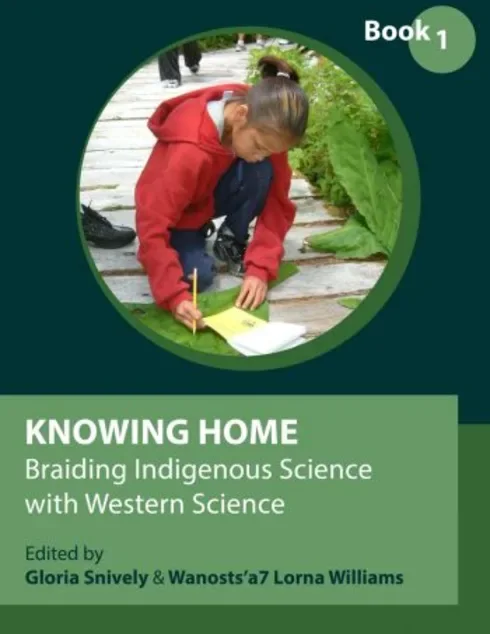
Knowing Home: Braiding Indigenous Science with Western Science
Not rated yetRate this bookKnowing Home: Braiding Indigenous Science with Western Science, Book One is a 2016 collection edited by Gloria Snively and Wanosts’a7 Lorna Williams. Its fifteen chapters combine foundations for science education with situated accounts of knowledge, teaching, storytelling, and intergenerational learning. This expanded guide preserves the existing chapter explanations, adds a study application to every chapter, and distinguishes all five appendices. Read each contribution with attention to its author, community, language, place, and educational purpose rather than treating the collection as one interchangeable set of Indigenous perspectives.
Read on the publisher’s website. Opens in a new tab.
 Free
About this book
Edited by Gloria Snively and Wanosts’a7 Lorna Williams, Book One of Knowing Home examines relationships among Indigenous knowledge, Western science, schooling, and the places where people live. Its fifteen chapters move from educational and epistemological questions to specific curriculum projects involving stories, seasonal knowledge, marine resources, and plants. The braiding metaphor proposes a relationship in which distinct knowledge traditions contribute without becoming indistinguishable. The accounts concern particular communities and contributors; they should not be read as a single perspective shared by all Indigenous peoples.
The detailed guide below explains the resource’s main ideas and how its chapters or sections connect. Read it alongside the study instructions and the complete official text.
Book summary
Knowing Home: Braiding Indigenous Science with Western Science, Book One is a 2016 collection edited by Gloria Snively and Wanosts’a7 Lorna Williams. Its fifteen chapters combine foundations for science education with situated accounts of knowledge, teaching, storytelling, and intergenerational learning. This expanded guide preserves the existing chapter explanations, adds a study application to every chapter, and distinguishes all five appendices. Read each contribution with attention to its author, community, language, place, and educational purpose rather than treating the collection as one interchangeable set of Indigenous perspectives.
Chapter-by-chapter summaries
1. Braiding Indigenous Science with Western Science
The opening chapter asks what happens when school science is encountered as an unfamiliar culture. Learners bring different relationships with nature and different ways of understanding why knowledge matters. A curriculum that assumes only one orientation may therefore create barriers even when its content appears accessible. Snively and Williams introduce braiding as a way to connect Indigenous science and Western science without requiring one to disappear into the other. The metaphor emphasizes relationship and reciprocity rather than the extraction of isolated facts to decorate an unchanged course. It also makes the learner’s movement among home, community, and classroom cultures visible. The chapter establishes the collection’s central educational question: how can science teaching broaden understanding and opportunity while taking learners’ existing knowledge and identities seriously? A successful connection needs attention to meaning and relationships, not simply the inclusion of a new example.
Study application: Explain the braiding metaphor using two ideas together: relationships can be created across knowledge traditions, and the traditions need not lose their distinct histories or purposes. Identify what an educator would need to learn before proposing a connection. Use a specific published example instead of claiming that every apparent similarity establishes the same meaning, method, or relationship.
2. Why Transforming the Science Curriculum Is Necessary
The second chapter situates underrepresentation and educational difficulties within a history of colonization and institutional practice. It challenges explanations that locate the problem entirely within Indigenous learners. Curriculum, language, teaching, governance, and wider social relationships all shape what happens in science education. Transformation therefore involves more than adjusting a lesson so that students fit an existing system. The authors connect educational opportunity with the recognition of knowledge and with the possibilities available to communities and future professionals. Their argument is structural: representation and participation depend on what institutions value and how they operate. Readers should distinguish this explanatory framework from a claim that every student has the same needs or experience. The chapter prepares a critical examination of schooling that can ask whose assumptions organize a course and which barriers remain invisible when success is attributed only to individual effort.
Study application: Distinguish a learner’s difficulty with a scientific concept from difficulty created by the way a curriculum presents knowledge and belonging. Identify an assumption about language, experience, or authority in a sample lesson. Explain how the chapter changes the question an educator should ask. The task is to examine the educational arrangement rather than label a student or community as deficient.
3. “Coming to Know”: A Framework for Indigenous Science Education
Coming to know describes learning as a developing relationship and a journey carrying responsibilities, rather than only the acquisition of information. The chapter connects reflection, experience, community, and relationships with the more-than-human world within the Indigenous epistemological framework it presents. Knowledge has consequences for how it is applied and shared. This provides a different starting point from treating a learner as an isolated recipient of facts. The authors also examine the learner’s relationship with Western science, making reflection on different perspectives part of the educational process. A careful reading preserves the framework’s cultural and philosophical dimensions instead of translating every idea into a familiar classroom technique. The chapter asks educators to consider what counts as understanding, how that understanding develops, and what responsibilities follow from knowing. Those questions organize the practical curriculum examples later in the book.
Study application: Map what coming to know involves in the chapter’s framework, including relationships, participation, context, and responsibility. Compare that process with a lesson assessed only through recall of isolated statements. Explain what each assessment can reveal and what it may miss. Keep the framework connected with the source’s discussion rather than presenting it as a universal description of every Indigenous community.
4. Creating Change in Teaching and Teacher Education
The fourth chapter translates the book’s argument into questions for instructional practice and teacher preparation. Recognizing that many cultures have contributed knowledge is only a beginning; teachers also need ways to make classroom participation meaningful for learners with different experiences. The authors examine teachers’ assumptions and the limitations of preparation dominated by one educational tradition. Rural Indigenous and urban multicultural settings raise related concerns without being identical contexts. Effective teaching requires learning about the community, choosing appropriate relationships and resources, and reconsidering how a lesson represents scientific activity. The chapter’s importance lies in linking inclusion with professional learning rather than assuming that goodwill supplies the necessary knowledge. Educators should be able to explain how an instructional choice supports understanding and belonging and what collaboration is needed before adapting material connected with a particular community.
Study application: Select one teaching decision involving materials, language, participation, or assessment and explain how it could change under the chapter’s approach. Identify who should help define the learning purpose and what preparation an educator requires. Compare a one-off addition of content with a sustained change in how knowledge and learners are treated. State the evidence you would seek when evaluating the change.
5. Representations in Textbooks, Resources, and Documents
This chapter examines how educational materials can make some contributions visible while obscuring others. An attractive image of cultural diversity does not necessarily correct an account that excludes Indigenous knowledge or presents history through a narrow set of discoverers. Textbooks and policy documents shape expectations about who produces knowledge, what counts as science, and which experiences belong in a classroom. The analysis therefore concerns the structure of representation, not merely the number of Indigenous examples included. Readers can ask who is credited, whose voice explains the knowledge, and whether a practice is separated from its context and purpose. Specific historical or chemical claims still require accurate evidence; the broader argument about recognition does not make every illustrative detail self-validating. The chapter offers a method for reviewing resources critically and for distinguishing substantive inclusion from a polished presentation that leaves the underlying exclusions intact.
Study application: Audit a short textbook passage for who is named, who speaks, which knowledge is treated as authoritative, and what context is omitted. Distinguish a missing representation from an inaccurate or stereotyped one. Propose a revision that makes attribution and context clearer without inventing a community voice. Then identify what consultation or further evidence would be required to support that revision.
6. Indigenous Science: Proven, Practical, and Timeless
Snively and John Corsiglia discuss Indigenous science as knowledge developed within communities and homelands and connected with practical survival, judgment, and sustained relationships with environments. Observation and innovation are embedded within values and responsibilities rather than presented as detached technical achievements. The chapter argues for recognizing such knowledge alongside the dominant scientific tradition and questions the assumption that useful understanding has only one institutional origin. Its environmental examples also invite scrutiny of the consequences of technological decisions. Readers should preserve the distinction between acknowledging a knowledge tradition and treating every claim as interchangeable across places. Locally developed practices are meaningful partly because of the circumstances in which they have been tested and transmitted. The chapter’s contribution is to broaden the history and social setting of science while asking how different traditions can participate in addressing ecological problems.
Study application: Choose one practice discussed in the source and record the place, people, purpose, and evidence presented with it. Explain why describing it only as a useful technique might omit important relationships or responsibilities. Compare the account’s practical and educational dimensions without assuming that knowledge becomes valuable only when translated into the categories of a conventional school-science lesson.
7. Examples from Northwestern North America
The regional survey connects Indigenous technologies with the conditions they address. Canoes, buildings, plant materials, food gathering, processing, and resource management illustrate how detailed environmental understanding supports practical design. A particular canoe form, for example, should be understood in relation to its waters, materials, transport needs, and users rather than ranked abstractly against another form. The chapter emphasizes that knowledge accumulated through sustained observation and refinement. Abundant resources were not automatically accessible throughout the year; obtaining and using them required skill, organization, and understanding of seasonal patterns. The examples concern specific peoples and locations and should retain those identifications. Their educational value lies in reconstructing the problem, the constraints, and the knowledge expressed in a solution. This makes technological achievement visible without reducing a living knowledge system to a collection of objects.
Study application: Create a comparison of two Northwestern North American examples while keeping their particular communities and environments distinct. Identify the problem each addresses and the contextual knowledge needed to understand it. Avoid grouping different practices into one timeless tradition. A useful comparison explains both a connection and a limit: what the examples illuminate together, and what should not be inferred from their resemblance.
8. When Uncles Become Killer Whales
A seashore learning encounter provides the starting point for examining how different worldviews meet. The author arrives with scientific field equipment and expectations about the activity, but the participation and interpretations of local people reveal a broader educational setting. The chapter asks how an educator can recognize that another account of human relationships with the natural world has meaning beyond a statement to be classified as correct or incorrect within one framework. Bridging requires listening and interpretation, not simply replacing the account with familiar terminology. The story also makes the teacher a learner whose original plan can change. Readers should distinguish respectful engagement with a culturally situated narrative from claiming to have mastered or generalized the worldview behind it. The chapter demonstrates why a cross-cultural encounter may transform the questions being asked as well as add information.
Study application: Analyze how an educator responds when a student’s account is unfamiliar within the teacher’s own worldview. Identify the questions that could open understanding and those that might dismiss the account before its meaning is explored. Read the chapter’s specific setting carefully. The aim is thoughtful educational dialogue, not treating the title as permission to generalize about the beliefs of every learner.
9. Changing Perceptions of Scientists and Science
Students’ images of scientists can narrow their sense of who participates in knowledge-making. The chapter reviews stereotyped representations and examines how teaching may reinforce or challenge them. If science is imagined only as solitary work by one kind of person in a laboratory, many genuine activities and contributors disappear from view. Broadening that picture involves settings, relationships, purposes, and cultural histories as well as demographic representation. The chapter connects those perceptions with learners’ possible identification with science. Its examples can be used to examine classroom materials, drawings, and assumptions, while recognizing that a changed picture alone does not demonstrate a lasting change in opportunity or achievement. The educational objective is a more accurate and inclusive understanding of scientific work, supported by concrete encounters and accounts rather than replacing one oversimplified image with another.
Study application: Examine what a drawing or description of a scientist reveals about a learner’s associations, then identify what it does not establish. Compare representations before and after an educational activity without assuming that one image measures every aspect of belonging or understanding. Ask whose scientific work and knowledge practices the curriculum makes visible and whether the assessment gives learners room to explain their own choices.
10. Seasonal Wheel
Gwixsisalas Emily Aitken presents the seasonal wheel as a way to connect learning with the recurring events of a home place. Harvests, animal movements, plant changes, and community practices can be organized through relationships among time, environment, and lived experience. The Kwakwaka’wakw example uses local language and particular resources, demonstrating that a season is more than an abstract quarter of a calendar. The activity can encourage close observation and continuing attention rather than a one-time labeling exercise. Adaptation to another setting should begin with that setting’s actual events and appropriate local knowledge, not the transplantation of every item from the published example. The chapter’s central insight is relational: patterns become meaningful when learners recognize how environmental changes connect with food, work, ceremony, and community life over time.
Study application: Read the seasonal wheel as a relationship among time, place, activity, and ecological observation, not merely a circular calendar template. Identify the particular community context given in the source. For an original planning exercise, ask what a locally appropriate seasonal inquiry would require, including collaborators and learning aims, rather than copying community-specific content into a new setting without examining its meaning.
11. Money from the Sea
The dentalium-shell activity introduces a practical problem through the historical use of marine shells as currency. Learners consider how people could obtain a resource located in a particular underwater environment using available materials and knowledge. The problem creates an opportunity to reason about organisms, habitat, tools, and design constraints together. Rather than presenting an Indigenous technology as a finished curiosity, the activity invites students to investigate why its features would make sense. The historical account supplies context, while the design exercise makes the intellectual work more visible. Students should distinguish their proposed solution from evidence about what a particular community actually did. The broader lesson is that a technical problem can be both scientifically demanding and culturally situated, and that successful design depends on a detailed understanding of conditions rather than a generic picture of ingenuity.
Study application: Trace the problem-solving process in the dentalium example from the question to the evidence, proposed explanation, and classroom learning. Identify where scientific, historical, and cultural contexts enter the reasoning. Distinguish reconstructing a published investigation from claiming firsthand knowledge of the associated practice. Evaluate a student explanation by how well it uses evidence and respects the limits of the account.
12. Dzaxwan: Stories My Elders Told Me
Nalaga Donna Cranmer introduces the chapter through her own family, Nation, language, and place, making the source of the knowledge explicit. Dzaxwan, or oolichan, is discussed within relationships involving food, oil, exchange, ceremony, and respect. Stories connect resource use with obligations and histories rather than treating the fish only as a biological specimen. The chapter’s form matters: the first-person account demonstrates how authority, identity, and transmission enter the knowledge being shared. A summary should not detach a practical detail and present it as a universal Indigenous rule. Readers can instead ask how ecological understanding, memory, and community practices reinforce one another in this particular account. The chapter prepares the curriculum discussion that follows by showing what would be lost if the topic were reduced to a list of species facts or an isolated classroom activity.
Study application: Read ‘Nalaga Donna Cranmer’s account with its introduction and family and community relationships intact. Identify how a story about dzaxwan connects observation, memory, language, and responsibility. Do not extract a practical detail as if the relationships surrounding it were irrelevant. A reflection can explain what the chapter teaches about learning while clearly distinguishing the author’s experience from the reader’s interpretation.
13. Gwaya’elas: Developing and Evaluating Dzaxwan Curriculum
The curriculum chapter asks how learning about dzaxwan can sustain relationships among young people, community knowledge, language, and environmental responsibility. Cranmer connects the project with concerns about changing resource extraction and the weakening of opportunities to learn associated practices and values. Curriculum design therefore has a purpose beyond transmitting information about a fish. The chapter links the choice of material with the people who carry it and with ways of evaluating whether the educational process supports those relationships. The account also makes clear that cultural relevance is not created simply by adding a local label to a standard lesson. Readers should examine how the project was developed, what participation involved, and what evidence supports its educational claims. It provides a situated example of curriculum-making whose principles invite reflection while its specific content remains connected to the community.
Study application: Compare the learning aims, contributors, activities, and evaluation in the Gwaya’elas curriculum. Ask how the project defines success beyond the memorization of facts about a fish. Identify the role of Elders and knowledge holders in shaping the work. A proposed adaptation should explain which relationships would need to be established locally rather than assuming that publication makes the entire educational process transferable unchanged.
14. Storytelling as Textbook and Curriculum Guide
Welila’ogwa Irene Isaac examines storytelling as an educational process within Kwakwaka’wakw life. Stories convey observations, histories, relationships, responsibilities, and ways of understanding the plant and animal world. Their significance is not exhausted by separating factual statements from an entertaining narrative wrapper. Performance, language, ceremony, and the circumstances of transmission contribute to how learning occurs. The chapter therefore challenges a narrow image of a textbook as the only organized container of knowledge. Classroom engagement with stories needs to consider who tells them, their purpose, and the relationships surrounding them. Readers can ask how a story guides conduct and interpretation as well as what it describes. This preserves the educational argument without assuming that every story may be reproduced, adapted, or interpreted outside its community in the same way.
Study application: Analyze one published discussion of storytelling by identifying the listener, teller, setting, language, and learning purpose. Explain why a transcript alone may not reproduce everything involved in the educational experience. Distinguish studying an account in a book from taking authority to retell a story in another context. The chapter supports careful attention to how knowledge is carried, not an assumption that every narrative is freely interchangeable.
15. Gitga’at Plant Project
Edosdi Judith C. Thompson describes a project designed to reconnect students with Elders through learning about plants, land, language, and culture. The problem addressed is not an absence of valuable knowledge but a reduction in opportunities for intergenerational learning. The project places relationships at the center of the educational design: learning about plants becomes a means of learning with people and within a homeland. Its account also shows why local ecological knowledge is cumulative and socially held rather than merely a collection of individual observations. Readers should distinguish the learning process, the specific knowledge shared, and the evidence used to evaluate the project. The chapter closes the main text by demonstrating the braiding argument in practice. A school curriculum can support access to additional scientific perspectives while strengthening connections that conventional schooling has sometimes weakened.
Study application: Map how the Gitga’at Plant Project connects students, Elders, plants, language, and homeland. Identify the educational problem the project addresses and the evidence used to discuss its outcomes. Compare intergenerational participation with an assignment that collects plant facts independently. Explain what relationships the latter might omit. Keep the project specific to the people and place described while considering how it can improve the questions you ask about your own teaching.
Appendices and Curriculum Resources
The appendices supply curriculum connections, selected websites and books, research-program information, and full-sized images. They support further study and planning but serve different purposes from the fifteen main chapters. A curriculum link can help identify an alignment; it does not by itself establish that a proposed activity is culturally appropriate or that every detail remains current. Similarly, a full-sized image needs its caption, attribution, and explanatory context. These materials are most useful when readers return to the relevant chapter and connect a resource with the relationship or learning purpose being discussed. They extend the book’s practical value without turning it into a universal package that can be transferred unchanged into any classroom.
Study instructions
- Begin with the theoretical and historical foundations. Explain the braiding metaphor while preserving the distinctions between the knowledge traditions being brought into relationship.
- Identify the people, places, and contexts associated with each example. Avoid presenting knowledge from a particular community as a universal Indigenous perspective.
- Compare the chapters on curriculum and representations of science. Note whose knowledge is included, who speaks, and what assumptions a conventional resource may leave implicit.
- Study the seasonal wheel, storytelling, and plant-project examples as situated curriculum designs. Record the relationships, participation, and learning processes on which each depends.
- When proposing a classroom adaptation, identify what requires local collaboration, permission, or contextual understanding. Do not turn a published account into an assumption that all associated knowledge can be freely reproduced.
Practice and review task
Write a curriculum reflection showing how one example could change your teaching questions and what consultation would be needed before adapting it.
Questions for reflection
What remains distinct within the braid? How does the relationship to a home place shape what is learned and how learning occurs?
Appendix A — Curriculum Connections
The curriculum connections help readers relate the book to educational outcomes, but alignment alone does not determine how a lesson should be taught. Select a connection and return to the chapter that gives it meaning. State the learning aim, the relationships needed to support it, and the evidence an assessment would collect. Treat the appendix’s policy context as dated material and check the requirements relevant to your present setting separately.
Appendix B — Selected Curriculum Websites
The website list is a starting point for further inquiry. Check who maintains a resource, the community or institution it represents, its stated audience, and any conditions of use. Record when you accessed it and whether it supplies context and attribution. A link that remains available is not by itself evidence that every classroom use is appropriate. Connect the resource with a specific question raised by the main chapters.
Appendix C — Selected Indigenous Science Books
Use the selected books to deepen a focused question rather than collect decontextualized examples. Record each work’s author or editor, subject, community context, and purpose. Compare how two works approach education or relationships with place without assuming either speaks for every community. The reading goal is to understand situated contributions and develop a better-supported educational question, while keeping the source of each idea visible.
Appendix D — Research Project and Graduate Program
This appendix locates the educational work within a research and programme setting. Use it to ask how research questions, participants, and institutional support shaped the studies discussed. Separate a description of the programme at publication from current admissions or programme information. For a research reflection, identify what a proposed study would need to establish through collaboration, a clear question, appropriate methods, and accountable interpretation.
Appendix E — Full-Sized Images
Consult the full-sized images with their captions, credits, and the chapters that explain them. A larger reproduction can reveal an important detail, but the image does not become a complete explanation of a practice or history. Describe what is visibly present before making an inference, and state which contextual information comes from the source. Preserve the relevant attribution and examine permissions before any reuse beyond your own study notes.
Sources and coverage
These original summaries draw on review of the source text, including chapter or section introductions and selected explanations, examples, review material, and concluding discussions. They are condensed study guides, not a page-by-page account or a replacement for the complete resource. Supplementary sections and original study illustrations are identified separately.
Official book source; Full source text.
Source and credit check: the linked 2016 Book One is edited by Gloria Snively and Wanosts’a7 Lorna Williams, with distinct contributing authors. The existing explanations have been retained and supplemented. Original study applications are educational reflections, not new accounts of community knowledge or substitutes for the relationships described in the source.
About access & copyright
This page provides book information and study material. Full-text access is provided by the original publisher or authorised source; a listing does not grant permission to republish the book.
Read our Library Access & Copyright policyExplore the contents
Check the chapters covered in this edition.
Visit the official source
See reading, preview or purchase options.
Save for later
Keep this textbook in your saved collection.
Reader ratings & reviews
Share your thoughts
Your review helps other students choose the right resources.
KEEP LEARNING
Your next great read
Distance learning data analysis
Learning Statistics with jamovi: A Tutorial for Beginners in Statistical Analysis
View Learning Statistics with jamovi: A Tutorial for Beginners in Statistical Analysis — book Education
al Data Analytics for Teachers and School Leaders
View Educational Data Analytics for Teachers and School Leaders — book Education
The Delft Method for System Dynamics
View The Delft Method for System Dynamics — book Education
START Handbook: How can I help my first-year students engage, persist and succeed?
View START Handbook: How can I help my first-year students engage, persist and succeed? — book Curriculum planning and development
Personal and professional development of students: A handbook for educators
View Personal and professional development of students: A handbook for educators — book Social Sciences
Psychology 2e
View Psychology 2e — book Business
Principles of Microeconomics 3e
View Principles of Microeconomics 3e — book Business
Principles of Macroeconomics 3e
View Principles of Macroeconomics 3e — book Social Sciences



