
Applying the International Classification of Functioning, Disability & Health: A Team-Based/Project Based Course for Undergraduate Students
MedicineTextbook
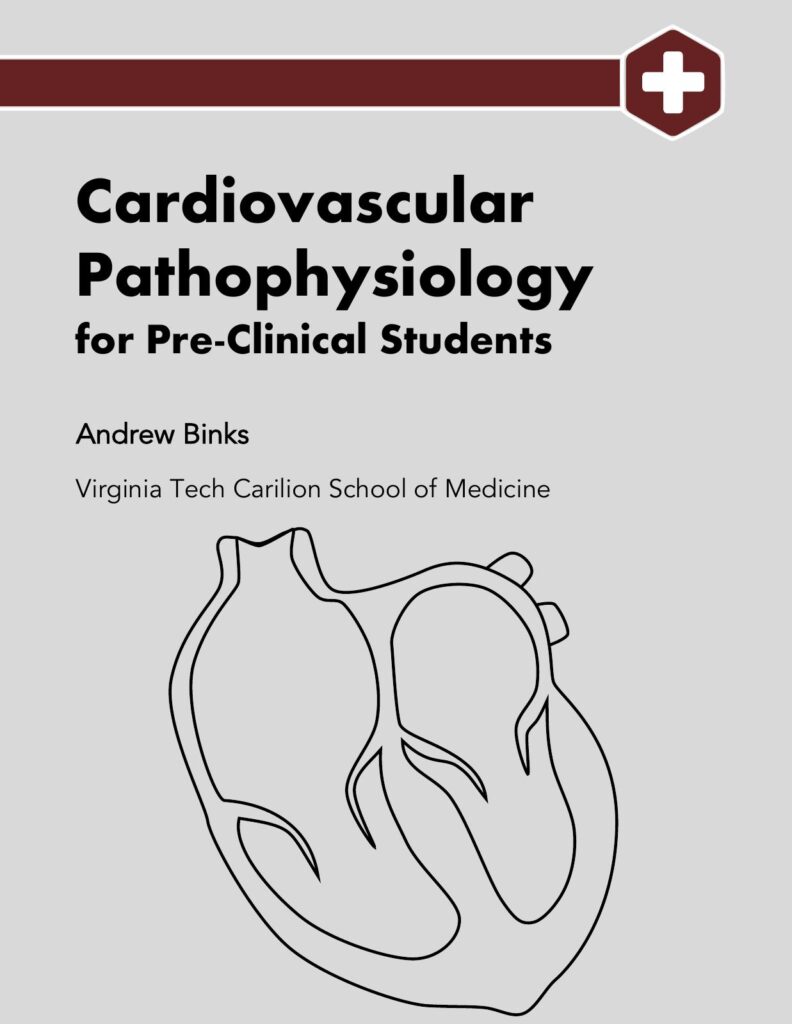
Cardiovascular Pathophysiology for Pre-Clinical Students
Not rated yetRate this bookAndrew Binks’s concise resource supports pre-clinical study of common cardiovascular disorders. It assumes basic cardiovascular physiology and prepares learners for classroom application. This guide identifies the book’s subject range and suggests a method for connecting mechanisms, terminology, and assigned course material.
Read on the publisher’s website. Opens in a new tab.
 Free
About this book
The 2022 book was developed for pre-clinical students at Virginia Tech Carilion School of Medicine and published in association with Virginia Tech Publishing. The source describes a concise, adaptable preparation resource aligned to USMLE content areas, with additional clinical application supplied during teaching.
The verified contents cover arrhythmias, heart failure, hypertension, valvular disease, heart sounds and murmurs, congenital heart disease, and ischemic heart disease. This description identifies the book’s organization; it does not claim that every disease discussion has been evaluated or reproduced on this page.
A foundation in normal cardiovascular physiology is assumed. Students can therefore use an assigned section to prepare for an active session, but should return to prerequisite material when the explanation relies on an unfamiliar mechanism. The PDF ISBN is 978-1-957213-02-6, and the publisher’s back-cover description identifies a 70-page text.
Sources, access, and reading coverage
2022 PDF title, publication and contents pages, back-cover description and selected introduction passages. The disease chapters have not been comprehensively reviewed; the guide discusses scope and study preparation. Reviewed 22 October 2026. The study guidance below is original Academic Master editorial material; it does not claim complete chapter coverage.
Official book information; official PDF; Open Textbook Library record. An authorized online reading edition is available through the official book link.
Cover credit: Cover art: Kindred Grey, CC BY 4.0. Illustration and cover design: Kindred Grey. Source: 2022 publication credits.
Book summary
Guide to the reviewed material
The reviewed introduction frames the resource around the basic mechanisms of common cardiovascular disease. Its purpose is to support an integrated medical curriculum in which classroom cases provide further application. That design helps explain the book’s brevity and the expectation that learners already understand normal function.
The introductory material favors short sections that teachers can combine with other curricular elements. A reader should therefore distinguish the assigned preparation from the full range of knowledge required for a clinical topic.
The contents provide a practical route through electrical rhythm, pumping function, pressure, valves, structural abnormalities, and ischemia. This is a map of verified headings, rather than a chapter-by-chapter clinical summary.
How to study this book
The following instructions are Academic Master editorial guidance.
Review the relevant normal process before starting the assigned disease section. Create a comparison sheet with separate spaces for normal function, the disturbance described in the source, and its stated consequences. Add page references to claims you will need to explain in class.
When a topic includes a diagram, trace or table, describe what is visible before naming a diagnosis or conclusion. Check your interpretation against the assigned text and instructor’s explanation. Record similar-sounding conditions separately so that terminology does not replace reasoning.
Use recall questions that ask for a mechanism, not only a label. After class, revise the comparison sheet to include the application actually taught. Use current course-approved clinical sources where an assignment requires contemporary management information.
Questions for reflection
- Which normal physiological relationship is needed for this assigned topic?
- Can you explain the mechanism without relying only on its disease name?
- Which information belongs to the preparation text, and which was added in class?
About access & copyright
This page provides book information and study material. Full-text access is provided by the original publisher or authorised source; a listing does not grant permission to republish the book.
Read our Library Access & Copyright policyPrerequisites
Begin with the relevant normal physiology.
Mechanisms
Explain how a disturbance changes function.
Comparison
Separate similar terms and conditions carefully.
Classroom use
Extend concise preparation through taught applications.
Reader ratings & reviews
Share your thoughts
Your review helps other students choose the right resources.
KEEP LEARNING
Your next great read
Medicine
Urinalysis Atlas: A Pictorial Guide to Formed Elements in Urine (Doty and Taylor)
Urinalysis Atlas: A Pictorial Guide to Formed Elements in Urine (Doty and Taylor)
View Urinalysis Atlas: A Pictorial Guide to Formed Elements in Urine (Doty and Taylor) — book Medicine
Drug Use and Misuse: A Community Health Perspective
View Drug Use and Misuse: A Community Health Perspective — book Medicine
Neuroscience for Pre-Clinical Students
View Neuroscience for Pre-Clinical Students — book Medicine
Pulmonary Physiology for Pre-Clinical Students
View Pulmonary Physiology for Pre-Clinical Students — book Medicine
Epidemiology
View Epidemiology — book Medicine
Social Determinants of Health in Nursing Education: Integrating Into Curriculum and Practice
View Social Determinants of Health in Nursing Education: Integrating Into Curriculum and Practice — book Medicine
Inclusive Approach to Anthropometric Body Measurement Assessments
View Inclusive Approach to Anthropometric Body Measurement Assessments — book Education
Qualitative Research – a practical guide for health and social care researchers and practitioners
View Qualitative Research – a practical guide for health and social care researchers and practitioners — book Medicine



