
Applying the International Classification of Functioning, Disability & Health: A Team-Based/Project Based Course for Undergraduate Students
MedicineTextbook
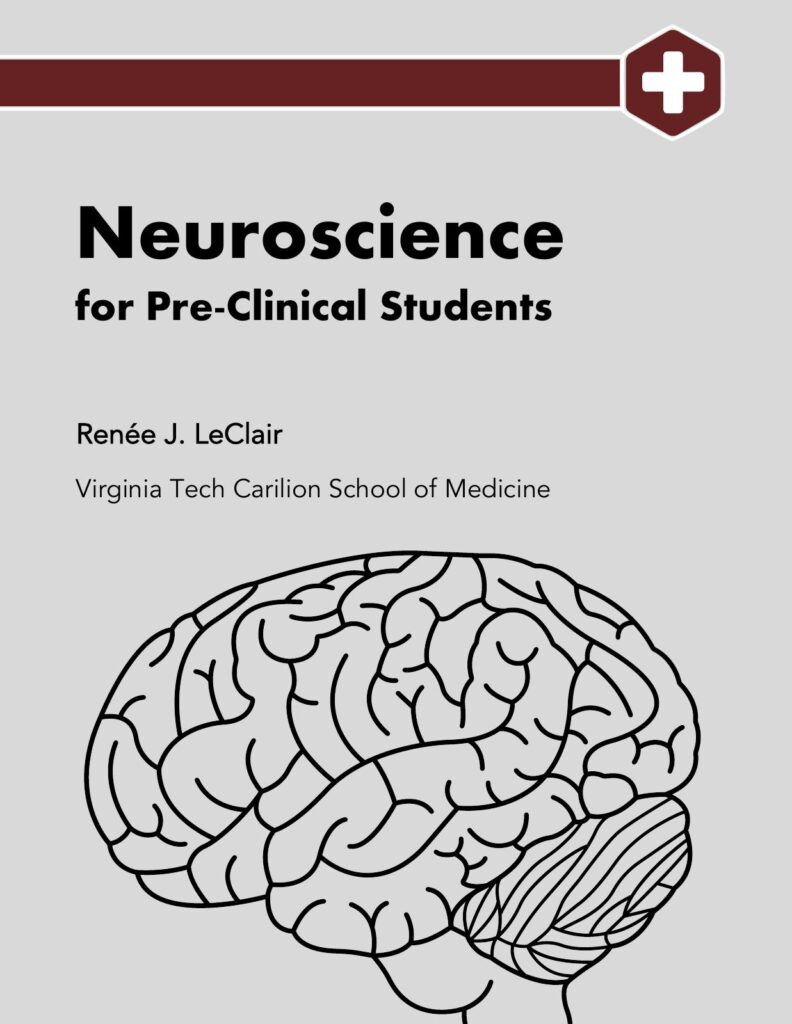
Neuroscience for Pre-Clinical Students
Not rated yetRate this bookRenée J. LeClair’s concise medical-learning resource focuses on biochemical neuroscience: brain energy use, neurotransmitters, neuropeptides, and selected amino acid pathways. It supports preparation for an active pre-clinical classroom. This guide clarifies the book’s scope and suggests ways to organize your reading and questions.
Read on the publisher’s website. Opens in a new tab.
 Free
About this book
Published in 2022 by the Virginia Tech Carilion School of Medicine in association with Virginia Tech Publishing, this resource was created for pre-clinical medical learners. Its introduction explains that short, flexible sections can support integrated teaching and problem-based learning.
The verified contents contain four chapters addressing neuron and astrocyte metabolism, selected neurotransmitters, neuropeptides and unconventional transmitters, and amino acid metabolism and specialized products. Despite its broad title, the publisher explicitly says that the resource does not cover neuroanatomy or neurophysiology. It is a focused biochemical primer rather than a complete neuroscience course.
The text assumes prior study of essential biology and chemistry. Clinical context and further applications are intended to be developed in the classroom. The PDF ISBN is 978-1-949373-80-6; the publisher separately identifies other formats. Its back-cover description identifies a 49-page text, distinct from the file’s preliminary and cover material.
Sources, access, and reading coverage
2022 PDF title, publication and contents pages, plus selected introductory passages on printed pages vi–vii; official Pressbooks description and publication metadata. The four substantive chapters have not been comprehensively reviewed. Reviewed 22 October 2026. The study guidance below is original Academic Master editorial material; it does not claim complete chapter coverage.
Official book information; official PDF; Open Textbook Library record. An authorized online reading edition is available through the official book link.
Cover credit: Cover design: Kindred Grey. Brain artwork: Mahmure Alp, The Noun Project, CC BY. Source: Virginia Tech publication credits.
Book summary
Guide to the reviewed material
The reviewed introduction explains a curricular problem: an integrated medical session may require material scattered across several traditional discipline textbooks. This book responds by organizing concise preparation around selected biochemical topics, allowing teachers to combine sections with changing classroom cases.
The author describes the sections as starting points for applied teaching rather than all-inclusive treatments. That distinction helps readers use the resource appropriately: learning the selected preparation material is a step toward understanding a class discussion, not proof of complete mastery of neuroscience.
The publisher identifies alignment with USMLE content areas. This describes the educational design of the resource; it does not provide a guarantee about an individual learner’s exam performance.
How to study this book
The following instructions are Academic Master editorial guidance.
Match the assigned section to the learning objectives for your class. Before reading, list the biological or chemical terms you need to refresh. After reading, draw a pathway or relationship map from memory and check it against the original figure or explanation.
Keep a comparison sheet for the different transmitter groups discussed in your assigned material. Use separate columns for what the source explicitly states and what you still need to ask in class. Avoid filling gaps from memory without checking the appropriate course source.
Bring one specific uncertainty to the active-learning session. When your instructor supplies a clinical case, explain how the assigned biochemical concept helps interpret it, while keeping this preparation text separate from current clinical management guidance.
Questions for reflection
- Which prerequisite concept is essential to understanding your assigned section?
- How does a short biochemical primer differ from a complete neuroscience reference?
- What would you need to explain a pathway without looking at its diagram?
About access & copyright
This page provides book information and study material. Full-text access is provided by the original publisher or authorised source; a listing does not grant permission to republish the book.
Read our Library Access & Copyright policyDefined scope
Recognize the text’s biochemical focus.
Preparation
Connect each short section to a class objective.
Organization
Compare pathways and transmitter groups systematically.
Application
Use classroom cases to extend the foundational reading.
Reader ratings & reviews
Share your thoughts
Your review helps other students choose the right resources.
KEEP LEARNING
Your next great read
Medicine
Urinalysis Atlas: A Pictorial Guide to Formed Elements in Urine (Doty and Taylor)
Urinalysis Atlas: A Pictorial Guide to Formed Elements in Urine (Doty and Taylor)
View Urinalysis Atlas: A Pictorial Guide to Formed Elements in Urine (Doty and Taylor) — book Medicine
Drug Use and Misuse: A Community Health Perspective
View Drug Use and Misuse: A Community Health Perspective — book Medicine
Cardiovascular Pathophysiology for Pre-Clinical Students
View Cardiovascular Pathophysiology for Pre-Clinical Students — book Medicine
Pulmonary Physiology for Pre-Clinical Students
View Pulmonary Physiology for Pre-Clinical Students — book Medicine
Epidemiology
View Epidemiology — book Medicine
Social Determinants of Health in Nursing Education: Integrating Into Curriculum and Practice
View Social Determinants of Health in Nursing Education: Integrating Into Curriculum and Practice — book Medicine
Inclusive Approach to Anthropometric Body Measurement Assessments
View Inclusive Approach to Anthropometric Body Measurement Assessments — book Education
Qualitative Research – a practical guide for health and social care researchers and practitioners
View Qualitative Research – a practical guide for health and social care researchers and practitioners — book Medicine



