
 Canada's Food Guide
MedicineTextbook
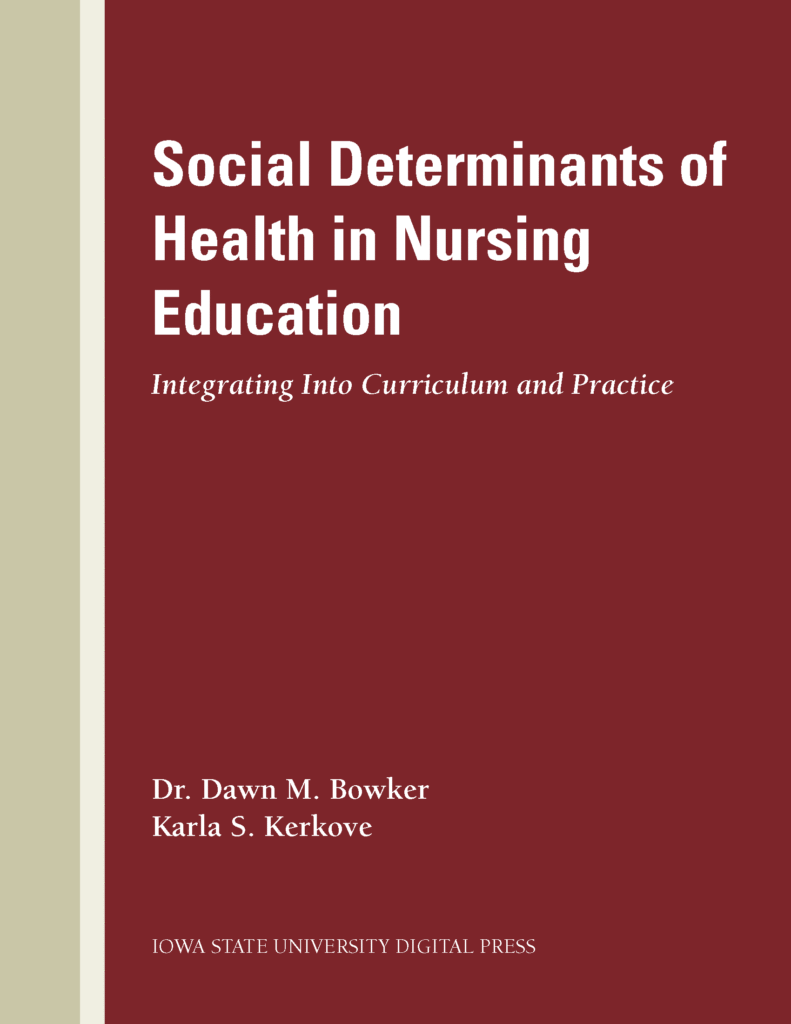
Social Determinants of Health in Nursing Education: Integrating Into Curriculum and Practice
Not rated yetRate this bookDawn M. Bowker and Karla S. Kerkove’s workbook supports the integration of social determinants of health into nursing education. It is aimed at educators and students connecting curriculum with nursing practice.
Free reading is available at the official source. Opens in a new tab.
 Free
About this book
Dawn Bowker and Karla Kerkove’s Social Determinants of Health in Nursing Education is a workbook for integrating population-health reasoning with clinical judgment. The 2023 first edition contains foundational sections, curriculum guidance, five unfolding cases, and a facilitator guide. Cases span chronic illness, home health, hospice, postoperative recovery, and childhood health promotion. The summaries below explain each case’s educational purpose without reproducing answer keys or presenting treatment instructions. A central lesson is to connect clinical observations with the social conditions affecting care, while avoiding assumptions that a person’s circumstances can be explained by motivation or culture alone.
The detailed guide below follows the book’s chapter, unit, or section structure. Read it alongside the study instructions and the complete official text.
Book summary
Chapter-by-chapter summaries
Section 1: Social Determinants of Health
The workbook begins with conditions in which people live, learn, work, and age and the wider systems that shape those conditions. Healthcare access is one part of the picture, alongside economic stability, education, neighborhood conditions, and social relationships. These domains influence opportunities and constraints rather than mechanically determining every individual's outcome. The section connects social conditions with healthcare encounters and asks nurses to consider what a conventional clinical assessment may leave unexplored. Identifying a barrier is a starting point for inquiry and collaboration, not permission to assume that everyone in a similar group has the same experience.
Section 2: What Is Cultural Aptitude?
Cultural aptitude is presented as an ongoing capacity to learn and understand, connected with competence, humility, safety, and recognition of implicit bias. The section shifts attention from memorizing presumed group traits toward examining the encounter and the nurse's own assumptions. Culture can matter to a person's choices, but asking and listening are essential because beliefs and preferences vary within groups. A respectful approach avoids converting identity into a prediction about consent, adherence, or priorities. The section also connects interpersonal care with power and trust, making reflection part of professional judgment rather than an optional personal exercise.
Section 3: Incorporating SDOH into Nursing Curriculum
The curriculum section connects social determinants with classroom, laboratory, clinical, and simulation learning. It uses the source's clinical-judgment and nursing-education frameworks to organize opportunities for students to recognize cues, interpret information, consider responses, and evaluate outcomes. Integration means revisiting social context across different care situations rather than adding one isolated lecture. Educators need objectives and assessment that make the intended reasoning visible. A student should be able to explain how a barrier changes the feasibility of a plan and which information remains unknown. Framework and policy references belong to the source's publication context.
Case 1: Stanley Flemming—COPD Exacerbation
The first Stanley case places a person with repeated admissions in an acute-care setting. It asks learners to distinguish immediate clinical concerns from the wider pattern of chronic illness and to connect both with social context. Repeated hospitalization is not explained adequately by labeling a person noncompliant. Access, understanding, relationships, environment, and resources require assessment rather than assumption. The unfolding format develops recognition of relevant cues and justification of priorities. Its educational focus is the connection between urgent assessment and a longer view of care, without suggesting that a summary can replace current clinical guidance or individualized decisions.
Case 2: Stanley Flemming—COPD and Home Health
The second Stanley scenario follows the transition after hospitalization into home-health and rehabilitation contexts. It contrasts what a nurse can learn in a home setting with the information available in acute care. Daily routines, neighborhood conditions, available support, and practical access can affect self-management and follow-up. The case encourages a community assessment and an understanding of the person's actual circumstances. A discharge plan can be technically complete yet difficult to carry out. The central learning task is to identify that gap and reason about collaboration, education, and support rather than repeat the hospital plan unchanged.
Case 3: Rhys Anderson—Hospice
The hospice case follows a person with advanced cancer and focuses on end-of-life experience, comfort, family, and cultural aptitude. Learners consider how symptoms and social relationships intersect with the person's goals and the care setting. The workbook prompts interdisciplinary thinking and distinguishes the purposes of palliative or hospice care from a simple expectation of cure. Communication should not presume what the person or family values. The case's clinical material is used here to explain the learning task, not to recommend medicines or symptom-management procedures. The social-determinants perspective asks whether appropriate support is understandable, accessible, and aligned with expressed preferences.
Case 4: Jacklyn Smuth—Postoperative Recovery
Jacklyn's scenario links recovery after cardiac surgery with mental health, economic circumstances, cultural or religious concerns, and access to care. The case demonstrates why a technically appropriate recovery recommendation may encounter constraints outside the immediate hospital encounter. Identity can indicate topics worth discussing, but it cannot substitute for asking the individual about preferences and decisions. Learners are asked to recognize evidence of delayed recovery and consider the interaction of physical and social factors. The educational purpose is a holistic, evidence-based account of the situation, avoiding a single explanation that attributes every difficulty to belief, attitude, or behavior.
Case 5: Khloe Seng—Early Childhood Health Promotion
Khloe's case places childhood development and health promotion within a rural, multigenerational household and preparation for school. Learners distinguish promotion of well-being from preventive services and connect developmental questions with education, neighborhood conditions, family support, and healthcare access. A family context can supply strengths as well as barriers. The case also introduces nursing advocacy and policy as responses to conditions that an individual household cannot change alone. Developmental and preventive-care references should be checked in their current professional context; this guide explains the workbook's reasoning task rather than supplying a screening schedule or individual assessment.
Section 5: Facilitator Guide—Stanley's Two Cases
The facilitator material develops teaching strategies and debriefing for the acute-care and home-health Stanley scenarios. Comparing them helps students notice how setting changes the information available and the nurse's role. A productive debrief asks learners to justify which cues mattered and how social conditions affected feasible care. It should also examine assumptions made before the relevant information was supplied. The guide can support discussion and simulation adaptation, but educators still need to fit the activity to learners, objectives, resources, and current clinical standards. The case answers are teaching material, not a universal protocol for every person with COPD.
Facilitator Guide—Rhys, Jacklyn, and Khloe
The remaining facilitator sections connect the three cases with their concepts, social domains, care spheres, and teaching strategies. They help educators move beyond checking whether a learner selected an expected answer toward exploring the reasoning behind it. Hospice, recovery, and childhood promotion require different goals and information, even when access and social support recur. Debriefing should distinguish what the case actually states from a student's inference and identify additional questions that would be needed in practice. The material is most useful when it supports respectful analysis rather than a scripted portrayal of a culture, family, or diagnosis.
Supplementary synthesis: Clinical judgment and social context
The case sequence can be read through a shared set of questions: what is known, what matters now, what may prevent a plan from working, and whose perspective has not yet been heard? A social factor should be connected with a plausible mechanism rather than mentioned as a decorative label. For example, noting access is more useful when the learner explains which service, resource, or follow-up is difficult to obtain. The response may involve coordination or advocacy as well as individual education. This additional synthesis connects the workbook's cases without adding another clinical scenario.
Supplementary synthesis: Avoiding assumptions while using case studies
A case compresses reality to create a teachable problem. It cannot represent every person's experience of an illness, religion, family structure, or community. Use the details supplied, identify uncertainties explicitly, and explain which questions would be asked next. Distinguish a structural constraint from a personal preference and a documented fact from an inference. That approach preserves the workbook's emphasis on cultural humility and social conditions while reducing the risk that an illustrative case becomes a stereotype. It also gives educators a clear standard for feedback on reasoning.
Study instructions
Read the workbook’s definitions before analysing a case. Separate the information the case provides from assumptions you bring to it. Identify social conditions relevant to the situation and note what further information would be needed to understand them.
Use the facilitator material and your course guidance when discussing possible responses. Explain the evidence behind a proposed interpretation and whose perspective is represented. Follow current professional and institutional guidance for practice; these prompts support reading and classroom discussion.
Full-book practice and review: Work through each case in two stages: first identify what is stated about the person and situation, then list the information still needed before drawing a conclusion. Link social conditions with feasible care or education options without substituting assumptions for the person's perspective. Compare your reasoning with the facilitator material after the initial analysis. Finish with a curriculum activity that includes learning objectives, discussion prompts, and evidence of students' developing clinical judgment.
Questions for reflection
- Which facts in a case concern conditions beyond an individual’s choices?
- What further information is needed before drawing a conclusion?
- Whose perspective is missing from the discussion?
The study suggestions and questions are independent Academic Master editorial material.
Sources and coverage
Coverage follows the 2023 first-edition workbook, including the five student cases and corresponding facilitator material. Clinical details are summarized for educational interpretation, not diagnosis or treatment. These original summaries draw on the source text, including chapter or section introductions and selected explanations, examples, exercises, and review material. They are condensed study guides, not a page-by-page account or a replacement for the complete resource. Additional synthesis sections are identified separately.
About access & copyright
This page provides book information and study material. Full-text access is provided by the original publisher or authorised source; a listing does not grant permission to republish the book.
Read our Library Access & Copyright policyContext
Notice the conditions surrounding a case.
Evidence
Separate stated facts from assumptions.
Perspective
Ask whose experience is represented.
Curriculum
Connect reading with the assigned learning goal.
Reader ratings & reviews
Share your thoughts
Your review helps other students choose the right resources.
KEEP LEARNING
Your next great read
Canada's Food Guide complete subjective health assessment
The Complete Subjective Health Assessment
View The Complete Subjective Health Assessment — book Health Sciences (general)
Leadership and Influencing Change in Nursing
View Leadership and Influencing Change in Nursing — book health
Vaccine Practice for Health Professionals, 1st Canadian edition
View Vaccine Practice for Health Professionals, 1st Canadian edition — book Nursing
 Care at the End of Life : What Every Clinician Should Know
View Nursing Care at the End of Life : What Every Clinician Should Know — book Health Sciences (general)
The Scholarship of Writing in Nursing Education: 1st Canadian Edition
View The Scholarship of Writing in Nursing Education: 1st Canadian Edition — book Coronavirus
Cancer Care in the Post-COVID World
View Cancer Care in the Post-COVID World — book Body-mind-spirit
Health Promotion in Health Care – Vital Theories and Research
View Health Promotion in Health Care – Vital Theories and Research — book bioinformatics
Bioimage Data Analysis Workflows
View Bioimage Data Analysis Workflows — book Behavioral sciences



