
 bioinformatics
MedicineTextbook
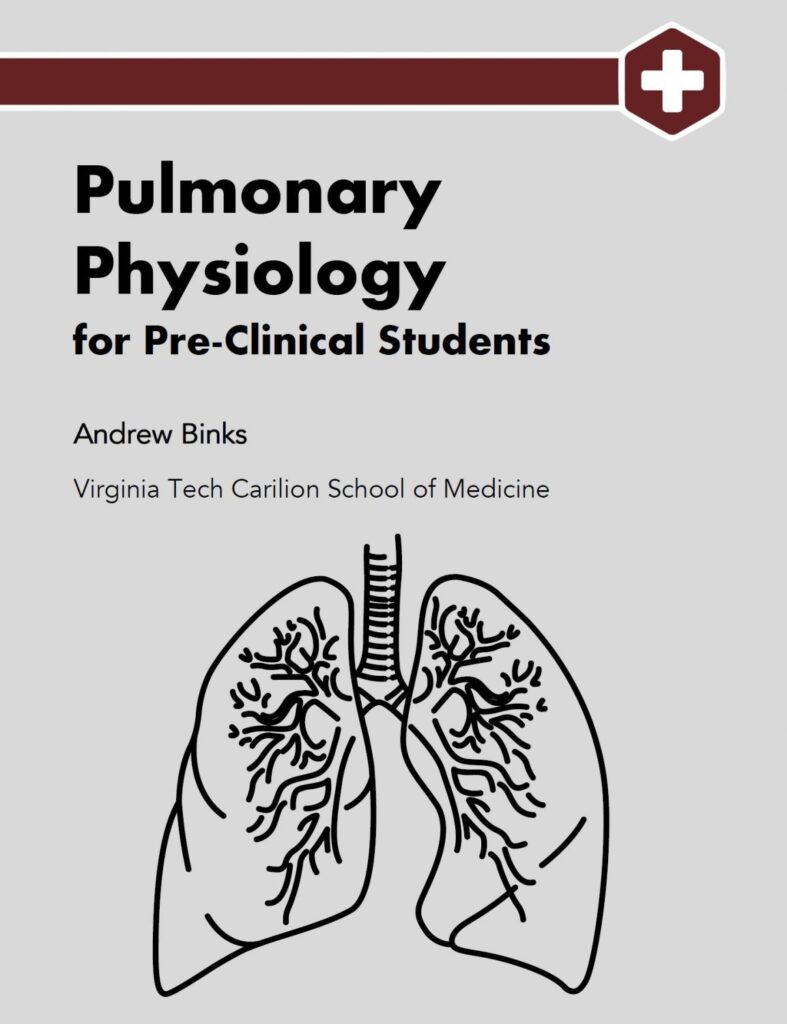
Pulmonary Physiology for Pre-Clinical Students
Not rated yetRate this bookPulmonary Physiology for Pre-Clinical Students introduces core respiratory concepts for medical learning. Andrew Binks organizes concise preparation around lung mechanics, gas exchange, circulation, transport, and control of breathing. This guide explains the intended use of the resource and provides a structured reading approach.
Read on the publisher’s website. Opens in a new tab.
 Free
About this book
Pulmonary Physiology for Pre-Clinical Students explains breathing, gas exchange, transport, and control through eighteen concise chapters. Andrew Binks develops the sequence from airway structure and pressure changes to ventilation–perfusion relationships and the sensation of dyspnea. The text is particularly useful for distinguishing concepts that sound similar but describe different processes, such as ventilation and oxygenation or oxygen pressure and oxygen content. This guide follows every original chapter. It concentrates on mechanisms and the interpretation of educational examples rather than current diagnostic thresholds or management advice. Readers should use the source diagrams and equations alongside the summaries to connect verbal explanations with quantitative relationships.
The detailed guide below follows the book’s chapter, unit, or section structure. Read it alongside the study instructions and the complete official text.
Cover credit: Cover design: Kindred Grey. Lungs artwork: iconmu, The Noun Project, CC BY 3.0. Source: 2022 publication credits.
Book summary
Chapter-by-chapter summaries
Chapter 1: Fundamentals
The opening chapter connects airway and alveolar structure with the functions needed for gas exchange. Conducting regions move and condition air, while the respiratory region provides the exchange surface. Ventilation, diffusion, perfusion, and transport are distinct parts of the overall process. Failure at one stage cannot be understood merely by saying that the lungs are not working. The chapter establishes a useful map: identify where air moves, where blood moves, and where gases cross between them. Later chapters explain how those coordinated processes maintain blood-gas homeostasis.
Chapter 2: Mechanics of the lungs
Airflow requires a pressure difference. Respiratory-muscle activity changes the mechanical relationships among the chest, pleural space, and lungs, producing changes in alveolar pressure and volume. The chapter asks readers to follow these variables through a breathing cycle rather than treat inhalation as air actively seeking a space. Pleural and alveolar pressures have different meanings, and their difference helps explain lung expansion. A diagram with the reference pressure stated clearly provides a useful check on the direction of flow at each stage.
Chapter 3: Lung volumes and compliance
Lung-volume categories describe different portions of the breathing range, while compliance relates volume change to a change in distending pressure. Compliance should not be confused with the amount of air moved in one breath or the resistance to airflow. The chapter connects pressure–volume behavior with elastic properties and surface-related effects. Readers should identify what a measurement can capture and which volumes require additional methods. The conceptual goal is to explain why two lungs exposed to a similar pressure change may expand differently.
Chapter 4: Distribution of ventilation
Ventilation is not distributed uniformly throughout the upright lung. Regional mechanical conditions affect resting expansion and the amount of additional volume produced during a breath. The chapter connects these differences with the pressure and compliance concepts already introduced. A region that is more expanded at rest does not necessarily receive the largest share of a normal breath. Readers should distinguish resting size from change in size. This prepares for the later comparison with blood-flow distribution and explains why whole-lung averages can conceal important regional relationships.
Chapter 5: Airflow and airway resistance
Airflow depends on driving pressure and resistance, with airway dimensions and flow conditions affecting the relationship. The branching system cannot be understood from the radius of one isolated tube alone because many small airways operate in parallel. Lung volume and airway smooth-muscle activity can also alter resistance. The chapter connects physical principles with these anatomical and physiological conditions. Readers should state the assumptions behind a simple flow equation before applying it. This avoids treating a useful model of one condition as an exact description of the entire bronchial tree.
Chapter 6: Dynamic airway compression
During forced expiration, pressure relationships along an airway can promote compression and limit flow. Increasing effort does not necessarily increase flow proportionally throughout the maneuver. The chapter connects this behavior with elastic recoil and explains how disease can alter it. Flow–volume patterns become intelligible when read through the mechanism rather than memorized as outlines. A useful review marks alveolar, pleural, and airway pressures and follows where the pressure falls along the path. This distinguishes a limitation caused by airway mechanics from a simple lack of expiratory effort.
Chapter 7: Fundamentals of gas exchange
Partial pressure describes one gas’s contribution to a mixture’s pressure. Diffusion across the exchange surface depends on a pressure difference and properties of the barrier and gas. The chapter introduces the factors summarized by Fick’s law, connecting area and thickness with transfer. Readers should distinguish gas concentration in a mixture from the partial pressure produced under a particular total pressure. This matters when comparing conditions such as altitude or humidification. The chapter supplies the physical framework for asking why a gas may fail to equilibrate despite adequate movement of air.
Chapter 8: Perfusion and diffusion limitations
Gas transfer can be limited by the arrival of blood or by equilibration across the exchange surface. The chapter compares these conditions and examines how transit time, exercise, disease, and interaction with hemoglobin affect the result. Perfusion-limited does not mean that blood flow is necessarily abnormal; it describes which factor limits further transfer under the stated conditions. Readers should follow the capillary pressure change over time and identify whether equilibrium is reached. That graphical reasoning is more reliable than assigning every gas one unconditional label.
Chapter 9: Pulmonary blood flow
The pulmonary circulation receives the cardiac output but operates under conditions different from the systemic circulation. Pressure, resistance, compliance, gravity, lung volume, and local oxygen conditions influence flow. The chapter connects regional perfusion with surrounding pressures and distinguishes vascular responses that may differ from familiar systemic behavior. Readers should identify which pressure is inside or outside a vessel and how that affects its caliber. This prepares the later ventilation–perfusion analysis, where both the distribution of air and the distribution of blood determine exchange.
Chapter 10: Pulmonary capillaries and nonventilatory function
Fluid balance at the exchange surface depends on vascular and tissue relationships that normally prevent excessive accumulation in airspaces. The chapter examines how disturbances can contribute to pulmonary edema. It also introduces functions of the pulmonary circulation beyond exchanging oxygen and carbon dioxide. Readers should distinguish the movement of gas from the movement of liquid, even though both affect the same region. The larger lesson is that an effective exchange surface depends on maintaining its surrounding conditions as well as providing air and blood.
Chapter 11: Arterial carbon dioxide and pH
Carbon dioxide participates in the chemical relationships that influence blood pH. Changing its removal through alveolar ventilation can therefore alter acid–base conditions. The chapter connects respiratory function with buffering rather than presenting ventilation as only an oxygen-supply process. Readers should follow the direction of the chemical relationship and distinguish a change in carbon dioxide from a primary change in another acid–base component. This provides the basis for the next chapter’s comparison of disturbances and compensation.
Chapter 12: Alkalosis and acidosis
The chapter separates respiratory and metabolic contributions to acid–base disturbance and examines compensatory responses. A measured pH alone does not identify the complete process. Carbon dioxide, bicarbonate-related information, context, and the direction of expected response need to be considered together. Compensation should not be assumed to erase the original disturbance. The educational task is to reconstruct which change is primary and which represents a response. Readers should also remain open to more than one process rather than force every example into a single uncomplicated category.
Chapter 13: Ventilation and perfusion
Ventilation–perfusion relationships describe how air supply and blood flow match within lung regions. A low ratio and a high ratio represent different imbalances, and their effects on gas pressures differ. The chapter connects regional variation with the whole-lung result. Mixing blood from different regions is not equivalent to simply averaging their pressure values. Readers should follow a region’s air and blood separately before explaining the combined outcome. This chapter integrates the mechanics and circulation material into a central account of effective gas exchange.
Chapter 14: Alveolar gas equation and alveolar–arterial difference
Estimating alveolar oxygen and comparing it with arterial oxygen helps distinguish mechanisms behind a reduced arterial value. The chapter connects the equation with its assumptions and with ventilation, diffusion, and matching problems. A pressure difference is an interpretive clue, not a complete diagnosis by itself. Readers should identify the inspired conditions, carbon-dioxide information, and model assumptions used in an example. The important distinction is between oxygen reaching the alveolus and oxygen appearing in arterial blood, with several processes potentially affecting the relationship.
Chapter 15: Pulmonary shunts
A shunt allows blood to reach the arterial side without participating in effective exchange with ventilated alveoli. The chapter distinguishes this from other ventilation–perfusion problems and develops a mixing-based calculation. Such reasoning depends on oxygen content, not merely substituting pressure values into a volume balance. Readers should draw the routes before performing arithmetic and specify the assumptions about blood that has passed the exchange surface. This makes the result physiologically interpretable and clarifies why different causes of low oxygen can respond differently to a changed inspired mixture.
Chapter 16: Gas transport
Oxygen partial pressure, hemoglobin saturation, and oxygen content describe different properties. The chapter connects their relationships with hemoglobin binding and the conditions in lungs and tissues. It also examines the principal forms in which carbon dioxide is carried. A change in hemoglobin amount can alter content without an equivalent change in oxygen pressure, illustrating why the terms are not interchangeable. Readers should identify which quantity an equation or graph uses before interpreting it. The chapter links pulmonary exchange with delivery and removal in the rest of the body.
Chapter 17: Control of breathing
Breathing is regulated through interacting neural and chemical mechanisms. Central and peripheral chemoreceptors provide information relevant to maintaining homeostasis, while cortical and other influences can modify the pattern. The chapter connects feedback with the ventilation needed for changing metabolic conditions. Readers should distinguish the sensed variable, the responding system, and the resulting change. This prevents a reflex from being reduced to a vague claim that the body needs more air. The mechanism also helps explain how altered conditions can change drive without a simple one-to-one relationship with subjective breathlessness.
Chapter 18: Dyspnea
Dyspnea includes distinguishable sensations such as air hunger, breathing effort, and chest tightness. The chapter connects those experiences with different physiological and neural mechanisms. A person’s description therefore supplies information that a broad label can conceal. Readers should avoid assuming that sensation directly measures one variable such as oxygen pressure. The chapter completes the book by connecting physical processes, control, and conscious experience. Its educational emphasis is careful interpretation: related symptoms can arise through different pathways, and a complete explanation requires more than matching a single phrase with one disease.
Study instructions
The following instructions are Academic Master editorial guidance.
Begin by identifying whether the assigned section concerns movement of air, transfer of gas, circulation, or regulation. Make a short list of the variables and terms used in the original explanation. Keep pressure, volume, flow, and concentration terminology distinct.
Redraw an assigned relationship or figure from memory and explain each label. When a calculation is assigned, state the meaning and units of the quantities before inserting values, then compare the result with the assumptions used in the source.
Use the chapter objectives to prepare questions for class. After the session, connect the foundational explanation to the case your instructor discussed. Mark any uncertainty that requires a prerequisite review instead of memorizing an unexplained result.
Study across the full book
- Build the eighteen chapters into a sequence from mechanics and ventilation to gas exchange, transport, and control. For each stage, distinguish a volume, a flow, a pressure, and a concentration rather than using the terms interchangeably.
- When solving a gas-exchange problem, state the assumptions and units before using an equation. Compare ventilation limitation, diffusion or perfusion limitation, ventilation–perfusion mismatch, and shunt using the source explanations.
- Draw and explain one mechanism diagram from memory, then correct it against the book. Finish with an instructor-supplied integrated example that connects airway behavior, blood gases, and respiratory control without skipping the intermediate steps.
Questions for reflection
- Which quantities describe air movement, and which describe gas exchange?
- What assumption is needed to interpret the figure or equation you are studying?
- How does the assigned concept connect respiratory and cardiovascular function?
Sources and coverage
All eighteen original chapters are covered. The guide emphasizes physiological mechanisms rather than current clinical management. These original summaries draw on review of the source text, including chapter or section introductions and selected explanations, examples, exercises, and concluding or review material. They are condensed study guides, not a page-by-page account or a replacement for the complete resource. Supplementary study discussions are identified separately.
About access & copyright
This page provides book information and study material. Full-text access is provided by the original publisher or authorised source; a listing does not grant permission to republish the book.
Read our Library Access & Copyright policyOrganization
Locate a topic within mechanics, exchange, circulation, or control.
Precision
Keep respiratory variables and units distinct.
Visual recall
Explain relationships rather than memorize unlabeled diagrams.
Integration
Connect preparation with the classroom case.
Reader ratings & reviews
Share your thoughts
Your review helps other students choose the right resources.
KEEP LEARNING
Your next great read
bioinformatics Behavioral sciences
Understanding Statistics and Experimental Design
View Understanding Statistics and Experimental Design — book Medicine
Veterinary Epidemiology: Principles and Methods
View Veterinary Epidemiology: Principles and Methods — book Medicine
Public Health Ethics: Cases Spanning the Globe
View Public Health Ethics: Cases Spanning the Globe — book Medicine
Cell Biology, Genetics, and Biochemistry for Pre-Clinical Students
View Cell Biology, Genetics, and Biochemistry for Pre-Clinical Students — book Medicine
Applying the International Classification of Functioning, Disability & Health: A Team-Based/Project Based Course for Undergraduate Students
View Applying the International Classification of Functioning, Disability & Health: A Team-Based/Project Based Course for Undergraduate Students — book Medicine
Urinalysis Atlas: A Pictorial Guide to Formed Elements in Urine (Doty and Taylor)
View Urinalysis Atlas: A Pictorial Guide to Formed Elements in Urine (Doty and Taylor) — book Medicine
Drug Use and Misuse: A Community Health Perspective
View Drug Use and Misuse: A Community Health Perspective — book Medicine
Neuroscience for Pre-Clinical Students
View Neuroscience for Pre-Clinical Students — book Medicine