
Applying the International Classification of Functioning, Disability & Health: A Team-Based/Project Based Course for Undergraduate Students
MedicineTextbook
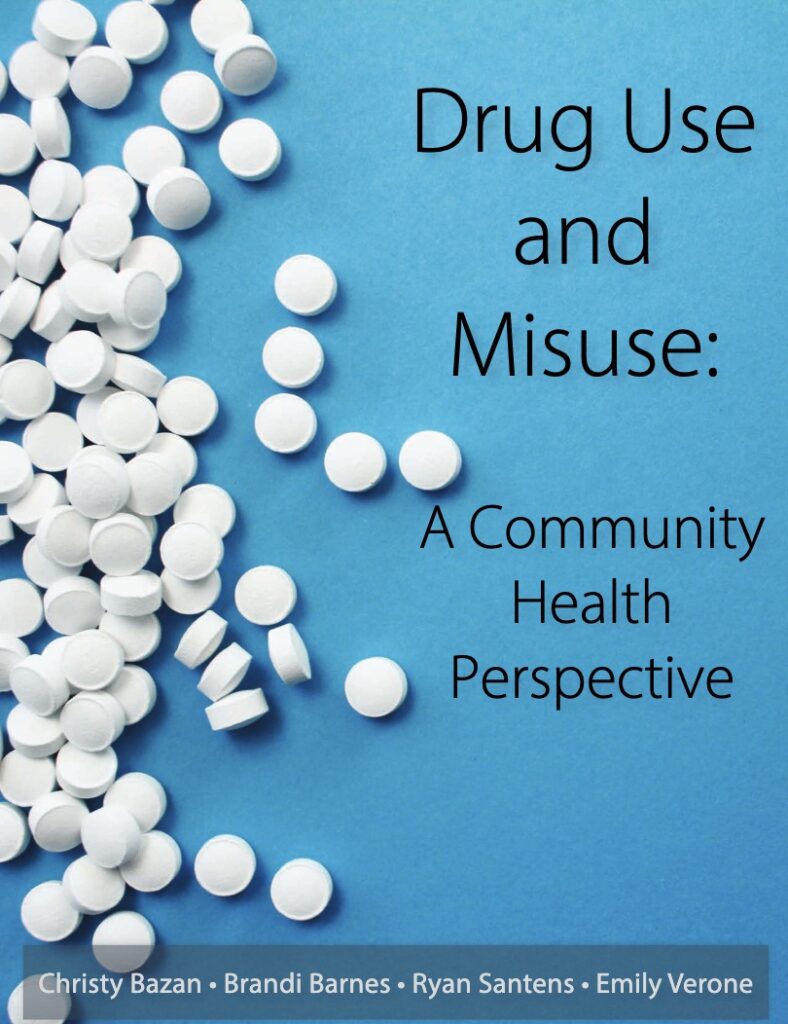
Drug Use and Misuse: A Community Health Perspective
Not rated yetRate this bookDrug Use and Misuse examines substances through a community-health perspective. It connects individual experiences with biological processes, social conditions, policy, and the effects of drug use on families and communities.
Free reading is available at the official source. Opens in a new tab.
 Free
About this book
About this book
Christy Bazan, Brandi Barnes, Ryan Santens, and Emily Verone developed this 2022 resource for an undergraduate University of Illinois Urbana-Champaign course. Windsor & Downs Press publishes the book through the Illinois Open Publishing Network.
Eight chapters range from introductory terminology and drug action to social determinants, substance categories, and prevention and treatment models. The authors frame the subject as a community-health concern. The online version includes interactive material that is represented differently or linked externally in the PDF.
Book summary
Chapter-by-chapter summaries
Chapter 1 — Drug Use and Misuse Overview
The opening chapter establishes terminology for discussing substances, patterns of use, and their consequences. It distinguishes use, misuse, and dependence while connecting individual experiences with effects on work, education, families, and communities. Routes of administration, reasons for use, and the relationship between legal classifications and social perceptions broaden the discussion beyond a list of illicit drugs. The chapter’s questions ask learners to examine assumptions about familiar substances and recognize that social acceptability and physiological effects are different dimensions. Its role in the book is foundational: later chapters depend on a shared vocabulary for comparing substances and understanding problems without reducing every pattern of use to the same category.
Chapter 2 — How Drugs Work in the Body and the Brain
This chapter introduces the biological processes needed to understand psychoactive effects. Neurons, supporting cells, neurotransmission, and the central nervous system provide a framework for explaining how substances can influence experience and behavior. Drug effects are also connected with bodily processes beyond the brain. The chapter places biomedical explanations alongside a biopsychosocial perspective, showing why biological mechanisms are important without exhausting the subject. Its educational progression moves from components of the nervous system toward interactions among substances, physiological regulation, and behavior. This gives learners a conceptual foundation for the substance categories discussed later, rather than presenting those categories as unrelated collections of effects.
Chapter 3 — Social Determinants of Drug Use, Misuse, and Involvement
The social-determinants chapter rejects an explanation based only on isolated individual choices. Patterns of use and involvement in drug production or distribution occur within interacting family, cultural, economic, physical, and institutional environments. These conditions also distribute drug-related harms unevenly. The chapter examines demographic patterns and the relationship between marginalized communities, economic opportunities, and criminal-justice responses. Its central contribution is a change in scale: understanding a person’s behavior requires examining the context in which opportunities, pressures, and resources are organized. Learners are encouraged to connect personal experiences with wider structures while remaining attentive to differences among groups and communities.
Chapter 4 — Gateway Drugs: Caffeine, Alcohol, Tobacco, and Marijuana
Under the textbook’s gateway-drug heading, this chapter compares four widely encountered substances with different legal positions, cultural meanings, and patterns of use. It introduces their effects and asks readers to distinguish ordinary use from misuse and dependence. Familiarity does not remove the need for critical examination: everyday consumption, marketing, and social expectations influence how risk is perceived. The chapter also connects the substances with policy and regulation in the context described by the book. Its comparative structure is more useful than treating the heading as a prediction of an inevitable progression for every person. The learning task is to understand differences among substances and how social circumstances shape their use.
Chapter 5 — Sedative Hypnotics, Psychotherapeutic Drugs, Psychedelics, and Hallucinogens
The fifth chapter introduces categories associated with changes in sleep, anxiety, mood, and perception. It distinguishes their purposes and characteristic effects while examining the difference between a therapeutic context and misuse. The discussion of hallucinogenic and dissociative experiences broadens the biological framework introduced earlier: substances can alter perception and a person’s relationship with their surroundings in different ways. The chapter combines definitions, examples, and learning activities so readers can recognize categories without assuming that all mind-altering substances have equivalent actions. Its material functions as an undergraduate survey of the textbook’s subject matter, rather than an individualized account of which medication or treatment is appropriate.
Chapter 6 — Opioids, Stimulants, Depressants, and Inhalants
This chapter surveys substance groups whose effects on the nervous system have substantial consequences for individuals and communities. It examines how different categories are used, why they may be misused, and how their effects can influence behavior and bodily functioning. The organization invites comparison rather than memorization of one undifferentiated list. Legal and prescribed uses are considered alongside nonmedical patterns, keeping the context of exposure in view. The community-health perspective connects the discussion with families, education, advocacy, and prevention. Its place in the book is to integrate biological mechanisms with the social consequences of substance use, preparing the reader for the later prevention and treatment chapter.
Chapter 7 — Prescription and Over-the-Counter Drugs, Supplements, and Performance Enhancers
The seventh chapter challenges the assumption that familiar packaging, legal availability, or a health-related purpose makes every product harmless. Prescription medicines, nonprescription products, dietary supplements, and appearance or performance enhancers occupy different regulatory and practical settings. The chapter examines reasons for using them and the ways use can become problematic. It also connects consumer expectations with bodily effects and the influence of peers or performance goals. The key educational distinction is between the intended purpose of a product and the circumstances of its actual use. Comparisons across categories help readers recognize why an analysis of substance-related harm must include everyday and medically associated products as well as illicit substances.
Chapter 8 — Evidence-Based Prevention and Treatment Models
The final chapter moves from describing substances and determinants to the organized responses used to reduce harm. Prevention and treatment are presented as public-health concerns with psychological, physical, social, and economic dimensions. The discussion distinguishes intervention at different stages, including attempts to prevent problems before they occur and responses to established difficulties. Evidence matters because a plausible or well-intentioned program is not automatically an effective one. The chapter links its models with the wider community context developed throughout the book. It encourages learners to consider the aims, timing, and basis of a response, rather than approaching prevention and recovery as a single technique applicable in every setting.
Supplement — Glossary
The glossary gathers terminology encountered across the chapters, including substance categories, bodily processes, legal concepts, prevention, and recovery. It supports comparison and review by allowing a reader to return to a term without rereading the entire chapter. Its entries are most useful when connected with the explanations and context in the main text. The glossary is a reference aid, not a substitute for the distinctions developed through examples and discussion.
Study instructions
- Create a terminology sheet from the opening chapter. Define each term in your own words and add a source location so that similar concepts remain distinguishable.
- For a substance discussed in class, organize questions under biological effects, reasons for use, social context, and community consequences. Record what the assigned reading actually answers.
- Draw a connection between one individual experience and one broader condition, such as access to resources or a social expectation. Explain the connection rather than assuming a single cause.
- Use the original online chapters for audiovisual activities. When reviewing dated statistics or legislation, record the date and jurisdiction before using them in an assignment.
Questions for reflection
- How does a community-health perspective change the questions asked about drug use?
- Why should legal status and health consequences be examined as separate dimensions?
Sources and coverage
These original summaries draw on chapter introductions, selected explanatory passages, examples, and concluding material across the chapters or units listed above. They are a condensed study guide, rather than a page-by-page account of the complete text. Supplementary sections are identified separately.
About access & copyright
This page provides book information and study material. Full-text access is provided by the original publisher or authorised source; a listing does not grant permission to republish the book.
Read our Library Access & Copyright policyConceptual distinctions
Keep use, misuse, and dependence analytically separate.
Community perspective
Connect individual behavior with social circumstances.
Source context
Identify the date and setting of empirical or policy examples.
Reader ratings & reviews
Share your thoughts
Your review helps other students choose the right resources.
KEEP LEARNING
Your next great read
Medicine
Urinalysis Atlas: A Pictorial Guide to Formed Elements in Urine (Doty and Taylor)
Urinalysis Atlas: A Pictorial Guide to Formed Elements in Urine (Doty and Taylor)
View Urinalysis Atlas: A Pictorial Guide to Formed Elements in Urine (Doty and Taylor) — book Medicine
Neuroscience for Pre-Clinical Students
View Neuroscience for Pre-Clinical Students — book Medicine
Cardiovascular Pathophysiology for Pre-Clinical Students
View Cardiovascular Pathophysiology for Pre-Clinical Students — book Medicine
Pulmonary Physiology for Pre-Clinical Students
View Pulmonary Physiology for Pre-Clinical Students — book Medicine
Epidemiology
View Epidemiology — book Medicine
Social Determinants of Health in Nursing Education: Integrating Into Curriculum and Practice
View Social Determinants of Health in Nursing Education: Integrating Into Curriculum and Practice — book Medicine
Inclusive Approach to Anthropometric Body Measurement Assessments
View Inclusive Approach to Anthropometric Body Measurement Assessments — book Education
Qualitative Research – a practical guide for health and social care researchers and practitioners
View Qualitative Research – a practical guide for health and social care researchers and practitioners — book Medicine



