
 Ethics
Academic Book
Julius Caesar
Not rated yetRate this bookWilliam Shakespeare stages contested political loyalty through speech, public reaction, and changing interpretations of authority. This English Gutenberg text contains five acts and 18 scenes. The guide reviews Act I, Scene I and Act III, Scene II, focusing on language, persuasion, dramatic action, and the relationship between an audience and its speakers.
Read on the publisher’s website. Opens in a new tab.
 Free
About this book
Julius Caesar is a drama in which public speech is also public action. The reviewed scenes show people celebrating a ruler, being challenged about their loyalties, and later listening to competing accounts of his death. Words alter the immediate situation on stage: they invite agreement, redirect feeling, and lead listeners toward action. A student reading therefore needs to attend to responses and stage directions as well as to individual speeches.
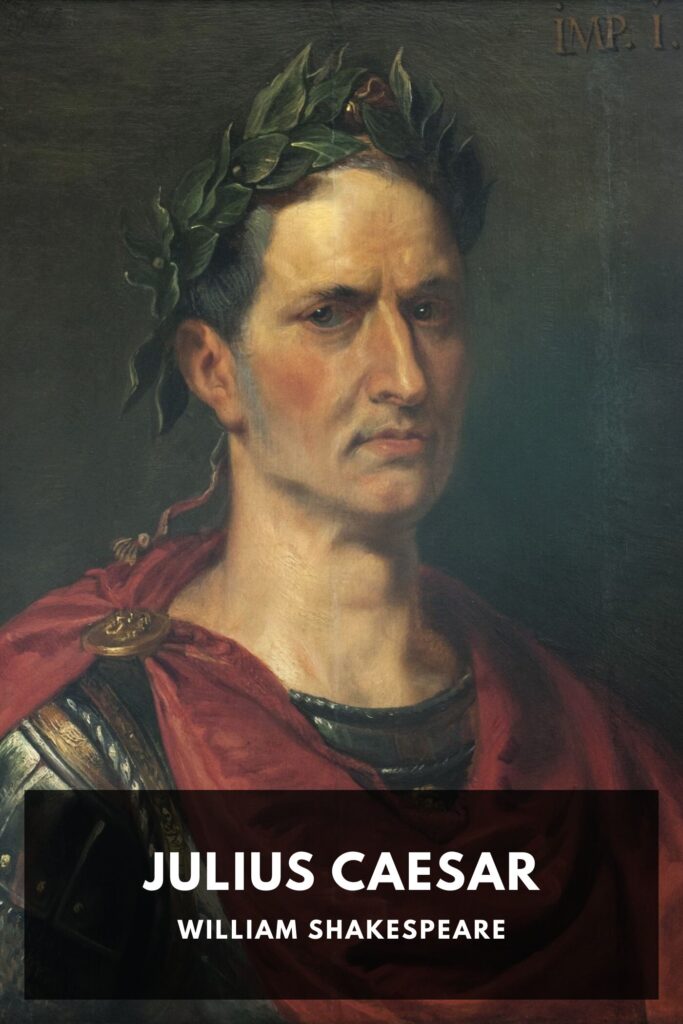
The linked resource is Project Gutenberg eBook 1522, released electronically on 1 November 1998. Its text gives the fuller title The Tragedy of Julius Caesar and is arranged in five acts containing 18 scenes. The page records the Gutenberg publication year and HTML ISBN. The cover belongs to this electronic presentation; it does not establish that the reader is a facsimile of the historical volume pictured on it.
MIT’s undergraduate Literature and Ethical Values course includes the play. That confirms academic use without specifying this Gutenberg edition. The guide reviews Act I, Scene I and Act III, Scene II in full. It contains substantial spoilers for the funeral scene, while leaving the intervening conspiracy and subsequent events to the original play.
Book contents
View the verified contents
- ACT I — SCENE I. Rome. A street.
- ACT I — SCENE II. The same. A public place.
- ACT I — SCENE III. The same. A street.
- ACT II — SCENE I. Rome. Brutus’ orchard.
- ACT II — SCENE II. A room in Caesar’s palace.
- ACT II — SCENE III. A street near the Capitol.
- ACT II — SCENE IV. Another part of the same street, before the house of Brutus.
- ACT III — SCENE I. Rome. Before the Capitol; the Senate sitting.
- ACT III — SCENE II. The same. The Forum.
- ACT III — SCENE III. The same. A street.
- ACT IV — SCENE I. Rome. A room in Antony’s house.
- ACT IV — SCENE II. Before Brutus’ tent, in the camp near Sardis.
- ACT IV — SCENE III. Within the tent of Brutus.
- ACT V — SCENE I. The plains of Philippi.
- ACT V — SCENE II. The same. The field of battle.
- ACT V — SCENE III. Another part of the field.
- ACT V — SCENE IV. Another part of the field.
- ACT V — SCENE V. Another part of the field.
Read the full text at Project Gutenberg
Cover image: Standard Ebooks edition. The hosted PDF remains the edition described above.
Book summary
Study overview of reviewed passages
The opening scene introduces public celebration as something politically contested. Flavius and Marullus question workers who have gathered to honour Caesar. The cobbler answers through playful language, resisting the officials’ demand for straightforward identification. Marullus then invokes the crowd’s earlier admiration for Pompey and challenges the consistency of its present enthusiasm. The scene puts popular feeling and attempts to regulate it into direct contact.
Act III, Scene II begins with an audience asking for reasons after Caesar’s death. Brutus grounds his explanation in honour and love of Rome, connecting his act to a claim about freedom. The listeners respond warmly, but their call to make him another Caesar complicates the civic justification he has just offered. Their reaction is part of the dramatic evidence, not merely a neutral confirmation of his argument.
Antony changes the terms of attention without beginning as an openly hostile speaker. His repeated acknowledgement of honour appears beside examples that cast doubt on the charge of ambition. Pauses, visible grief, Caesar’s body, the damaged mantle, and the delayed will turn the funeral into more than a comparison of propositions. The audience’s replies show its understanding changing as the performance proceeds.
By the end of the scene, listeners who accepted Brutus demand retaliation. Antony’s final response acknowledges that the speech has set something in motion. The two scenes can therefore be studied together as demonstrations of how public loyalty is claimed, challenged, and redirected. They do not by themselves settle whether every statement made by the speakers is true. A close reading should distinguish asserted evidence, rhetorical arrangement, and the actions that follow.
Selected chapter and passage summaries
Act I, Scene I. Rome. A Street
Officials confront citizens celebrating Caesar’s triumph. The cobbler’s wordplay disrupts their questions before Marullus reminds the crowd of its former devotion to Pompey. The citizens leave, and the officials plan to remove celebratory decorations and disperse gatherings. The scene presents a struggle over public memory and the visible signs of allegiance. Its shifts between comic exchange and accusation make language a means of both resistance and authority.
Act III, Scene II. The Same. The Forum
Brutus offers a justification for killing Caesar, then leaves Antony to speak. Antony combines repeated references to honour with counterexamples to ambition, displays associated with the wounds, and delayed disclosure of the will. The crowd’s responses move from approval of Brutus to grief and calls for revenge. After the citizens leave, Antony acknowledges the disturbance he has encouraged and receives information about Octavius and the fleeing conspirators. The guide summarizes the scene’s rhetorical progression without reproducing its speeches.
Further analysis — Academic Master
Arguments and audiences
Brutus invites judgment but frames disagreement through emotionally charged questions about slavery and loyalty. Analyse both the reason offered and the pressure of the choices presented. Then compare what the crowd actually says with what his justification appears to require.
Speech as performance
Antony’s effect depends on timing, pauses, movement, objects, and listeners’ responses. Mark where a change of attention occurs and what precedes it. A paraphrase of the spoken argument alone would miss some of the scene’s most important dramatic mechanisms.
A changing public memory
The first scene invokes earlier loyalty to Pompey; the funeral scene reconstructs Caesar through selected memories and displays. Compare how each speaker makes the past relevant to immediate action. The play presents acts of interpretation, not a single settled public recollection.
Questions for discussion and written work
These questions are Academic Master study prompts.
- How does the cobbler’s wordplay affect the officials’ attempt to control the exchange?
- What does the crowd’s response to Brutus reveal beyond simple agreement?
- How do the body, mantle, and will affect Antony’s speech?
- At what moments does an audience’s changed interpretation become a plan for action?
Sources and coverage
Act I, Scene I and Act III, Scene II were reviewed in full. The five-act, 18-scene sequence was verified against the same text. Other scenes are not summarized. The funeral discussion contains spoilers; the guide does not claim complete play coverage or historical verification of characters’ assertions.
Source text and contents · Edition catalogue · Academic-use evidence
About access & copyright
This page provides book information and study material. Full-text access is provided by the original publisher or authorised source; a listing does not grant permission to republish the book.
Read our Library Access & Copyright policyDramatic language
Relate wordplay and rhetoric to action on stage.
Competing justifications
Distinguish claims about honour, ambition, and public duty.
Performance and persuasion
Analyse pauses, objects, movement, and audience responses.
Public interpretation
Trace how recollection shapes changing political allegiance.
Reader ratings & reviews
Share your thoughts
Your review helps other students choose the right resources.
KEEP LEARNING
Your next great read
Ethics Ethics
The Secret Sharer
View The Secret Sharer — book Ethics
The Prince
View The Prince — book Ethics
Utilitarianism
View Utilitarianism — book Ethics
The Republic
View The Republic — book Ethics
Leviathan
View Leviathan — book Ethics
The Prince
View The Prince — book Ethics
Crime and Punishment
View Crime and Punishment — bookResearch Methods in Psychology
Research Methods in Psychology
View Research Methods in Psychology — bookWetlands Law: A Course Source



