
 Literature
Academic Book
Pride and Prejudice
Not rated yetRate this bookJane Austen explores courtship, family expectations, social rank, and the difficulty of judging character. This edition preserves three volumes with chapter numbering restarting in each. The student guide focuses on the opening and Elizabeth’s reassessment of Darcy’s letter, linking social comedy with the uncomfortable work of changing one’s mind.
Read on the publisher’s website. Opens in a new tab.
 Free
About this book
Pride and Prejudice connects the Bennet family’s marriage plans with questions about money, reputation, and personal judgment. Austen’s dialogue places different interests in direct conversation, while the narration exposes gaps between confidence and understanding. Elizabeth Bennet’s quickness of mind is part of the novel’s appeal, but the selected chapters also invite readers to examine the limits of wit and the influence of vanity on interpretation.
This page links to Project Gutenberg eBook 42671, released digitally in 2013. The catalogue credits R. W. Chapman as editor, and the text reproduces 1813 T. Egerton title pages. It is organized into three volumes containing 23, 19, and 19 chapters, with numbering restarting in each volume. It therefore differs from the continuously numbered Gutenberg 1342 edition elsewhere in the library. MIT’s undergraduate Major English Novels course lists Austen’s novel; that evidence concerns the work rather than adoption of this particular edition. The guide uses this edition’s volume and chapter references.
Book contents
Three volumes: Volume I has 23 chapters, Volume II has 19, and Volume III has 19. Numbering restarts in each volume; the contents below follow this edition.
View the verified contents
- Volume I — Chapter I.
- Volume I — Chapter II.
- Volume I — Chapter III.
- Volume I — Chapter IV.
- Volume I — Chapter V.
- Volume I — Chapter VI.
- Volume I — Chapter VII.
- Volume I — Chapter VIII.
- Volume I — Chapter IX.
- Volume I — Chapter X.
- Volume I — Chapter XI.
- Volume I — Chapter XII.
- Volume I — Chapter XIII.
- Volume I — Chapter XIV.
- Volume I — Chapter XV.
- Volume I — Chapter XVI.
- Volume I — Chapter XVII.
- Volume I — Chapter XVIII.
- Volume I — Chapter XIX.
- Volume I — Chapter XX.
- Volume I — Chapter XXI.
- Volume I — Chapter XXII.
- Volume I — Chapter XXIII.
- Volume II — Chapter I.
- Volume II — Chapter II.
- Volume II — Chapter III.
- Volume II — Chapter IV.
- Volume II — Chapter V.
- Volume II — Chapter VI.
- Volume II — Chapter VII.
- Volume II — Chapter VIII.
- Volume II — Chapter IX.
- Volume II — Chapter X.
- Volume II — Chapter XI.
- Volume II — Chapter XII.
- Volume II — Chapter XIII.
- Volume II — Chapter XIV.
- Volume II — Chapter XV.
- Volume II — Chapter XVI.
- Volume II — Chapter XVII.
- Volume II — Chapter XVIII.
- Volume II — Chapter XIX.
- Volume III — Chapter I.
- Volume III — Chapter II.
- Volume III — Chapter III.
- Volume III — Chapter IV.
- Volume III — Chapter V.
- Volume III — Chapter VI.
- Volume III — Chapter VII.
- Volume III — Chapter VIII.
- Volume III — Chapter IX.
- Volume III — Chapter X.
- Volume III — Chapter XI.
- Volume III — Chapter XII.
- Volume III — Chapter XIII.
- Volume III — Chapter XIV.
- Volume III — Chapter XV.
- Volume III — Chapter XVI.
- Volume III — Chapter XVII.
- Volume III — Chapter XVIII.
- Volume III — Chapter XIX.
Read the full text at Project Gutenberg
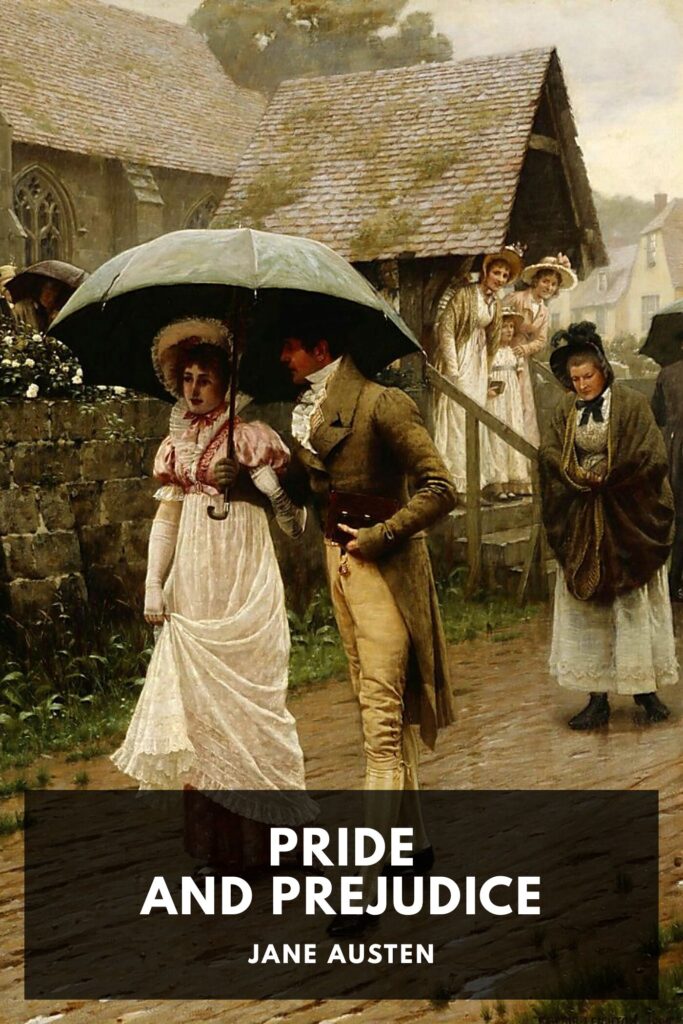
Cover image: Standard Ebooks edition. The hosted PDF remains the edition described above.
Book summary
Spoiler notice: The literary chapter guide discusses important events and, where covered, the ending.
Study overview of selected chapters
The opening places a confident general statement about marriage beside the Bennets’ sharply different voices. Mrs. Bennet treats Bingley’s arrival as an opportunity for her daughters. Mr. Bennet answers with teasing questions and evasions. The contrast makes social planning comic, while the focus on income and introductions gives that comedy a material foundation. Readers should ask whose wishes are being expressed when a marriage is described as a natural expectation.
Volume II, Chapter XIII turns from conversation to the difficulty of reading unwelcome evidence. Elizabeth initially approaches Darcy’s letter with anger and a settled opinion of his character. She wishes to reject its account of Wickham, but repeated reading forces her to compare it with remembered conversations, behaviour, and possible corroboration. The movement is gradual: the chapter records hesitation and resistance as well as recognition.
Elizabeth notices that a pleasing appearance and manner had supplied much of the apparent evidence for Wickham’s worth. She also recognizes inconsistencies in his conduct and the limits of her knowledge about his past. Her reassessment includes her own motives, especially the pleasure of receiving attention and resentment at being slighted. Academic Master’s reading emphasizes this relation between evaluating testimony and understanding one’s investment in a preferred account.
These selected scenes connect Austen’s social comedy with a demanding account of judgment. Cleverness does not eliminate bias, and reconsideration does not require uncritical acceptance of another person’s claims. The chapter instead presents comparison, memory, and self-questioning as difficult practices. Students can follow the sequence of Elizabeth’s responses and identify the moment when an attractive impression ceases to function as sufficient evidence.
Selected chapter summaries
Volume I, Chapter I
The Bennets discuss the arrival of wealthy Bingley and its possible significance for their daughters. Mrs. Bennet wants an introduction; Mr. Bennet replies with teasing resistance and favours Elizabeth’s quickness. Dialogue establishes contrasting temperaments while connecting courtship to income and social access. The narrator’s opening generalization is complicated by the conversation that follows, making the chapter useful for analysing irony and the interests behind apparently universal expectations.
Volume II, Chapter XIII
Elizabeth rereads Darcy’s letter and compares its claims with her memories of Wickham, Jane, and their acquaintances. Resistance gives way to a painful recognition of how appearance, flattery, and resentment shaped her confidence. She checks inconsistencies and considers possible corroboration instead of merely adopting a new opinion. The chapter turns interpretation into a process of self-examination. This is Chapter XXXVI in editions with continuous numbering, but Chapter XIII of Volume II here.
How to study this book
Academic Master suggests a reading log that records the speaker or narrator, the evidence offered, and the reasoning behind an interpretation. These are study suggestions; consult the original text for context.
Further analysis and study — Academic Master
Confidence, evidence, and reconsideration
The opening conversation makes certainty a social performance. Mrs Bennet treats a wealthy newcomer as an opportunity before any relationship exists, while Mr Bennet uses irony to unsettle her expectations. The contrast invites a reader to distinguish what a speaker knows from what a speaker wants. In Volume II, Chapter XIII, Elizabeth’s response to Darcy’s letter gives that distinction a more personal force. Reconsideration requires her to examine her own pleasure in believing one account and dismissing another. Read these passages together to explore how Austen turns judgment into an activity that can be revised.
A useful method for close reading
Academic Master suggests making two columns for a passage: statements that the text establishes and interpretations offered by its characters. Add a third column for the reader’s initial inference. When new evidence appears, identify exactly which conclusion changes and which remains supported. This exercise keeps analysis attached to language rather than to a general description of Elizabeth as clever or prejudiced. Notice irony, interruptions, and the gap between a confident claim and the evidence behind it. Cite this edition by volume and chapter because its numbering restarts.
Questions for discussion and written work
- How does irony change the opening conversation?
- Which evidence makes Elizabeth reconsider an earlier belief?
- How does this edition’s numbering affect a citation?
Sources and coverage
This selective guide is based on Volume I, Chapter I and Volume II, Chapter XIII in Project Gutenberg eBook 42671. Edition details and the complete chapter structure were also checked. Other chapters were not reviewed in full; this is not an exhaustive chapter-by-chapter account.
Read the source text · Edition and format details · Course reading list
About access & copyright
This page provides book information and study material. Full-text access is provided by the original publisher or authorised source; a listing does not grant permission to republish the book.
Read our Library Access & Copyright policyIrony and dialogue
Compare the narrator’s generalization with the Bennets’ competing interests.
Social expectations
Connect courtship with income, introductions, and family plans.
Testing testimony
Trace Elizabeth’s use of memory and corroboration when rereading the letter.
Self-knowledge
Examine how vanity and resentment influence her earlier judgments.
Reader ratings & reviews
Share your thoughts
Your review helps other students choose the right resources.
KEEP LEARNING
Your next great read
Literature Literature
Adam Bede
View Adam Bede — book Literature
The Odyssey
View The Odyssey — book Literature
Tess of the d'Urbervilles: A Pure Woman
View Tess of the d'Urbervilles: A Pure Woman — book Literature
Lady Audley's Secret
View Lady Audley's Secret — book Literature
Mrs. Dalloway
View Mrs. Dalloway — book Literature
Don Quixote
View Don Quixote — book Literature
Heart of Darkness
View Heart of Darkness — book Literature
Frankenstein; or, the Modern Prometheus
View Frankenstein; or, the Modern Prometheus — book Literature



