
 college
LiteratureAcademic Book
Mrs. Dalloway
Not rated yetRate this bookVirginia Woolf's Mrs. Dalloway moves through one London day while memory, sensory association, and shifting viewpoints connect lives that do not meet directly. The novel has no titled chapters. The editorial movements below follow its main developments without pretending that clock time makes consciousness orderly. Clarissa's preparations and Septimus's crisis place social performance beside the aftermath of war, while the evening party becomes a setting in which those separate histories unexpectedly touch.
Read on the publisher’s website. Opens in a new tab.
 Free
About this book
Virginia Woolf's Mrs. Dalloway moves through one London day while memory, sensory association, and shifting viewpoints connect lives that do not meet directly. The novel has no titled chapters. The editorial movements below follow its main developments without pretending that clock time makes consciousness orderly. Clarissa's preparations and Septimus's crisis place social performance beside the aftermath of war, while the evening party becomes a setting in which those separate histories unexpectedly touch.
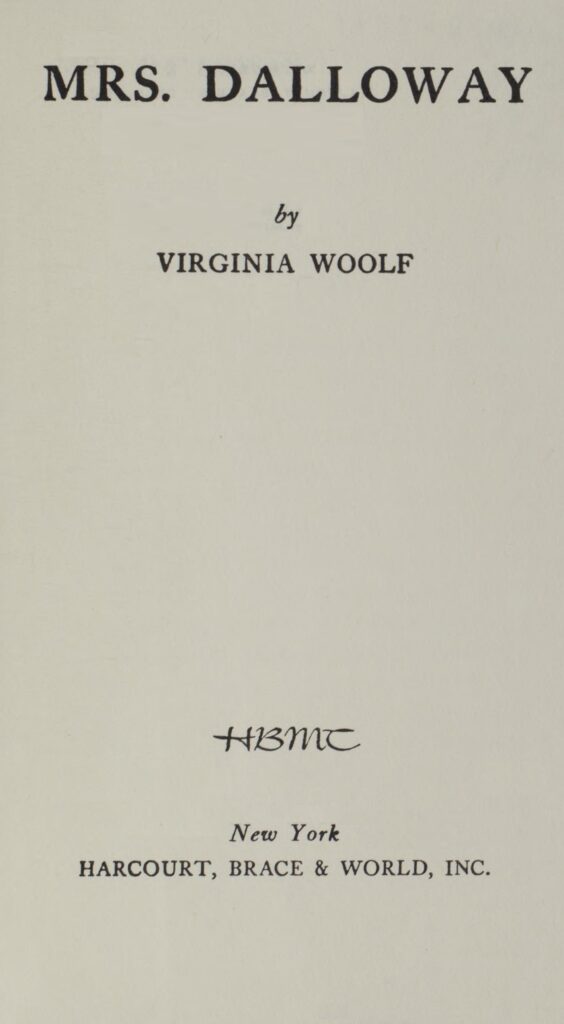
This page links to Project Gutenberg eBook 71865, released electronically on 13 October 2023. Its transcribed title and copyright pages name Harcourt, Brace & World, Inc., include a 1925 copyright, and identify a twenty-third printing. The digital publication year and HTML ISBN are recorded for the Gutenberg resource; the source printing’s date is not supplied. The text preserves page markers but provides no titled chapter sequence. Page references in this guide belong to that source and should not be transferred to another edition.
MIT’s undergraduate Major English Novels course includes the work in a Harcourt Brace Jovanovich edition, providing evidence for its academic use. The guide below reviews the opening and the conclusion rather than the complete intervening narrative. Its discussion of the final party includes a report of suicide and significant ending spoilers. Students should treat a character’s response to that report as a represented perspective, not as the book’s settled explanation of another person’s experience.
Book contents
The narrative has no titled chapters. The electronic text retains source page markers; the reading guide uses these markers for selected passages rather than inventing a chapter list.
Book summary
Virginia Woolf's Mrs. Dalloway moves through one London day while memory, sensory association, and shifting viewpoints connect lives that do not meet directly. The novel has no titled chapters. The editorial movements below follow its main developments without pretending that clock time makes consciousness orderly. Clarissa's preparations and Septimus's crisis place social performance beside the aftermath of war, while the evening party becomes a setting in which those separate histories unexpectedly touch.
Narrative movements and close reading
Morning departure — Buying the flowers
Clarissa leaves to buy flowers, and London sensations open memories of Bourton, Sally Seton, and Peter Walsh. A practical errand becomes a route through decisions about marriage, intimacy, and the person she might have become. The narration moves between outward observation and inward association, so a passing street can contain decades without becoming a conventional flashback announced from outside.
Public spectacle — The motorcar and the aeroplane
A mysterious car and skywriting draw strangers into shared attention without giving them the same interpretation. National authority, advertising, speculation, and private anxiety intersect in a public space. The scene demonstrates a central method: people can look toward one object while remaining separate in experience. Collective spectacle creates momentary connection rather than a unified consciousness.
Septimus and Rezia — Distress after the war
Septimus Warren Smith experiences the city through terror, heightened significance, and the presence of his dead comrade Evans. Rezia's loneliness reveals another dimension of the crisis, including the limits of her ability to explain it to others. His earlier inability to feel expected grief is not evidence of indifference; the narrative places present suffering within the dislocation of wartime experience and its aftermath.
At home — Dress, marriage, and Peter's return
Clarissa's domestic preparations expose both the security and constraints of her position. Remembering Sally and reflecting on Richard complicate any simple account of a successful marriage. Peter's unexpected visit revives the emotional claims and judgments associated with their former relationship. Their conversation repeatedly fails to state all that each is thinking, making shared history a source of misrecognition as well as intimacy.
Peter's walk — Replaying another life
After leaving, Peter moves through London and reassesses Clarissa, himself, and his attachments in India. His interpretations can be penetrating and self-protective at once. Fantasy, irritation, and memory compete with observation, demonstrating why access to a character's inward voice does not make that voice an authoritative judgment of everyone else. A sleeping interval changes his relation to the passing day without resolving those contradictions.
The doctors — Help imagined as conformity
Holmes and Bradshaw interpret Septimus through confident claims about health, proportion, and appropriate conduct. Bradshaw's proposed separation from Rezia appears within the couple's experience as another threat of control. The novel challenges medical authority when its language turns difference into something to correct without sufficient listening. This is a representation of particular encounters, not a modern diagnostic guide or a denial that care can be necessary.
Lunch and a gift — Social influence and unspoken love
Lady Bruton's luncheon connects private association with public policy and imperial assumptions. Richard later returns with flowers intending to express love but cannot say what he planned. Clarissa receives the gesture within the complicated familiarity of marriage. Objects and routine can communicate where explicit language fails, though they also leave parts of another person's life inaccessible.
Elizabeth and Miss Kilman — Rival claims on a future
Miss Kilman's resentment and religious intensity develop within real experiences of exclusion, while her possessive attachment to Elizabeth creates another problem of power. Clarissa's response combines hostility with class prejudice. Elizabeth's independent journey gives her a provisional future beyond either woman's claim, showing how several people can imagine a young person's destiny without owning it.
A brief domestic recovery and an irreversible death
Rezia and Septimus share a moment of practical companionship around a hat, temporarily recovering ordinary creativity and affection. The threat of Holmes's arrival ends that interval, and Septimus dies by suicide. The narrative presents the act amid fear and a desire to preserve something of himself, without making it an inevitable or desirable answer. Peter hears the ambulance without knowing whose story it carries.
The party — A stranger's death enters Clarissa's evening
Guests bring political rank, old friendships, aging bodies, and incomplete memories into one house. Sally's appearance unsettles Clarissa's preserved image of their youth. News of Septimus's death reaches the gathering through the Bradshaws, and Clarissa withdraws to reflect on a man she never knew. Her identification does not turn their circumstances into equivalents; it creates an encounter through imagination that the reader can assess. She returns, and Peter's heightened awareness closes the novel on a renewed, unresolved perception of her presence.
Study instructions
- Keep a clock-time outline beside a separate map of memories and changes of viewpoint.
- Choose a shared public event and compare how several characters interpret it.
- Separate Peter's descriptions of Clarissa from the evidence supplied through her own consciousness.
- Compare the hat-making scene with party preparation as different forms of making a livable world.
- Analyze the doctors' vocabulary through the responses it produces rather than accepting professional certainty as proof.
- Read Clarissa's reaction to the death with attention to both connection and the limits of identification.
Questions for reflection
- What can a novel connect without making its characters directly meet?
- How does social fluency both protect and isolate Clarissa?
- When does imagining another person's experience become sympathy, and when might it appropriate a difference?
Sources and coverage
This original study guide follows the complete work and includes its conclusion. Numbered chapters or books follow the linked edition. Where the work has no chapters, the reading movements are editorial aids. Interpretive questions and practice tasks are supplied for study rather than quoted from the author. Read the source edition. Consult its full text, examples, and references when developing an essay or solving a problem.
About access & copyright
This page provides book information and study material. Full-text access is provided by the original publisher or authorised source; a listing does not grant permission to republish the book.
Read our Library Access & Copyright policyPerspective
Identify whose perceptions or judgments organize a passage.
Time and memory
Compare clock time with the emotional duration of recollection.
Social identity
Analyse differences between a public impression and private experience.
Interpretive limits
Distinguish emotional identification from knowledge of another person.
Reader ratings & reviews
Share your thoughts
Your review helps other students choose the right resources.
KEEP LEARNING
Your next great read
college Literature
Mary Barton
View Mary Barton — book Literature
Adam Bede
View Adam Bede — book Literature
The Odyssey
View The Odyssey — book Literature
Tess of the d'Urbervilles: A Pure Woman
View Tess of the d'Urbervilles: A Pure Woman — book Literature
Lady Audley's Secret
View Lady Audley's Secret — book Literature
Don Quixote
View Don Quixote — book Literature
Heart of Darkness
View Heart of Darkness — book Literature
Frankenstein; or, the Modern Prometheus (1818 Edition)
View Frankenstein; or, the Modern Prometheus (1818 Edition) — book Literature



