
 college
LiteratureAcademic Book
Frankenstein; or, the Modern Prometheus (1818 Edition)
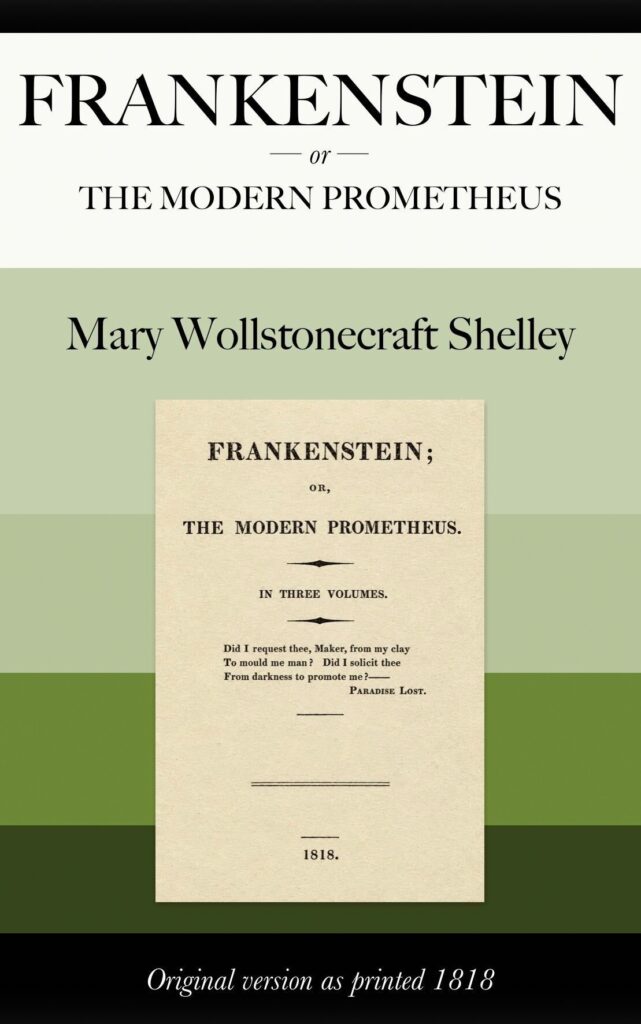
5 / 5 · 1 ratingsRate this bookThe 1818 Frankenstein is presented here through a source based on a photo-reprint of the first edition, arranged in three volumes of seven, nine, and seven chapters. The four letters precede that structure. This edition-specific guide emphasizes how nested testimony, kinship, and withheld information organize the tragedy. It should not be cited using the chapter numbers of the later twenty-four-chapter text without checking the corresponding passage.
Read on the publisher’s website. Opens in a new tab.
 Free
About this book
The 1818 Frankenstein is presented here through a source based on a photo-reprint of the first edition, arranged in three volumes of seven, nine, and seven chapters. The four letters precede that structure. This edition-specific guide emphasizes how nested testimony, kinship, and withheld information organize the tragedy. It should not be cited using the chapter numbers of the later twenty-four-chapter text without checking the corresponding passage.
Project Gutenberg eBook 41445 was digitally released in 2012. Its transcriber states that it was prepared from a photo-reprint of the 1818 edition, and its title pages reproduce the original London publication. The text contains a preface, four opening letters, and three volumes with 7, 9, and 7 chapters respectively. Chapter numbering restarts in each volume. The HTML ISBN and displayed year identify the Gutenberg publication. MIT’s Reading Fiction: Imaginary Journeys course assigns Shelley’s novel in a different specified edition; this verifies academic use of the work. The expanded guide below follows the complete work and includes its conclusion.
This edition is especially useful when an assignment requires references to the 1818 structure. A chapter number alone can be misleading: the creation scene occurs in Volume I, Chapter IV here, and the encounter on the glacier occurs in Volume II, Chapter II. Students comparing another edition should check the scene as well as the number before transferring a citation. The contents on this page preserve the source’s volume divisions for that reason.
The glacier encounter extends the questions raised by Victor’s withdrawal after creation. The being he describes as intolerable becomes a speaker who asks to be heard, invokes obligations between creator and creature, and connects his suffering with rejection. Victor’s hostile descriptions remain present, but they no longer provide the only account available in the scene. The reader must compare accusation, appeal, threat, and the eventual decision to listen.
Academic Master’s analysis focuses on how Shelley makes responsibility a matter of relationship and interpretation. Walton’s imagined discovery, Victor’s recoil, Clerval’s care, and the creature’s appeal offer different responses to dependence and vulnerability. Reading them together supports a more precise discussion than a general claim that ambition is simply good or bad. The point is to identify what a particular character wants, what that character notices, and what obligations the character accepts or refuses.
Book contents
Preface, four opening letters, and three volumes. Volume I has 7 chapters, Volume II has 9, and Volume III has 7. Numbering restarts in each volume.
View the verified contents
- Preface
- Letter I.
- Letter II.
- Letter III.
- Letter IV.
- Volume I — Chapter I.
- Volume I — Chapter II.
- Volume I — Chapter III.
- Volume I — Chapter IV.
- Volume I — Chapter V.
- Volume I — Chapter VI.
- Volume I — Chapter VII.
- Volume II — Chapter I.
- Volume II — Chapter II.
- Volume II — Chapter III.
- Volume II — Chapter IV.
- Volume II — Chapter V.
- Volume II — Chapter VI.
- Volume II — Chapter VII.
- Volume II — Chapter VIII.
- Volume II — Chapter IX.
- Volume III — Chapter I.
- Volume III — Chapter II.
- Volume III — Chapter III.
- Volume III — Chapter IV.
- Volume III — Chapter V.
- Volume III — Chapter VI.
- Volume III — Chapter VII.
Book summary
The 1818 Frankenstein is presented here through a source based on a photo-reprint of the first edition, arranged in three volumes of seven, nine, and seven chapters. The four letters precede that structure. This edition-specific guide emphasizes how nested testimony, kinship, and withheld information organize the tragedy. It should not be cited using the chapter numbers of the later twenty-four-chapter text without checking the corresponding passage.
Chapter-by-chapter summaries
Letters I-IV — Exploration and an interested listener
Walton's correspondence establishes the desire for discovery and companionship that makes him receptive to Victor. The framing audience is not detached: his own expedition will be tested by the history he hears.
Volume 1, Chapter 1
The 1818 opening makes Elizabeth Victor's cousin, locating intimacy within kinship rather than the later adoption story. Childhood interests, family attachment, and early scientific reading occupy one chapter, making the first volume's structure different from the twenty-four-chapter text.
Volume 1, Chapter 2
Bereavement and departure establish ambition within a family history. Victor's response to his teachers shows how persuasion and recognition shape the direction he later describes as destiny. The chapter asks readers to locate choices inside that retrospective language.
Volume 1, Chapter 3
The work of animation occupies attention so completely that its social aftermath is scarcely imagined. A reader should ask what kind of success excludes the future welfare of the life being made.
Volume 1, Chapter 4
Animation turns a planned achievement into a dependent presence, and Victor flees. Clerval's unknowing care offers an immediate contrast: one person undertakes sustained responsibility while the creator refuses even the beginning of it.
Volume 1, Chapter 5
Home is reconstructed through a letter and through Clerval's companionship. Recovery is possible because others work on Victor's behalf, yet he withholds the information that would allow them to understand its conditions.
Volume 1, Chapter 6
William's death and the evidence against Justine separate Victor's conviction from publicly usable proof. The source of the accusation matters as much as the sincerity of those who believe it.
Volume 1, Chapter 7
Justine's condemnation exposes the harm of a confession extracted under spiritual pressure. Victor's inward remorse cannot substitute for successful action, while Elizabeth's defense demonstrates the limits of affectionate testimony within the proceedings.
Volume 2, Chapter 1
Mourning makes ordinary continuance difficult. The landscape supplies intermittent relief, but the narrative does not allow a change of feeling to count as a resolution of responsibility.
Volume 2, Chapter 2
On the glacier, the creature demands the attention Victor has withheld. His request makes listening a preliminary obligation, while preserving the possibility that hearing an explanation will not justify every act it explains.
Volume 2, Chapter 3
The creature's first sensations have no ready social vocabulary. Hunger, warmth, and rejection teach him before books do, making the later question of character inseparable from the conditions of his early exposure.
Volume 2, Chapter 4
Observation develops sympathy without acknowledgment. His secret assistance shows an ability to care that has not been produced by human acceptance, challenging a definition of him based only on appearance.
Volume 2, Chapter 5
Safie's language lessons become an unintended education for a hidden listener. Knowledge reveals possibilities of belonging while sharpening his understanding that property, lineage, and recognition may exclude him.
Volume 2, Chapter 6
The cottagers' history supplies evidence of both generosity and injustice. Because this account itself passes through several narrators, readers should identify its perspective rather than mistake extensive detail for direct access.
Volume 2, Chapter 7
Reading and the journal turn the question of origin into a personal wound. The failed approach to the blind father tests the hope that explanation can precede appearance and prevent rejection.
Volume 2, Chapter 8
The account moves from injury toward retaliation, including William's death and Justine's implication. Understanding that sequence must preserve the creature's agency in harming people who did not commit the original abandonment.
Volume 2, Chapter 9
The proposed companion makes responsibility contractual, but the absent female being is imagined chiefly through the needs and fears of others. Victor's agreement depends on predictions neither participant can make secure.
Volume 3, Chapter 1
The British journey allows others to imagine education and marriage while Victor privately prepares another creation. Secrecy makes the same movement support incompatible accounts of what will happen next.
Volume 3, Chapter 2
The contrast between Clerval's travel and Victor's isolation measures what fear has displaced. The Orkney work proceeds under obligation and dread rather than a genuinely considered plan for another being's independent future.
Volume 3, Chapter 3
Destroying the companion substitutes a new unilateral decision for the earlier bargain. Victor interprets the wedding threat through his own expected victimhood, beginning another failure to recognize whose life may be exposed.
Volume 3, Chapter 4
Clerval's death converts the concealed experiment into another public accusation. Acquittal answers a narrow legal question without ending the ethical relation between Victor's choices and the friend's loss.
Volume 3, Chapter 5
Elizabeth seeks an explanation for Victor's distance before marriage. His silence protects an image of her happiness while withholding the conditions under which she would have to decide about risk.
Volume 3, Chapter 6
The wedding-night killing exposes the cost of Victor's mistaken expectation. Further bereavement gives him a claim upon official assistance, but the appeal fails to make his extraordinary history institutionally manageable.
Volume 3, Chapter 7
The final pursuit reverses the relation of hunter and hunted without restoring a family. Walton's refusal to sacrifice the crew supplies a practical alternative to solitary ambition. The creature's farewell remains a reported intention rather than a witnessed conclusion.
Study instructions
- Record the volume and chapter when selecting a quotation.
- Compare the cousin relationship here with the later edition's adoption narrative.
- Map the creature's account inside Victor's inside Walton's letters.
- Distinguish creating life, acknowledging a claim, and sustaining care as separate acts.
- Read the companion bargain from the perspective of the person imagined but never allowed to speak.
- Assess Walton's return as an action rather than merely a moral extracted from Victor's words.
Questions for reflection
- How does the first edition distribute choice and retrospective explanation?
- Can sympathy with abandonment coexist with condemnation of retaliation?
- What changes when a frame narrator must decide whether to repeat the behavior he has heard described?
Sources and coverage
This original study guide follows the complete work and includes its conclusion. Numbered chapters or books follow the linked edition. Where the work has no chapters, the reading movements are editorial aids. Interpretive questions and practice tasks are supplied for study rather than quoted from the author. Read the source edition. Consult its full text, examples, and references when developing an essay or solving a problem.
About access & copyright
This page provides book information and study material. Full-text access is provided by the original publisher or authorised source; a listing does not grant permission to republish the book.
Read our Library Access & Copyright policyAmbition and recognition
Compare Walton’s proposed public benefits with his desire for glory.
Perspective and evidence
Separate Victor’s descriptions from what is known about the creature’s intentions.
Care and responsibility
Compare Victor’s withdrawal with Clerval’s sustained attention.
Edition awareness
Use volume and chapter references appropriate to the 1818 text.
Reader ratings & reviews
Share your thoughts
Your review helps other students choose the right resources.
KEEP LEARNING
Your next great read
college Literature
Mary Barton
View Mary Barton — book Literature
Adam Bede
View Adam Bede — book Literature
The Odyssey
View The Odyssey — book Literature
Tess of the d'Urbervilles: A Pure Woman
View Tess of the d'Urbervilles: A Pure Woman — book Literature
Lady Audley's Secret
View Lady Audley's Secret — book Literature
Mrs. Dalloway
View Mrs. Dalloway — book Literature
Don Quixote
View Don Quixote — book Literature
Heart of Darkness
View Heart of Darkness — book Literature



