
Mathematical Methods for Physics
Mass CommunicationTextbook
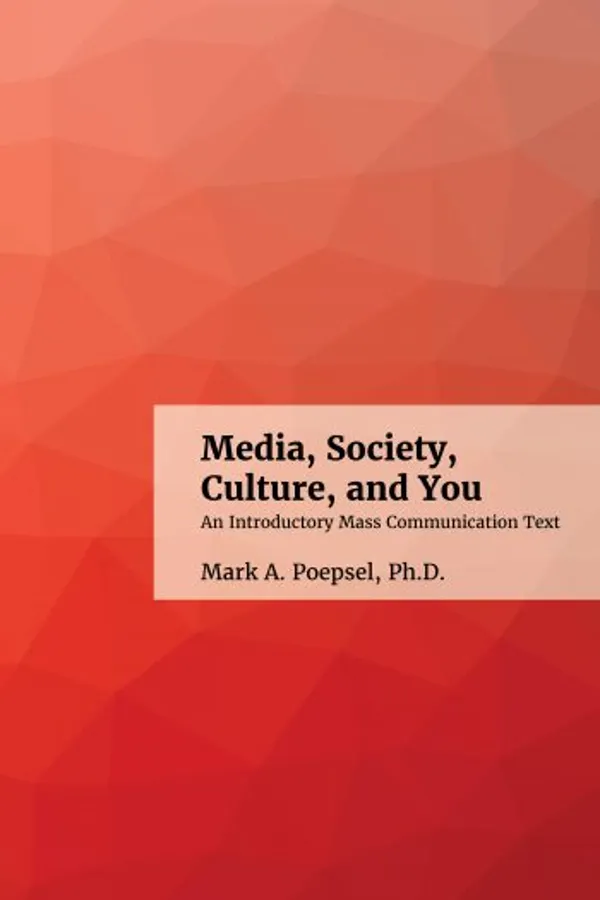
Media, Society, Culture and You : An Introductory Mass Communication Text
Not rated yetRate this bookMark Poepsel’s Media, Society, Culture and You examines how communication technologies, institutions, content, and audiences shape one another. This guide follows its ten chapters, connecting media literacy with the histories and economies of film, television, music, radio, gaming, news, and persuasion.
Free reading is available at the official source. Opens in a new tab.
 Free
About this book
Mark Poepsel’s Media, Society, Culture and You examines how communication technologies, institutions, content, and audiences shape one another. This guide follows its ten chapters, connecting media literacy with the histories and economies of film, television, music, radio, gaming, news, and persuasion.
How to study this book
Keep a media diary and analyse who produces, distributes, funds, and interprets each example. Distinguish an observed pattern from a causal claim about effects. Compare the text’s historical examples with your observations without presenting its platform descriptions as current specifications.
Chapter-wise explanations and study tasks
1. Media, Society, Culture and You
Communication creates and sustains relationships and institutions. Interpersonal, organizational, and mass communication can overlap on networked platforms. The mode of distribution and relationship among participants matter as much as the message’s topic.
Study task: Analyse one message that moved from a personal exchange to a wider audience and explain what changed.
2. Digital Culture and Social Media
Digital participation links identity, networks, platforms, and commercial structures. Users create meaning within systems that shape visibility and circulation. Separate individual choices from the incentives and technical arrangements influencing them.
Study task: Map the actors and incentives involved in a fictional social-media post’s circulation.
3. Media Literacy and Research
Media literacy requires critical questions about messages, evidence, representation, and institutions. Research methods provide ways to test claims that personal impressions cannot settle. Distinguish analysing content from demonstrating its effect on audiences.
Study task: Turn a media-effects claim into a research question and propose evidence that would test it.
4. Film and Bricolage
Film combines existing cultural materials and production choices into new meanings. Bricolage directs attention to selection and recombination rather than treating a work as created in isolation. Consider industrial context alongside interpretation.
Study task: Analyse how a short film example combines earlier conventions and explain the meaning created by one choice.
5. Television through Time
Television’s forms and institutions change with distribution, economics, and audience practices. A new delivery system can alter viewing without eliminating every older convention. Compare changes at several levels rather than equating technology with content.
Study task: Create a comparison of two viewing arrangements covering funding, distribution, scheduling, and audience control.
6. Music and the Information Economy
Recording and sharing change the relationship between creative work, copies, distribution, and payment. Accessibility and value capture are different questions. Examine whose labour and rights are visible in a business model.
Study task: Trace a fictional recording from creator to listener and identify who receives value at each stage.
7. Radio, Podcasting, and Superbug Media
Older media can adapt and coexist with newer forms rather than disappear. Radio and podcasting provide different combinations of scheduling, audience relationship, and distribution. Analyse adaptation instead of assuming a simple replacement story.
Study task: Compare a broadcast and a podcast on a common topic and explain one continuity and one structural difference.
8. Digital Gaming
Gaming combines designed systems with player activity and meaning-making. Rules, interaction, narrative, and communities influence the experience. A game cannot be analysed only as a sequence of images viewed passively.
Study task: Analyse how a game mechanic shapes participation and distinguish the designer’s possibilities from a player’s actual choices.
9. Newspapers and Digital News
News involves institutional work, verification, distribution, and economic support. Digital circulation changes these relationships and can separate a story from its original context. Distinguish an outlet’s business model from the credibility of a particular claim.
Study task: Trace a news claim to its source and assess evidence, attribution, context, and the funding arrangement separately.
10. Advertising, PR, and Propaganda
Persuasive communication differs in sponsors, aims, methods, and accountability. Labels alone do not establish truth or manipulation. Examine evidence, framing, audience, and disclosed interests in the message itself.
Study task: Compare three persuasive messages and justify their classification using sponsor, purpose, evidence, and distribution.
Applied assignment
Prepare a media-analysis portfolio with a diary, one historical comparison, a distribution-and-funding map, a source-verification exercise, and an analysis of persuasion. Distinguish content interpretation from claims that would require audience research.
Suggested reading plan
Study chapters 1–3 for concepts and methods, 4–8 for medium-specific histories and practices, and 9–10 for news and persuasion. Return to the same media diary to test whether each chapter changes the questions you ask.
Questions for reflection
- Who controls distribution and who captures value?
- What evidence would establish an audience effect?
- How does a medium adapt without losing every earlier feature?
Edition and source notes
Based on Poepsel’s linked 2018 introductory text, containing ten chapters and a glossary. Platform descriptions, commercial arrangements, and current-event examples reflect its publication period. These original activities emphasize analytical questions rather than unverified present-day claims.
About access & copyright
This page provides book information and study material. Full-text access is provided by the original publisher or authorised source; a listing does not grant permission to republish the book.
Read our Library Access & Copyright policyExplore the contents
Check the chapters covered in this edition.
Visit the official source
See reading, preview or purchase options.
Save for later
Keep this textbook in your saved collection.
Reader ratings & reviews
Share your thoughts
Your review helps other students choose the right resources.



