
Hair and Scalp Disorders
Operations ManagementTextbook
Operations Management
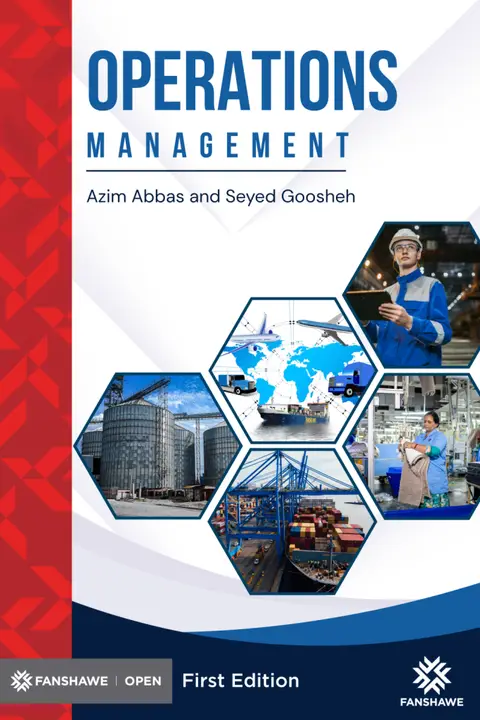
Not rated yetRate this bookOperations Management by Azim Abbas and Seyed Goosheh connects everyday production and service delivery with the decisions that make organizations effective. This guide follows all 17 chapters, combining strategic reasoning with forecasting, optimization, inventory, scheduling, lean operations, and maintenance.
Free reading is available at the official source. Opens in a new tab.
 Free
About this book
Operations Management by Azim Abbas and Seyed Goosheh connects everyday production and service delivery with the decisions that make organizations effective. This guide follows all 17 chapters, combining strategic reasoning with forecasting, optimization, inventory, scheduling, lean operations, and maintenance.
How to study this book
Keep a calculation notebook and a separate record of assumptions. For each technique, identify its decision, required inputs, units, constraints, and limitations before using a formula or spreadsheet. Complete the source’s review questions and cases, and explain what a numerical result means operationally.
Chapter-wise explanations and study tasks
1. Introduction to Operations Management
Operations transform resources into outputs that customers value. Manufacturing and services share this purpose but differ in customer contact, variability, labour requirements, and how quality is judged. Follow a familiar product or service through its inputs, activities, outputs, and feedback.
Study task: Map a bakery or clinic as a transformation system and identify two operational decisions that affect customer value.
2. Operations Strategy and Competitiveness
Operational choices should support an organization’s competitive priorities. Cost, quality, delivery, and flexibility can involve trade-offs, while productivity measures relate outputs to resource use. A higher ratio is meaningful only when its numerator, denominator, time period, and quality assumptions are clear.
Study task: Compare two competing service businesses and propose one productivity measure for each, explaining its limitations.
3. Forecasting
Forecasting supports decisions over different time horizons. Associative methods link demand to explanatory variables, whereas time-series approaches use patterns in past observations. Compare forecasts through error measures and realistic assumptions rather than selecting the method that happens to fit one period best.
Study task: Apply two forecasting methods to a small demand series, calculate an error measure from the chapter, and justify which forecast you would use.
4. Product and Service Design
New-product development translates customer needs into a feasible offering. The house of quality links those needs to design characteristics, while life-cycle costing extends the analysis beyond initial acquisition. Distinguish purchase price from the costs incurred over ownership and use.
Study task: Construct a small house-of-quality matrix for a reusable container and identify two costs that occur after purchase.
5. Process Strategy and Design
Process choice connects output volume and variety with flexibility, customer involvement, and capital intensity. Projects, job shops, batches, lines, and continuous flows suit different conditions. Process documentation makes dependencies visible and helps distinguish necessary work from avoidable delay.
Study task: Draw a process flow for a custom-order business and explain whether its volume and variety support a job-shop, batch, or line arrangement.
6. Managing Quality
Quality management combines organizational responsibility with measurement and improvement tools. Prevention and appraisal costs differ from the costs of failures. The chapter’s quality systems and analytical tools help investigate recurring problems rather than relying on inspection alone.
Study task: Classify examples into prevention, appraisal, internal-failure, and external-failure costs, then select a quality tool for investigating one recurring defect.
7. Supply Chain Management
Materials, information, and financial flows connect organizations beyond their own boundaries. Inventory, logistics, technology, and collaboration affect how reliably the chain serves customers. Evaluate a local efficiency gain in terms of its consequences for suppliers and downstream partners.
Study task: Map the three main flows for an online retailer and explain how inaccurate demand information could affect inventory and deliveries.
8. Capacity Planning and Management
Capacity decisions determine the resources available to meet demand. Design capacity, effective capacity, utilization, and efficiency answer different questions. Bottlenecks constrain sequential processes, and break-even analysis offers one way to compare alternatives while making fixed and variable costs explicit.
Study task: Calculate the capacity of a three-stage process, identify its bottleneck, and evaluate whether adding capacity at another stage increases total output.
9. Facility Location Strategy
Location affects costs, access, labour, transport, and long-term competitiveness. Quantitative evaluation helps compare alternatives, but the choice also depends on strategic and qualitative factors. Make the weighting of criteria explicit rather than treating a single score as an objective verdict.
Study task: Compare three candidate locations using a weighted evaluation and test whether changing one major weight changes the preferred site.
10. Layout Strategy and Design
Layouts arrange people, equipment, inventory, and movement to suit the work performed. Retail, warehouse, process, product, and work-cell layouts pursue different objectives. Material-handling costs help explain why an apparently tidy arrangement may still perform poorly.
Study task: Sketch an improved layout for a small workshop and compare the main movement paths before and after the change.
11. Transportation Models
Transportation models allocate shipments from supply points to demand points under cost and availability constraints. Balance the model before applying initial-solution methods such as north-west corner, least cost, or Vogel’s approximation. An initial feasible allocation must be distinguished from an optimal solution.
Study task: Build a small transportation table, find an initial feasible allocation, and verify every supply and demand total before discussing optimality.
12. Linear Programming
Linear programming expresses a decision through variables, an objective, and constraints. Graphical, simplex, and spreadsheet methods solve the stated model, so correct formulation is essential. A plausible numerical optimum cannot compensate for missing capacity limits or inappropriate assumptions.
Study task: Formulate a two-product resource-allocation problem, solve it graphically or with Solver, and explain the operational meaning of its binding constraints.
13. Inventory Management
Inventory provides availability but incurs ordering, holding, and shortage-related costs. EOQ and EPQ address particular assumptions about demand and replenishment; uncertainty requires additional consideration. Separate the question of how much to order from when replenishment should occur.
Study task: Calculate an EOQ using stated assumptions, then explain which part of the decision would need revision if demand became unpredictable.
14. Aggregate Planning
Aggregate planning coordinates output, workforce, inventory, and demand over an intermediate horizon. Different strategies shift costs and risks between these resources. Service planning and yield management add further constraints because capacity and demand cannot always be stored or shifted in the same way as goods.
Study task: Compare a level and a chase plan for a seasonal business, showing the effects on staffing, inventory, and one nonfinancial consideration.
15. Scheduling
Scheduling translates plans into an order and timing of jobs or services. Different priorities can improve one performance measure while worsening another. Resource assignment and service-shop constraints make it important to specify the objective before comparing schedules.
Study task: Sequence a small set of jobs with two rules from the chapter and compare their waiting or completion measures.
16. Just-in-Time and Lean Systems
Lean systems seek to improve flow and reduce activities that do not create value. Just-in-time depends on coordinated replenishment and reliable processes rather than merely reducing inventory. Examine the operating conditions and relationships required to make smaller buffers workable.
Study task: Identify three forms of waste in a process and propose one improvement, including the reliability condition needed before reducing its inventory buffer.
17. Reliability and Maintenance
Reliability concerns the likelihood of satisfactory performance under stated conditions over time. System design and maintenance choices affect downtime, risk, and cost. Compare preventive and other maintenance strategies in relation to the failure patterns and consequences discussed in the source.
Study task: Create a maintenance decision table for three assets, specifying failure consequences, a reliability measure, and a justified maintenance approach.
Applied assignment
Develop an operations improvement proposal for a small business. Include a demand forecast, process map, bottleneck calculation, inventory or scheduling analysis, and one quality or maintenance recommendation. State assumptions and show how the recommendations support the business’s competitive priorities.
Suggested reading plan
Study chapters 1–4 for strategy and design; 5–8 for processes, quality, supply chains, and capacity; 9–12 for facilities and optimization; and 13–17 for planning and control. Give the quantitative chapters an additional practice session before moving to the integrated proposal.
Questions for reflection
- When does improving one department reduce overall operational performance?
- Which model assumptions are least realistic for your chosen business?
- How do reliability and supplier coordination affect lean operations?
Edition and source notes
Based on the linked 2024 Fanshawe College source by Abbas and Goosheh. The guide follows its 17 chapters and offers original practice prompts. Use the full text for worked calculations, cases, spreadsheets, and review problems; its numerical examples are teaching scenarios.
About access & copyright
This page provides book information and study material. Full-text access is provided by the original publisher or authorised source; a listing does not grant permission to republish the book.
Read our Library Access & Copyright policyExplore the contents
Check the chapters covered in this edition.
Visit the official source
See reading, preview or purchase options.
Save for later
Keep this textbook in your saved collection.
Reader ratings & reviews
Share your thoughts
Your review helps other students choose the right resources.
KEEP LEARNING
Your next great read
alopecia, hair loss, alopecia areata, hair follicle, depression, pathogenesis
 Complex analysis
Mathematical Methods for Physics
View Mathematical Methods for Physics — book Biophysics
Principles of Development : An Inquisitive Journey into Embryology
View Principles of Development : An Inquisitive Journey into Embryology — book Communication écrite
Le Littéraire dans le quotidien : Resources for a transdisciplinary approach to reading/writing at the first and second year levels of college French
View Le Littéraire dans le quotidien : Resources for a transdisciplinary approach to reading/writing at the first and second year levels of college French — book Communication
Advanced professional communication : A principled approach to workplace writing
View Advanced professional communication : A principled approach to workplace writing — book Early Childhood Education
Children's learning through play
View Children's learning through play — book Budgeting and financial management
Financial Empowerment (2nd Edition)
View Financial Empowerment (2nd Edition) — book Conflict management
Navigating HR : The art of problem-solving and conflict resolution
View Navigating HR : The art of problem-solving and conflict resolution — book Algebra
Medical mathematics
View Medical mathematics — book #FunctionalAnalysis



