
 Communication
Textbook
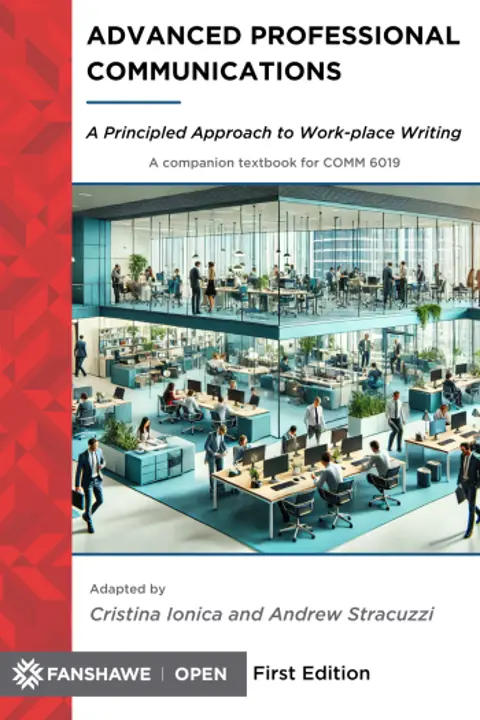
Advanced professional communication : A principled approach to workplace writing
Not rated yetRate this bookAdvanced Professional Communication by Cristina Ionica and Andrew Stracuzzi develops workplace writing, research, speaking, and group communication. This guide follows its 18 chapters and supporting appendices, helping readers move from communication principles to complete professional messages and evidence-based reports.
Free reading is available at the official source. Opens in a new tab.
 Free
About this book
Advanced Professional Communication by Cristina Ionica and Andrew Stracuzzi develops workplace writing, research, speaking, and group communication. This guide follows its 18 chapters and supporting appendices, helping readers move from communication principles to complete professional messages and evidence-based reports.
How to study this book
Choose one realistic workplace situation and return to it throughout the book. Before drafting, identify audience, purpose, context, channel, and required action. Revise organization and evidence before proofreading sentences. Use the source’s cases, exercises, and appendices as practice resources.
Chapter-wise explanations and study tasks
1. Communication Studies
Communication is shaped by context, participants, channels, and interpretation. Foundational concepts help explain why sending information does not guarantee shared understanding. Study the chapter’s communication forms and principles as tools for analysing actual exchanges rather than as vocabulary alone.
Study task: Analyse a workplace misunderstanding by identifying participants, purpose, channel, context, and a point where the intended meaning changed.
2. Form and Style
Formality, the six Cs of style, and document design affect how easily a reader can use a message. Headings, fonts, spacing, lists, visuals, and accessibility are part of meaning and usability. Match style to the communication situation rather than equating professionalism with complicated language.
Study task: Rewrite a dense notice using clear language and accessible formatting, then explain three changes in relation to its audience.
3. Patterns of Communication
Organizational patterns determine when readers encounter the main point and its support. Direct and indirect approaches respond to different purposes and likely reactions. Compare their effects on clarity, goodwill, and the reader’s ability to understand the reasoning behind a decision.
Study task: Prepare direct and indirect outlines for the same difficult announcement and justify which is more suitable for a stated audience.
4. Business Message Formats
Email, memos, and business letters have conventions that help readers identify purpose, responsibility, and next steps. Subject lines, openings, bodies, closings, and attachments each do specific work. Check recipients and supporting files as carefully as the wording.
Study task: Write an email and a memo about the same operational change, adapting their structure and closing action to each format.
5. Case Studies and Common Business Messages
Requests, replies, claims, complaints, and negative messages require more than a correct template. Case analysis helps identify the underlying problem and the information the audience needs. Pay particular attention to fair explanations and practical actions when communicating unwelcome decisions.
Study task: Draft a response to a customer complaint that acknowledges the issue, explains the decision, and gives a concrete next step without making unsupported promises.
6. Cultural Communication
Intercultural communication requires examining expectations, assumptions, and individual differences. Cultural frameworks can raise useful questions but should not substitute for learning about a particular person or situation. Consider how context and global business relationships influence interpretation.
Study task: Identify two cultural assumptions in a hypothetical international exchange and replace them with respectful clarification questions.
7. Social Media and Professional Environments
Digital engagement creates an enduring public presence and blurs personal and professional contexts. Self-presentation, disclosure, relationships, and crisis communication involve different audiences and risks. Evaluate a message’s possible circulation beyond its initial intended readership.
Study task: Audit a fictional organization’s social post for tone, disclosure, audience, and reputational effects, then revise it with a clear engagement objective.
8. Employment Communication
Job searching connects evidence of skills to the needs of a specific role. Resumes, cover letters, and interviews should support one another while performing different functions. Replace unsupported claims with accurate examples and tailor the emphasis without inventing experience.
Study task: Use a job advertisement to build a requirements-to-evidence table and draft one resume bullet and one cover-letter paragraph from it.
9. Report Writing
Reports organize information so an audience can understand a problem and make a decision. Audience analysis shapes scope, report type, organization, and level of detail. Formal elements should support navigation and evidence rather than become a substitute for a clear purpose.
Study task: Prepare a report outline for a manager choosing between two suppliers, indicating what evidence belongs in each section.
10. The Research Process
Research begins with a question that is specific enough to investigate. Source types, interviews, surveys, search strategies, and evaluation determine what the eventual report can support. A source plan should identify gaps before drafting creates pressure to accept weak evidence.
Study task: Write a focused research question and a source plan that includes one primary method, two secondary source types, and evaluation criteria.
11. Academic Integrity and Professional Research
Using sources responsibly requires both acknowledgement and accurate representation. Workplace and academic settings may use different conventions, but neither permits presenting another person’s work as one’s own. Connect in-text citations with references and distinguish quotation, paraphrase, and unsupported assertion.
Study task: Paraphrase a short source passage, compare the meaning with the original, and supply a matching in-text citation and reference.
12. Argumentation and Research
An argument connects a claim to reasons and evidence. Synthesis explains relationships among sources rather than listing their contents separately. Assess whether the support actually warrants the conclusion and acknowledge evidence that complicates the preferred answer.
Study task: Write a recommendation paragraph synthesizing two contrasting sources and explain why your conclusion remains justified.
13. Components of the Research Writing Process
Research writing develops through methodological choices, purposeful reading, source collection, and the responsible use of source text. Treat drafting and revision as stages in reasoning. Organize notes so that evidence, your interpretation, and possible wording remain distinguishable.
Study task: Create an evidence matrix for three sources and use it to draft a paragraph organized by an issue rather than by author.
14. Visual Communication Strategies
Visuals communicate comparisons and relationships through selection, design, and placement. A chart or image needs a clear purpose and must work with its surrounding explanation. Examine whether labels, scales, context, and accessibility let readers interpret the intended message accurately.
Study task: Design one visual for your report and provide a caption and text description that explain its main finding without overstating the evidence.
15. Public Speaking
Public speaking involves a relationship among speaker, purpose, audience, and occasion. Preparing an effective message begins before slide design or rehearsal. Use the introductory principles to define what the audience should understand or do and how the speech can support that outcome.
Study task: Write a speaking objective and a short opening for two different audiences discussing the same issue.
16. Small Group Communication
Group communication involves relationships, expectations, coordination, and approaches to management. Individual competence does not automatically produce effective teamwork. Track how a group exchanges information, makes participation possible, and responds to differences before evaluating its output.
Study task: Observe a study-group meeting and record one helpful communication behaviour, one barrier, and a specific improvement to its process.
17. Leadership, Roles, and Problem Solving
Leadership and group roles shape how teams define problems and make decisions. Effective collaboration requires a process that can evaluate alternatives and manage participation. Separate disagreement about a proposal from attacks on participants and make decision criteria explicit.
Study task: Plan a team decision meeting with a problem statement, roles, evaluation criteria, and a method for recording the agreed action.
18. Preparing and Delivering a Speech
Speech preparation brings audience analysis, research, organization, supporting material, delivery, and practice together. Rehearsal tests whether the written plan works aloud. Revise transitions and timing based on listener feedback instead of merely reading faster to fit the allotted time.
Study task: Deliver a three-minute recommendation, obtain feedback on structure and clarity, and revise both the outline and one delivery choice.
Appendices A–E: Supporting Resources
The appendices extend the chapters with visual communication, work-integrated learning, EAP/ESL writing support, language mechanics, and documentation guidance. Use them to resolve a diagnosed need during revision. They support professional judgment rather than replace the audience and purpose analysis.
Study task: Review a completed portfolio item with the relevant appendix and document one change to design, language, or source documentation.
Applied assignment
Create a workplace communication portfolio around one fictional organizational problem: an email, a difficult-message response, a short researched report with a visual, and a three-minute presentation. Include an audience analysis and a revision note for each item.
Suggested reading plan
Study chapters 1–5 for messaging foundations, 6–8 for cultural, digital, and employment contexts, 9–14 for research and report development, and 15–18 for speaking and teamwork. Consult the appendices during drafting and revision rather than leaving them to the end.
Questions for reflection
- How does the likely reader response affect message organization?
- What turns a set of sources into a synthesized argument?
- Which parts of a written report must change when presented aloud?
Edition and source notes
Based on the linked 2021 source by Cristina Ionica and Andrew Stracuzzi. It contains 18 numbered chapters, followed by appendices A–E. These original study prompts follow that edition; consult the full text for detailed cases, models, and documentation examples.
About access & copyright
This page provides book information and study material. Full-text access is provided by the original publisher or authorised source; a listing does not grant permission to republish the book.
Read our Library Access & Copyright policyExplore the contents
Check the chapters covered in this edition.
Visit the official source
See reading, preview or purchase options.
Save for later
Keep this textbook in your saved collection.
Reader ratings & reviews
Share your thoughts
Your review helps other students choose the right resources.
KEEP LEARNING
Your next great read
CommunicationHair and Scalp Disorders
Hair and Scalp Disorders
View Hair and Scalp Disorders — book Complex analysis
Mathematical Methods for Physics
View Mathematical Methods for Physics — book Biophysics
Principles of Development : An Inquisitive Journey into Embryology
View Principles of Development : An Inquisitive Journey into Embryology — book Communication écrite
Le Littéraire dans le quotidien : Resources for a transdisciplinary approach to reading/writing at the first and second year levels of college French
View Le Littéraire dans le quotidien : Resources for a transdisciplinary approach to reading/writing at the first and second year levels of college French — book Operations Management
View Operations Management — book Early Childhood Education
Children's learning through play
View Children's learning through play — book Budgeting and financial management
Financial Empowerment (2nd Edition)
View Financial Empowerment (2nd Edition) — book Conflict management
Navigating HR : The art of problem-solving and conflict resolution
View Navigating HR : The art of problem-solving and conflict resolution — book Algebra



